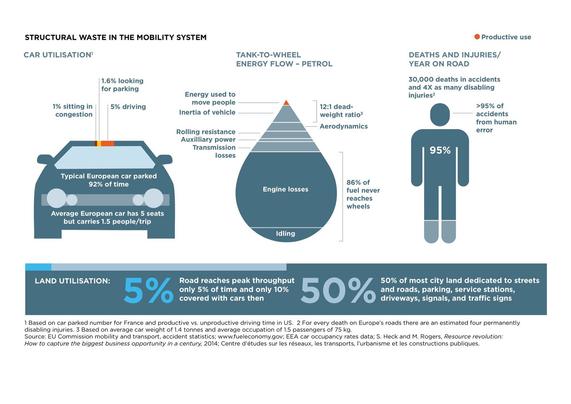
A typical European car is parked 92% of the time. It spends 1/5th of its driving time looking for parking. Its 5 seats only move 1.5 people. 86% of its fuel never reaches the wheels, and most of the energy that does, moves the car, not the people. Sound efficient? HT @ellenmacarthurfdn.bsky.social
Ellen MacArthur Foundation (@ellenmacarthurfdn.bsky.social)

We are committed to the creation of a circular economy to eliminate waste, circulate products, and regenerate nature.

Bluesky Social
@brenttoderian.bsky.social And all the statistics don't help if you can't get where you need to go by public transport at the time you need to get there and then you're confronted with the unreliability of public transport.
@nabor @brenttoderian.bsky.social and that is the big problem outside the towns and cities (certainly here in Britain, and likely in the rest of Europe). I never owned a car until I moved away from London and SE England to the East, where there is less reliable public transport and what does exist is concentrated around "normal" business hours, not evenings or weekends (and I work unusual hours)

@nabor @brenttoderian.bsky.social I think what it speaks to is that we have more than enough cars for everyone, but that that individual ownership of cars for _everyone_ is demonstrably wasteful and inefficient because most of them are not being used most of the time.

Public infrastructure that augmented mass transit with services that allow people in populated areas to reserve and use a car anytime - and, crucially, know one would always be there - would be transformative.

@nabor @brenttoderian.bsky.social Zipcar is a great example of a company trying to do this, and I think better resembles the long term future of personal transportation, but it's hard to see how a single private company can scale without central government support to get them to the critical mass required for people to feel comfortable changing their mental model about how they think about using cars for transport.
@iaincollins @brenttoderian.bsky.social I agree with you, but it's not helpful to tell everyone who has to have a car how stupid they are or that they are the bad guys. I would like to do without one or two of the three cars we have in the family, but unfortunately that's not possible, and that's in the suburbs of two big cities.
All of these cars are on the road every working day and yes, they still just stand around for more than 20 out of 24 hours
There is no car sharing out here
@nabor @brenttoderian.bsky.social
If the money spent for the needs of motorized individual driving in past and present would be used by public transport and a decent cycling infrastructure then there'd be public transport with decent frequency and service time even in the most remote rural hamlet.

@brenttoderian.bsky.social I mean, my TV is probably off about 92% of the time also. That doesn't sound like a meaningful statistic. Would making more 2-seater cars (fewer wasted seats) improve anything? The fuel inefficiency problem is already solved by EVs.

I dunno. Where I live there's great public transport, and I'm all for it, and I use it for getting into the city. I rarely drive there. But I still need my car. Public transport can't really replace it.

@brenttoderian.bsky.social

Fa riflettere, ed è TOTALMENTE vero

@brenttoderian.bsky.social
Translation
Une voiture européenne typique est garée 92 % du temps. Elle passe un cinquième de son temps à chercher une place de stationnement. Ses 5 places ne permettent de déplacer qu'une personne et demie. 86 % de son carburant n'atteint jamais les roues, et la majeure partie de l'énergie qui y parvient sert à déplacer la voiture, pas les passagers. Ça vous paraît efficace ? HT