 Spaceflight 🚀
#Space #LaunchCost comparison by ourworldindata.org : https://ourworldindata.org/grapher/cost-space-launches-low-earth-orbit?time=1982..latest

#LaunchCost per kg https://en.wikipedia.org/wiki/Space_launch_market_competition#2010-2020s:_Competition_and_pricing_pressure
#SpaceShuttle #SLS #Electron #Ariane #LongMarch #Proton #Falcon9 #FalconHeavy #Starship

Launch costs have fallen 95% 📉 (with another massive reduction expected in the coming years) thanks to reuse, improved engineering, and increased volumes.
“In economics, we assume that resources are limited; land is limited; natural resources are limited. With #space 🌌, it allows us to change that.” https://www.theguardian.com/science/article/2024/may/03/were-in-a-new-era-the-21st-century-space-race-takes-off
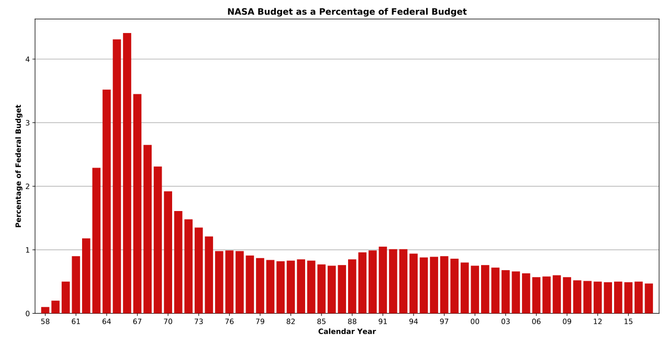
📊 The #US 🇺🇸 spent $257 billion 💰💰💰 when adjusted for inflation to 2020 dollars on Project #Apollo between 📆 1960 and 📆 1973. The total amount spent on #NASA during this period was $482 billion 💰💰💰💰💰 adjusted https://www.planetary.org/space-policy/cost-of-apollo