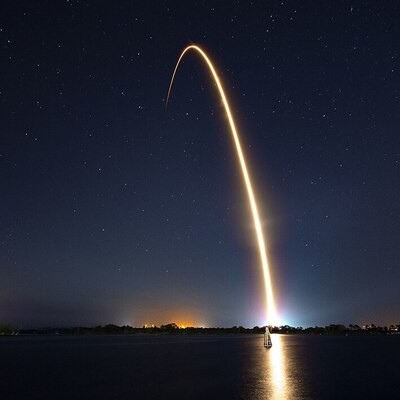
 Spaceflight 🚀
#HelioLinc3D spotted an #asteroid ☄️ that similar surveys had failed to see. It was specifically designed for the @VRubinObs in #Chile 🇨🇱. The #observatory’s huge mirror 📡, massive camera and expansive eye will see 👁️ pretty much everything in the night sky 🌌 in unprecedented detail https://www.nytimes.com/2023/08/05/science/space-asteroids-rubin-heliolinc3d.html

In 📆 2018, #StephenHawking considered an #asteroid ☄️ collision to be the biggest threat to the #planet. The #US National Science and Technology Council warned that America is unprepared for an asteroid impact 💥 event https://en.wikipedia.org/wiki/Asteroid_impact_prediction

“Our goal is that by 📆 2030, #Europe 🇪🇺 can provide early warning for hazardous #asteroids larger than 40 m in size, about three weeks before any impact” https://www.esa.int/Space_Safety/Flyeye_ESA_s_bug-eyed_asteroid_hunter

Closest & Biggest #Asteroid ☄️ Flybys of 📆 2023 https://www.statista.com/chart/27703/asteroid-flybys
Timeline of approaches within one #lunar distance 📏 https://en.wikipedia.org/wiki/List_of_asteroid_close_approaches_to_Earth#Timeline_of_approaches_within_one_lunar_distance


190 confirmed ☄️ #craters given in the #Earth Impact 💥 Database as of 2017. Only the largest impact structures within a time period are included https://en.wikipedia.org/wiki/List_of_impact_structures_on_Earth


“The most glaring mistake is the #government cover-up… just completely bogus.” And a #meteorite that struck southwest #Ontario in November illustrated that a cover-up couldn’t be further from the truth when actual Earth-pummeling #asteroids ☄️ are found. https://www.sciencefocus.com/news/you-help-protect-earth-asteroid
#AsteroidInstitute / #University of #Washington / #OpenSpace Project - #Asteroid discoveries 🔭 from Earth https://www.youtube.com/watch?v=fFvf86SM7CY

Asteroid discoveries from Earth -Asteroid Institute + Google April 30, 2024
We simply didn't notice 🙈 until recently 😨 https://ourworldindata.org/data-insights/over-33000-near-earth-asteroids-have-been-detected-since-1990


Over 40,000 near-Earth asteroids have been detected since 1990
Since the late 20th century, astronomers and space agencies have taken steps to monitor the threat of large asteroids passing near Earth. They set up international efforts to find these objects early, track their paths, and learn more about what they’re made of, so we’d have the best chance of spotting a real collision risk in time.
Only eight #asteroids ☄️ have ever been detected before impact 💥 with #Earth’s atmosphere. The first of these discoveries took place in 📆 2008, and four were detected in just the last two years https://www.esa.int/Space_Safety/Planetary_Defence/Asteroid_2024_BX1_spotted_three_hours_before_impact
#Asteroid danger explained : "The main challenge stems from the population of middle-size objects, ranging from tens to hundreds of metres in diameter. There are a lot of these asteroids, and most have not been spotted yet." https://www.esa.int/ESA_Multimedia/Images/2018/06/Asteroid_danger_explained

@VRubinObs 🔭 Today, #astronomers are aware of only about 40 percent 📊 of potentially hazardous #asteroids ☄️ - close-flying objects that are large enough to cause continent-wide destruction if they were to impact 💥 Earth. "The idea is, if there is an object like that, we want to find it while it’s maybe 40 or 50 years out, because that gives us enough time to figure out how we’re going to deflect it.” https://www.smithsonianmag.com/science-nature/this-revolutionary-new-observatory-will-locate-threatening-asteroids-and-millions-of-galaxies-180984514/
List of predicted 🔭 #asteroid ☄️ impacts on Earth 🌏 https://en.wikipedia.org/wiki/List_of_predicted_asteroid_impacts_on_Earth
When discovered in 2004, #Apophis ☄️ was thought to have a 2.7% chance of colliding with Earth in 📆 2029. In 2021, #NASA ruled out these collision 💥 risks after refining its trajectory, but recent simulations have revived some concerns.
#2024YR4 will be too distant for radar observations until 📆 2032, when it could strike 💥 Earth. #Astronomers need more data to refine its exact orbit https://www.forbes.com/sites/jamiecartereurope/2025/02/02/a-deadly-asteroid-may-strike-earth-in-2032---what-to-know

#2024YR4 was first reported on 📆 27 December 2024 by the Asteroid Terrestrial Last Alert System (#ATLAS) station of the University of Hawai’i in #Chile 🇨🇱. It is likely in the range 40–90 meters 📏. The #asteroid will be observable through early April 2025 and then again starting in June 2028 when the asteroid ☄️ will return to the vicinity of Earth. Potential for impact 💥 on 22 December 2032 https://iawn.net/documents/NOTIFICATIONS/IAWN_Potential_Impact_Notification_2024_YR4.pdf
#ESA has determined that the #asteroid ☄️ will pass the Earth on 📆 22 December 2032 at a distance of almost 136,000 kilometers – with an #inaccuracy of 311,000 kilometers. 🤔 https://www.heise.de/en/news/Potentially-dangerous-asteroid-2024-YR-The-risk-continues-to-rise-very-slowly-10273047.html

#ESA : #2024YR4 ☄️ is estimated to be between 40 m and 100 m wide 📏. It is too early to determine where exactly on Earth a potential impact 💥 could occur. The #asteroid is currently moving away from Earth in almost a straight line, making it difficult to accurately determine its orbit by studying how its trajectory curves over time. It is possible it will fade from view 🔭 before we are able to entirely rule out any chance of impact in 2032 https://www.esa.int/Space_Safety/Planetary_Defence/ESA_actively_monitoring_near-Earth_asteroid_2024_YR4
 (moved)Galbinus Caeli 🌯
@spaceflight is there anything we can do to hurry it up?
@SkipHuffman the asteroid or the calculation ?
@spaceflight The asteroid. It can't get here fast enough.
(Just kidding, mostly.)
For the calculation we just need more compute power. Waiting for the LLM bubble to burst.
@SkipHuffman if it would arrive ahead of us we wouldn't care. ESA says "studying how its trajectory curves over time...", so it seems more a matter of measurement than calculation