the business model of element evidently is "write shitty code then extract rent from governments and cops to make it less shitty"

is there any wonder it's as bad as it is

https://m.unix.house/@jmc/113857052951936006

Joshua M. Clulow (@[email protected])

I know Synapse has few contributors outside of the Element company, but I just read this blog post about how Element is keeping the good Synapse code, increasingly rewritten in Rust so that it doesn't perform like a garbage barge, completely proprietary: https://element.io/blog/scaling-to-millions-of-users-requires-synapse-pro/ Why would *anybody* contribute to the legacy Python code which this post makes clear is not scalable and is not good enough to sell? Surely it's a self fulfilling prophecy.

m.unix.house

it disgusts me when companies make "community [project]" mean "a shitty useless version of proprietary [project] we actually care about"

it also disgusts me that AGPL mostly enables that

it's a transparent (and often successul) attempt to exploit unpaid labor by attracting people who want to improve the commons with the "open source" label and then selling the work they contribute, or using it to fundraise

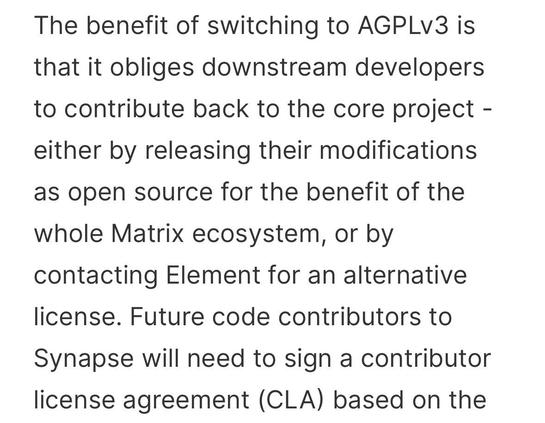
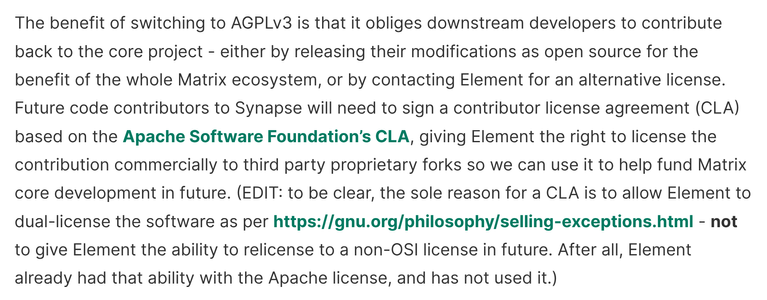
yes, element does have a CLA, which they adopted simultaneously with AGPLv3 https://element.io/blog/element-to-adopt-agplv3/

(i consider AGPL a regressive force on the whole, and this kind of stuff is why. GNU even encourages it!)

A new home and license (AGPL) for Synapse and friends

Element has chosen to pursue future development of Synapse, Dendrite and associated server-side projects under the terms of AGPLv3.

Element Blog
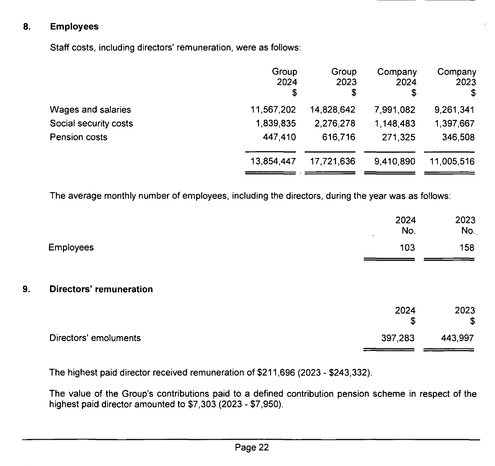
NEW VECTOR LIMITED filing history - Find and update company information - GOV.UK

NEW VECTOR LIMITED - Free company information from Companies House including registered office address, filing history, accounts, annual return, officers, charges, business activity

to those who tell me it's not AGPLv3's fault:
- i claim this is the primary way in which the AGPLv3 license is utilized, in terms of number of deployments
- FSF encourages "selling exceptions"
- FSF encourages copyright assignment
therefore, FSF and AGPLv3 explicitly encourage this behavior. even if you try to claim it is not the "intended" one, it is the one that happens in practice
@whitequark FSF taking a good idea and making the shittiest choices in how to use and market that is very on brand tho.
@whitequark “We, and only we, can create proprietary forks that include your open source contributions”
@whitequark The problem is the CLA, not the (A)GPL.
@whitequark Why would this be solved by something other than the AGPL?

@whitequark It’s funny because this is not even true lmao.

People can make downstream contributions without signing their CLA and Element won’t be allowed to merge them lmao. The ONLY advantage for Element on this is being able to sell proprietary forks of peoples open source contributions. People don’t actually need to contribute back if they don’t want, and I’m so fucking hoping we see this happening: open source downstream forks of matrix with contributions that element cannot use unless they cut their bullshit.

@whitequark

the sole reason for a CLA is to allow Element to dual-license the software - not to give Element the ability to relicense to a non-OSI license in future.

Can’t they just sell themselves an exception for $0?

@luana i mean it doesn't matter, legally the CLA lets them relicense it as far as i can tell
@whitequark @luana they've added "Element shall be entitled to make Your Contribution available under Element’s proprietary software licence, provided that Element shall also make Your Contribution available under the terms of an OSI-approved open-source license." to the Apache CLA text. But keeping the old repository archived and selling a proprietary codebase with the Contribution included would still be compliant
@lnl @luana oh, I missed that bit. that's slightly less awful

@lnl @whitequark

But keeping the old repository archived and selling a proprietary codebase with the Contribution included would still be compliant

Yep, that’s the issue here. In the end of the day that condition is useless

@luana @whitequark GPL/AGPL is amazing, it keeps code outside of proprietary software

a CLA completely breaks that. you need to have contributions from many people under their own copyright to make it impossible to make the code proprietary

@whitequark Wouldn't the AGPL work against this by forcing them to not use anything contributed to the free version in their proprietary one?

Assuming of course that they aren't a shit project with copyright reassignments or CLAs, of course. But that's a clear warning flag to anyone to not bother contributing.

@whitequark So they are indeed a shit project with CLA as a warning to future contributors.

@whitequark @maswan Yep. Licenses apply to people that do not own the code. People that own the code, own the code, and get to choose what licenses others can use.

If you sign a CLA, they own the code. They can deny you the right to use your own code under AGPL unless AGPL itself has guards against that.

@whitequark @maswan Any downstream developer would have to share code with Element*, but would not have to sign such a CLA.

Element can put downstream projects' code in their open-source offering, but *cannot* in their Synapse Pro nonsense.

@whitequark @maswan Isn't the CLA the part that is enabling the stealing? AGPLv3 for thee but not for me.

@PuercoPop Yup. They are a pox on free software.

@whitequark

@whitequark same energy with for-profit companies built around a single "open" spec/standard that in practice is controlled by that single entity (like Matrix, from what I can tell, but I've had a similar impression to Bluesky)
@whitequark they have their own propriety enterprise license for all element products next to the AGPL, which would be fine in theory but Synapse Pro, rewriting Synapse parts in rust, is what happens in practice :/