Hope you're all having a lovely sunday evening! Here's a short science thread! #astronomy #astrodon #science

This paper is part of one of my longer-term projects, combining observations I (and collaborators) collected from 2018 to 2021 with extensive modeling to find the largest local supermassive black known to date, 22 billion times the mass of the sun.

https://arxiv.org/abs/2501.01493

1/5
A 22-Billion Solar Mass Black Hole in Holmberg 15A with Keck KCWI Spectroscopy and Triaxial Orbit Modeling

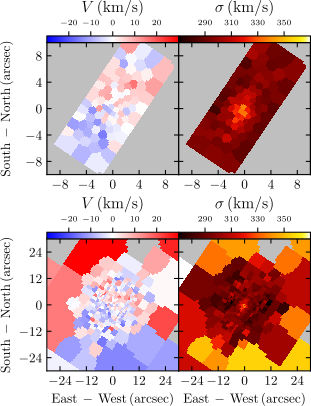
Holmberg 15A (H15A), the brightest cluster galaxy of Abell 85, has an exceptionally low central surface brightness even among local massive elliptical galaxies with distinct stellar cores, making it exceedingly challenging to obtain high-quality spectroscopy to detect a supermassive black hole (SMBH) at its center. Aided by the superb sensitivity and efficiency of KCWI at the Keck II Telescope, we have obtained spatially resolved stellar kinematics over a ${\sim}100''\times 100''$ contiguous field of H15A for this purpose. The velocity field exhibits a low amplitude (${\sim}20\mathrm{~km~s}^{-1}$) rotation along a kinematic axis that is prominently misaligned from the photometric major axis, a strong indicator that H15A is triaxially shaped with unequal lengths for the three principal axes. Using 2500 observed kinematic constraints, we perform extensive calculations of stellar orbits with the triaxial Schwarzschild code, TriOS, and search over ${\sim}$40,000 galaxy models to simultaneously determine the mass and intrinsic 3D shape parameters of H15A. We determine a ratio of $p=0.89$ for the middle-to-long principal axes and $q=0.65$ for the short-to-long principal axes. Our best estimate of the SMBH mass, $M_\mathrm{BH}=(2.16^{+0.23}_{-0.18})\times 10^{10}M_{\odot}$, makes H15A -- along with NGC 4889 -- the galaxies hosting the most massive SMBHs known in the local universe. Both SMBHs lie significantly above the mean $M_\mathrm{BH}-σ$ scaling relation. Repeating the orbit modeling with the axisymmetrized version of TriOS produces worse fits to the KCWI kinematics and increases $M_\mathrm{BH}$ to $(2.55\pm 0.20) \times 10^{10}M_{\odot}$, which is still significantly below $M_\mathrm{BH}=(4.0\pm 0.8) \times 10^{10}M_{\odot}$ reported in a prior axisymmetric study of H15A.
arXiv.org

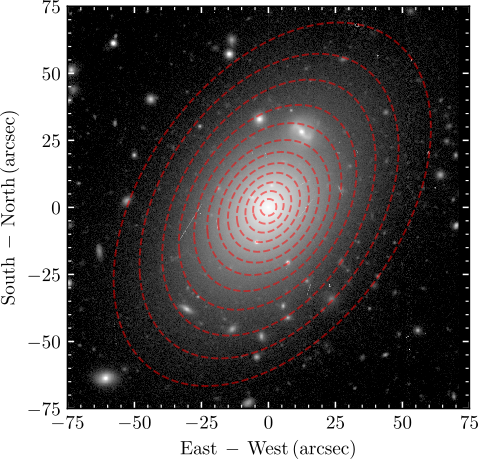
This galaxy is named Holmberg 15A. It's about 730 million lightyears away and has a light profile which is remarkably flattened at its center.

The shape of the light distribution of elliptical galaxies tells quite a bit about its history. After massive galaxies merge, their supermassive black holes sink to the center of the resultant galaxy. These SMBHs will form a binary which may take billions of years to merge.

This SMBH binary has a major impact on its surroundings. Individual stars near the center of the galaxy tend to be scattered by these co-orbiting black holes, reducing the number of stars in that region and overall reducing the observed brightness of the galaxy right near its center.

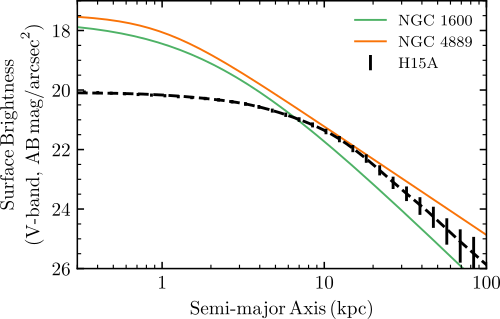
This region where the number of stars is reduced is called the 'core', and Holmberg 15A has one of the largest cores that we know about. The figure compares the light profile against two other galaxies known to have extremely large cores.

2/5

One of the tricky things here is that because this galaxy is sooo distant and that the core is sooo depleted of stars, we need to use many hours of observations. In total we used about 12 hours of exposures pointing at the target, plus many more hours of various calibrations (and unfortunately many hours where the sky was cloudy). We observed the galaxy during several observation runs from 2018 to 2021 and combined those numerous observations for analysis.

The data we obtained used integral field spectroscopy, where we obtain spectra at a bunch of regions across the galaxy. These spectra contain contributions from all the stars in those regions. Stellar spectra have numerous absorption features, and as those stars zip around, those features are red and blue-shifted, depending on their velocity along the line of sight. By examining the shapes of those doppler-broadened absorption lines, we can determine the distribution of velocities of the stars in those regions.

3/5

Finally, we feed this data into our Schwarzschild modeling code which gives us an estimate of how consistent a given assumed galaxy is with the data. We repeat this process over and over with tens of thousands of models to infer the parameters which best describe the galaxy.

Most strikingly, the data suggests that the black hole is 22 billion times the mass of the sun, making it the **most massive** in the local universe.

4/5

This result helps us constrain the extreme end of the relations between the properties of black holes and their host galaxies. Most importantly, this galaxy is about a factor of 10 off of the 'M-sigma' relation which links the velocities of stars far out in the galaxy to the black hole mass. There has been some speculation that this relation breaks for very massive galaxies because those galaxies form through different channels than small galaxies.

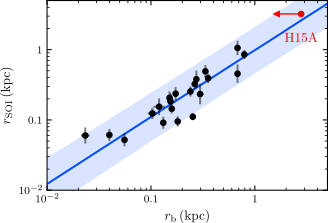
But other relations still work well! For example, it appears that the size of the depleted region at the center is consistent with the size of the region where the galaxy potential is dominated by the black holes. This strongly supports the core scouring hypothesis from post #2 above, which is pretty nifty!

5/5

@erl thank you for this interesting thread on your latest paper!