 jonny (nonvenomous)
i love this paper
https://www.pnas.org/doi/10.1073/pnas.2414274121
(Edit: yes @ futurebird has already been tagged plenty of times ♥)
i love this paper
https://www.pnas.org/doi/10.1073/pnas.2414274121
(Edit: yes @ futurebird has already been tagged plenty of times ♥)
@jonny Yes! Incredible!!
Here's a video from the paper.. Ants rock!
#ProblemSolving #Ants
Omg is right. Look at them go!
Attention @futurebird i was surprised to find that you weren't the one sharing this in my feed
AMAZING
I also thought of @futurebird when seeing the paper! She boosted @jake4480 ’s post on it:
Fascinating experiments done with humans and ants. "Unsurprisingly, the cognitive abilities of humans gave them an edge in the individual challenge, in which they resorted to calculated, strategic planning, easily outperforming the ants. In the group challenge, however, the picture was completely different, especially for the larger groups. Not only did groups of ants perform better than individual ants, but in some cases they did better than humans." https://phys.org/news/2024-12-ants-superior-humans-group-problem.html #science #ants
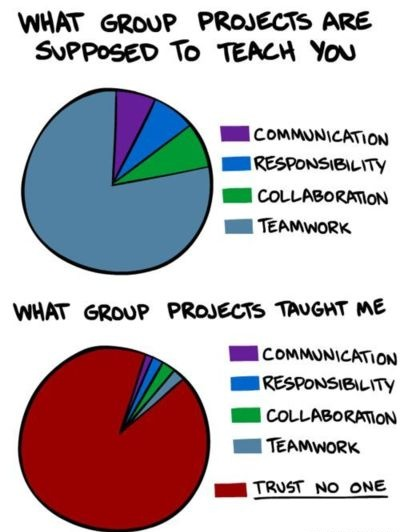
@joncounts @MichaelPorter @elduvelle @jonny In school, my finding it basically impossible to work in groups was generally used by the faculty to try to "prove" something was wrong with *me*.
Even when:
1) I got grouped with verbal bullies.
2) I got physically shut out of a group when I was trying to follow instructions and they weren't (and I burst out crying).
3) I got basically ignored when I tried to stop a group from being careless in ways we were specifically told not to be.
@joncounts @pteryx @MichaelPorter @elduvelle @jonny
Probably because they don't individually have egos to contend with.
@pteryx @joncounts @MichaelPorter @elduvelle @jonny That sounds like (my prejudice -- this is how it happened to me) the problems started long before the group was formed.
Sticking a bunch of kids in a group work project won't magically make them accept an already-ostracized kid into their working group.
I used to do all the work myself and if they wanted to join in, that was cool. Often they didn't.
@pteryx @eyrea @joncounts @MichaelPorter @elduvelle @jonny Probably a super-unpopular take here: imagine what an LLM might do with such input, Words and tonality and circumstances of reports of bullying could be analyzed and assessed and outcomes accounted for in future cases.
Could be good - less self-serving adult bias.
Could be bad - I'm sure people can imagine this.
Imagine having the intake be more reliable and unbiased.
That sort of data could be useful with no further LLM(AI) element.
@alakest @pteryx @joncounts @MichaelPorter @elduvelle @jonny As it happens, I wound up becoming a teacher. Teachers college gave me my best experiences in group work, ironically.
I was taught that the kids who makes noise is probably not the real disruptor, to look for why they were acting out, but that was a pretty new concept still (90s).
For that AI to work, it would mean multiple mics and cameras in every part of the school, and an AI that could interpret it all perfectly. Good luck.
@eyrea @pteryx @joncounts @MichaelPorter @elduvelle @jonny
I was thinking more for the intake of reports from kids.
IIRC from my school days I watched, and experienced myself, adults whose task was supervision put squelch or gain to whatever kids said as it suited the adult's objectives (along with heaps of bias and sloppy reasoning) Even the teachers who were smart were so pressed with a 1:30 ratio there was only so much they could practically do.
An LLM could do intake.
@alakest @pteryx @joncounts @MichaelPorter @elduvelle @jonny I think that's too compressed to understand. I don't see why an LLM couple do better intake than a form attached to a spreadsheet.
Besides, LLMs have well-established bias, and also sloppy reasoning. They have horrible track records evaluating job applicants, for example. LLMs get trained on what's been done before and perpetuate it.
You can't compute yourself out of a human issue. Teachers ARE humans, right?
@eyrea @pteryx @joncounts @MichaelPorter @elduvelle @jonny Not championing LLMs here. Getting at the personality/authority thing.
Kid are likely to be more candid with a "screen" of sorts. Perhaps you'd have all the benefit if there were adults not-on-site at the other end of a telephone.
I sense some bias and a forgone conclusion here. If you don't see how an LLM with good voice recognition could do better than a form attached to a spreadsheet, then <shrug> not my job to convince you.
@alakest @pteryx @joncounts @MichaelPorter @elduvelle @jonny Where I live, teachers are, by law, to act in the place of the parents. If you just see them the way you saw them when you were in grade 2... yeah, I can't help you with that either.
You still don't need an LLM for what you're proposing. Everything you've mentioned has been around since the 90s.
But you should really read up on LLM bias, because it's a real and serious thing. They are NOT unbiased.
@eyrea @alakest @pteryx @joncounts @elduvelle @jonny Let's not forget the other problem with a technological solution - they cost money, and boards will often go for the cheapest crap out there, not knowing enough about it to realize what they are about to foist on their staff/students.
Don't ask me about the quagmire we endured when some bright soul decided that a marks management system from "Two Guys And A Van" was a good idea (Not the actual company name–I’m not sure if the two guys owned a van). I just put my head down and kept using my polished, self-purchased app and tried to ignore the wailing and gnashing of teeth from the teachers who thought they were required to use the board-purchased package...
@MichaelPorter @eyrea @alakest @joncounts @elduvelle @jonny
"AI" isn't. Despite the hype, they don't actually understand or reason, they just develop records of patterns and probabilities. Would you roll on a random table to determine the innocence or guilt of a child? No? Then don't use an LLM to judge them either.
@pteryx @eyrea @alakest @joncounts @elduvelle @jonny A simple LLM might not be the answer, but there are "AI" (interpret that how you like) systems that have been developed for diagnosing cancers, predicting shapes of proteins, etc. that are better/faster than humans.
Whatever the programming, I could see how interacting with a program that drills down to what is adversely affecting a child could be preferable, at least for part of the amelioration process, than talking to a staff member.
For better or (probably) worse, a lot of students are more comfortable interacting with a screen for things that require some thought than with a face-to-face scenario. Plus, if the program was good, it could support a kid with their claims/problem/situation where a staff member might have bias.
The *big* trick would be obtaining a system that does what it should, as opposed to a quick 'n' dirty program that someone wrote for a fast buck. And, of course, I don't think anyone is saying that the program would be the only thing determining a course of action.
@MichaelPorter @eyrea @alakest @joncounts @elduvelle @jonny
About those "cancer detection AIs"... word is that they tended to be trained on images where pictures of cancer had rulers (for measuring the tumor's size), so they often "assume" that the presence or absence of a ruler is a cancer indicator. Thus, they're frequently inaccurate and used to deny insurance claims.
@aaron @alakest @eyrea @joncounts @MichaelPorter @elduvelle @jonny
Agreed with all of this. Heck, sixth grade was hell for me in part because the verbal bullies I had to deal with figured out that they could do plausibly deniable bullying by having conversations deliberately designed to upset me within earshot. This was a major factor in my eventually getting MISDIAGNOSED AS HALLUCINATING ALL THE BULLYING I'D EVER EXPERIENCED.
1/2
@aaron @alakest @eyrea @joncounts @MichaelPorter @elduvelle @jonny
This, in turn, eventually led to an incident at the end of sixth grade wherein one of the bullies, having figured out they could get away with literally anything, threw a rock at me and hit me in the jaw. I made a big stink about it, and the teachers went out of their way to ignore a PINK SWOLLEN ROCK WOUND, which my father called them on at the end of the day.
I thus fear similar results from involving "AI".
2/2
@aaron @eyrea @pteryx @joncounts @MichaelPorter @elduvelle @jonny
I'm not prescribing LLMs, I'm saying "what do we imagine happening?"
But most of the response here is "but think of the children!" and "let's not habituate them to surveillance."
I *am* thinking of them.
I was hoping there might be some speculation about how to regain agency and not merely be the subject of systems people with money have the resources to maintain.
Check out:
https://en.wikipedia.org/wiki/Sousveillance
Prompts one to think.
@aaron @eyrea @pteryx @joncounts @MichaelPorter @elduvelle @jonny I did and you have a very good point about bullies spoofing policy to continue bullying in forms less detectable.
But that's why I linked to the the Sousveillance entry in Wikipedia.
Another dynamic that is often unaddressed is how bullying and such is an expression of deeper pathologies rooted in resource disparities and the underlying zeitgeist of power and dominance among adults who configure and administer the system.
@alakest @aaron @eyrea @joncounts @MichaelPorter @elduvelle @jonny
My personal experience is that teachers will ignore inconvenient evidence, no matter how hard and incontrovertible, in order to victim-blame, maintain narratives, and shirk their duties. I can just see the same people who actively looked away at my wound in 1991 accusing me of using Gen "AI" to fabricate evidence against the "teasers" (yes, the faculty insisted on that terminology) today.
@pteryx @aaron @eyrea @joncounts @MichaelPorter @elduvelle @jonny
The only thing I'd add to your description is I'd edit "teachers will ignore inconvenient evidence" to say "MOST teachers".
I've had some teachers that, if I were witnessing what they did as an adult, I would call out immediately, perhaps more. But I've also had a handful of teachers that were... brilliant. Really made a difference at crucial points.
The extent to which I am sane I'd say they made significant contributions.
@alakest @aaron @eyrea @joncounts @MichaelPorter @elduvelle @jonny
I can't claim to have never had a good teacher, but I can say that one good teacher does not undo an entire childhood of trauma.
By no means. But teachers do have a role that increases their impact.
Teachers are often the first adult with which they have a persisting daily relationship that is not completely at the behest of a parent.
Whatever a parent does to a child is hard to hide 6 hours a day, five days a week.
It's no wonder some parents (we can recognize the sort) are absolutely committed to ensuring that school only install, and not uninstall, habits of thought the parent is accustomed to.
@pteryx @alakest @aaron @eyrea @joncounts @elduvelle I'm sorry that you experienced that. Institutionalized education is great for educating large numbers of kids, but bad at taking care of anyone more than a standard deviation away from the norm, as applied to almost any situation.
The comments about the majority of teachers handling these situations badly, even malevolently, have me wondering about your jurisdiction. I worked with a couple of bad apples, but my experience (HS teacher) was almost exactly the opposite - we did the best we could to look out for those outliers. I had zero tolerance for bullies, as far as I could detect them. And the conversations I had with people who taught my students in the previous year allowed me to handle difficult situations compassionately, and with a bit of forethought. I taught in a handful of different schools, I don't think this was unusual.
My context: I taught in Ottawa, Ontario, Canada. My B.Ed. included training on barriers to education, and exceptionalities. My teacher's federation fought for class size limits in our collective agreements - aside from improving the education, it made it a little easier to help outliers.
@grootinside @elduvelle @jonny
One of the best #SciFi-#Film/s ever.
#Ants taking over the #World.
@farbel and also @porrporr:
I'll redirect you to the other time this question was asked, by @RolfBly (trying to consolidate answers, I know you don't all see each other's answers):
https://mastodon.social/@RolfBly/113715800115176156
@jonny... Hope you're enjoying all the tagging 😘
Pretty crazy that the humans don't actually seem to do it any faster in a group.
Does anyone know how much signalling is happening between the ants?
The comment about emergence kind of makes me wonder if communication is inversely proportional to self-organising emergence in some contexts..
So, we're probably all thinking of pheromones, but apparently they weren't so useful for this puzzle:
"The puzzle is challenging for ants since their pheromone-based communication takes neither load size versus door size nor load rotations into account (36), and this deems a major part of their collective navigation strategy useless."
So instead the authors say the main communication medium was probably "haptic sensation":
"For longhorn crazy ants, communication in the context of cooperative transport is naturally mediated by both haptic sensation (38) and pheromone communication (36). However, since in the context of our puzzle, pheromones are practically useless (see above), this primarily leaves the ants with force-based communication. This makes comparisons between ant groups and restricted communication human groups especially compelling."
 El Duvelle
 Tom Stafford
 David
David Jeremy Kahn
 Jon Sullivan
 Michael Porter
 Pteryx the Puzzle Secretary
 Mackaj
 eyrea 🇨🇦
 Alakest
 Aaron
Aaron
 fanf42
 Gondor
 cmdrSprocket
 aproitz
 Northern Solar Punk
 Elon Muksis 🇺🇦 🇵🇸 🇪🇺
 David Scott Moyer
 porrporr
 Calum
Calum Dave Fischer
 stib
stib ned haughton
 bunnyhero+
 mattg
mattg