
This is a clearer way to express what instances are on Mastodon.

The advantage of Mastodon (controlling your data more, more resistant to single-owner issues and more) gets muddled by talking about the reality of it sloppily.

Like how "it's federated" is less intelligible than "like email, you can be on anybody's server (the @example.com part) and still communicate fine with people on another company or person's server."

Saying that, and then this bit about choosing moderators, might help.
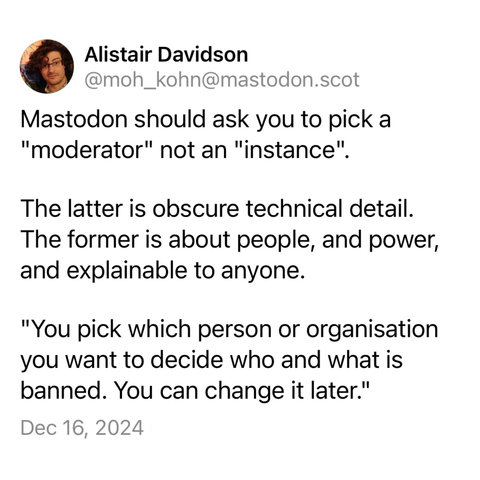
I may use this when asked how Mastodon works:

Mastodon works like emails does: you can be on anybody's server (the @example.com part) and still communicate fine with people on another company or person's server. When you pick what server to be on (what they call an Instance) you are picking which person or organization you want to decide who and what is banned. You can change it later.

h/t to Alistair Davidson @moh_kohn for the verbiage about how picking a server works

#TwitterMigration

@davidaugust @moh_kohn This explanation is the first time any of this has made sense to me, and I've been here for going on 3 years.

Thank you! šŸ˜ŠšŸ¤˜šŸ––

@courtcan @moh_kohn I’m so happy this helps, it is my pleasure 😊