 jpziller
 Bob Downie
Health benefits of pedestrian and cyclist commuting: evidence from the Scottish Longitudinal Study
If ever you doubted that #cycling was good for you, doubt no longer!

Health benefits of pedestrian and cyclist commuting: evidence from the Scottish Longitudinal Study
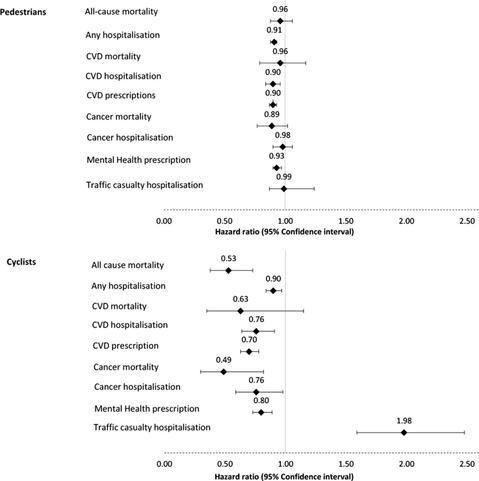
Background Despite active travel investment increasing, evidence of benefit is often limited to selected health outcomes and a short follow-up period, and cyclists and pedestrians are often analysed together. We aimed to examine prospective associations with multiple health outcomes over 18 years for pedestrians and cyclists separately.Methods The Scottish Longitudinal Study is based on census data, from which we selected 82 297 individuals aged 16–74 years. Individuals were followed-up between 2001 and 2018 through linkage to hospitalisation, death and prescription records. Cox proportional hazard models were used to compare cyclist and pedestrian commuters with non-active commuters for a range of health outcomes, controlling for pre-existing health conditions, and demographic and socioeconomic characteristics.Results Compared with non-active commuting, cyclist commuting was associated with lower all-cause mortality risk (HR 0.53, 95% CI 0.38 to 0.73), lower risk of any hospitalisation (HR 0.90, 95% CI 0.84 to 0.97), lower risk of cardiovascular disease (CVD) hospitalisation (HR 0.76, 95% CI 0.64 to 0.91) and of having a CVD prescription (HR 0.70, 95% CI 0.63 to 0.78), lower risk of cancer mortality (HR 0.49, 95% CI 0.30 to 0.82) and cancer hospitalisation (HR 0.76, 95% CI 0.59 to 0.98), and lower risk of having a prescription for mental health problems (HR 0.80, 95% CI 0.73 to 0.89). Pedestrian commuting was associated with lower risk of any hospitalisation (HR 0.91, 95% CI 0.88 to 0.93), lower risk of CVD hospitalisation (HR 0.90, 95% CI 0.84 to 0.96) and of having a CVD prescription (HR 0.90, 95% CI 0.87 to 0.93), and lower risk of a mental health prescription (HR 0.93, 95% CI 0.90 to 0.97).Conclusion Active commuters were less likely to suffer from a range of negative physical and mental health outcomes than non-active commuters. These findings strengthen the evidence for the health benefits of active commuting.
 Jon Sullivan
 JF
JF 

 Raglan Niall

 Erwin Rossen 🔸
 InsertUser