The thing on the left is a common adornment of streetside utility poles, attached maybe a meter off the ground. It is colored with highly-reflective yellow paint, and clearly intended to help night drivers avoid the pole.

I imagined that it was manufactured in three steps:
1. 3mm sheet metal cut to size
2. Spray-painted yellow
3. Little rectangles cut out with a die

This raised questions: why all the little holes? Does it improve visibility? And what do you do with all those little rectangles afterward?

Eventually I realized: this thing isn't the primary product. It's the waste material left over from manufacturing the little rectangles!

Every 20 meters or so, every highway has a little wooden or plastic post on its margin, topped with one of those little rectangles, to help people stay on the road. At night you can see a long line of them stretching out, following the curve of the road.

But after you punch out the rectangles from the sheet metal, what do you do with the leftover sheet? Might as well nail it to a utility pole somewhere, since it's already painted.

So that cleared that up. At least, I was satisfied enough that I didn't look into it to verify my guess.

Today, though, there was a new wrinkle, seen at right. Apparently not enough waste material was available to meet demand, because this one appears to have been manufactured for the purpose. I didn't think to feel it to find out what it was made of, but I suspect vinyl.

(Also, it has been installed sideways. Normally they are oriented as the one on the left.)

By the way, if you find this sort of thing interesting you might enjoy these blog articles I have written about utility poles and other street infrastructure:

https://blog.plover.com/tech/utility-poles.html
https://blog.plover.com/tech/gompertz.html
https://blog.plover.com//tech/highway-stuff.html

They are some of my favorites.

Utility poles

From the highly eclectic blog of Mark Dominus

The Universe of Discourse : Utility poles
@mjd these are a delight.
@brennen Thanks, I'm glad to have delighted you!
@mjd Do you know the YouTube channel Practical Engineering? It's full of that sort of stuff: https://www.youtube.com/@PracticalEngineeringChannel
Before you continue to YouTube

@pozorvlak I've seen a few and I always like it but I don't watch it habitually. Thanks for the rec.
@mjd what was the explanation for the high hog turnover in https://blog.plover.com/addenda/201804.html ?
Addenda to recent articles 201804

From the highly eclectic blog of Mark Dominus

The Universe of Discourse : Addenda to recent articles 201804

This old Philly Inquirer article confirms that the yellow thing (called a "grid reflector") is "what is leftover from the manufacture of reflective ID tag digits that also go on poles and equipment". https://www.inquirer.com/news/philadelphia/yellow-grids-peco-utility-poles-reflectors-drivers-20190831.html

I mentioned those ID tag digits on my blog a while back but didn't make the connection. I'll try to measure the digits and the holes to see if they match. But it seems plausible. I observed at the time that they seem to have phased out the yellow digit rectangles in favor of ID number burnt directly into the wood, which might explain why the grid reflectors changed design: maybe they finally ran out of leftover waste reflectors! https://blog.plover.com/tech/utility-poles.html

Why yellow grids are on some Philly-area utility poles​

“It’s just weird that some of them have them, and some of them don't," said Howard Frysinger, 66 of Glenmore.

https://www.inquirer.com

"The answer came as a bit of a surprise to Jay Lipschutz, 73, of Northeast Philly… his wife, Ruth, he said, had insisted they’re reflectors for drivers to see. She was right."

Jay, my man, I hate to break it to you, but your wife is smarter than you are.

OK , so further developments on this.

1. The grid reflectors are not made of sheet metal, as I said, but vinyl or maybe polyethylene. (I thought I remembered being surprised in the past that they were sheet metal and _not_ plastic, but all the ones I checked on Thursday were definitely plastic.)

2. The single-digit ID numbers are indeed the same size as the cutouts in the grid reflectors; I measured. I'm not certain they are made of the same material as the grid reflectors but it is definitely not ferrous.

3. I found an older ID tag style I haven't seen before, consisting of digits embossed on metal rectangles which are then mounted on a metal ribbon attached to the pole. I think the metal is aluminum. These tags are the same size as the yellow ones so I guess the yellow ones were made to match.

4. According to an old South Philly Review article, the ID tags and grid reflectors were manufactured by Almetek Industries Inc. The Almatek web site does offer the grid reflectors for sale: https://almetek.com/product/delineators/ They cost $87.50 for a bag of 25.

South Philly Review: https://web.archive.org/web/20140627183435/https://southphillyreview.com/news/features/Time-to-pause-and-reflect-87289567.html

I hope this will satisfy all the depraved perverts who have been following me around hoping for more juicy utility pole content.

(Now picture me surreptitiously reading the OnlyFans TOS.)

I said last time “The grid reflectors are not made of sheet metal, as I said, but vinyl or maybe polyethylene. (I thought I remembered being surprised in the past that they were sheet metal and _not_ plastic, but all the ones I checked on Thursday were definitely plastic.)”

Today I found some sheet metal ones again, so my memory was correct. They were on poles with matching rectangular yellow ID tags, which I think were also made of metal.

I guess aluminum, because they were nonmagnetic.

I took photos, but they look almost exactly the same as the plastic ones.

@mjd at a guess, the older poles have metal and the newer ones have plastic
@mjd interesting. Poles in Melbourne (maybe wider Australia) have reflective blue and white markers to help fire fighters find hydrants.
@adavis Is it these blue and white markers? I spent too much time this morning wandering around Melbourne in Google when I should have been attending to business.

@mjd yes that's them.

I think the orientation matters too. I think one orientation means the hydrant is between this pole and the next, and the other orientation means between this pole and the previous. Don't quote me on that part though!

@mjd here's some trivia for you to figure out. Why do we need markers on poles?
@adavis I'm not sure yet, but as I walked around Street view I saw many markers and few hydrants, so I know the hydrants can be hard to spot!

@mjd
Most of our hydrants are below ground. Here is one near my house.

The triangle points to the hydrant location. So they're a bit hard to spot!

@adavis Aha! I think I saw one of those in its above-ground mode and suspected it was a hydrant without being certain.
@mjd Now this is the content I come to the internet for!!
@dx Then you will probably want to read my blog! It is loaded with this kind of random stuff. https://blog.plover.com/
My reply to the people who want to designate my neighborhood a "historic district"

From the highly eclectic blog of Mark Dominus

The Universe of Discourse
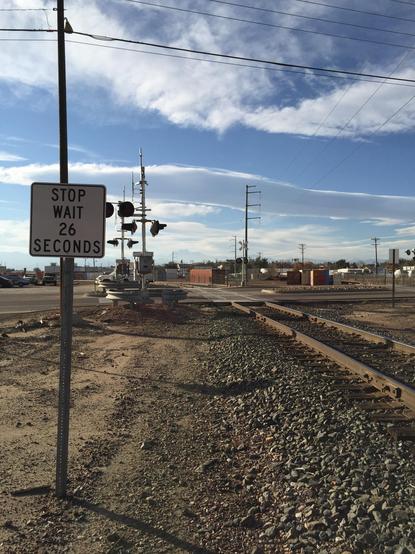
@mjd love this kind of stuff - maybe someone here can explain this, an instruction to a train conductor at a road crossing. 26!

@dxpack @mjd
Not sure, but the answer is probably in the following document (for Canada) - e.g. section 16.1.1

https://tc.canada.ca/sites/default/files/2023-11/gcr_handbook_en.pdf

@mjd @nuncamind here is some utility pole content for you ⚡️