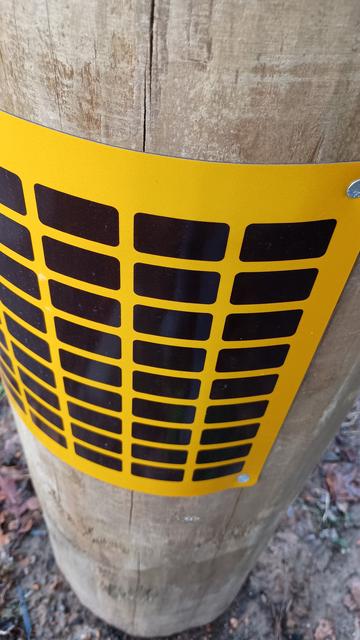
The thing on the left is a common adornment of streetside utility poles, attached maybe a meter off the ground. It is colored with highly-reflective yellow paint, and clearly intended to help night drivers avoid the pole.

I imagined that it was manufactured in three steps:
1. 3mm sheet metal cut to size
2. Spray-painted yellow
3. Little rectangles cut out with a die

This raised questions: why all the little holes? Does it improve visibility? And what do you do with all those little rectangles afterward?

Eventually I realized: this thing isn't the primary product. It's the waste material left over from manufacturing the little rectangles!

Every 20 meters or so, every highway has a little wooden or plastic post on its margin, topped with one of those little rectangles, to help people stay on the road. At night you can see a long line of them stretching out, following the curve of the road.

But after you punch out the rectangles from the sheet metal, what do you do with the leftover sheet? Might as well nail it to a utility pole somewhere, since it's already painted.

So that cleared that up. At least, I was satisfied enough that I didn't look into it to verify my guess.

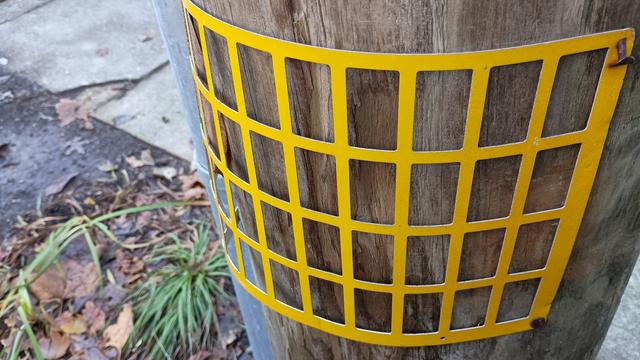
Today, though, there was a new wrinkle, seen at right. Apparently not enough waste material was available to meet demand, because this one appears to have been manufactured for the purpose. I didn't think to feel it to find out what it was made of, but I suspect vinyl.

(Also, it has been installed sideways. Normally they are oriented as the one on the left.)
OK , so further developments on this.

1. The grid reflectors are not made of sheet metal, as I said, but vinyl or maybe polyethylene. (I thought I remembered being surprised in the past that they were sheet metal and _not_ plastic, but all the ones I checked on Thursday were definitely plastic.)

2. The single-digit ID numbers are indeed the same size as the cutouts in the grid reflectors; I measured. I'm not certain they are made of the same material as the grid reflectors but it is definitely not ferrous.

3. I found an older ID tag style I haven't seen before, consisting of digits embossed on metal rectangles which are then mounted on a metal ribbon attached to the pole. I think the metal is aluminum. These tags are the same size as the yellow ones so I guess the yellow ones were made to match.

4. According to an old South Philly Review article, the ID tags and grid reflectors were manufactured by Almetek Industries Inc. The Almatek web site does offer the grid reflectors for sale: https://almetek.com/product/delineators/ They cost $87.50 for a bag of 25.

South Philly Review: https://web.archive.org/web/20140627183435/https://southphillyreview.com/news/features/Time-to-pause-and-reflect-87289567.html

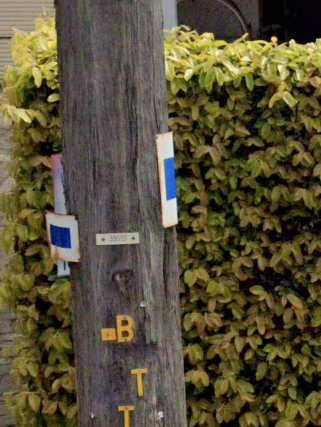
@mjd interesting. Poles in Melbourne (maybe wider Australia) have reflective blue and white markers to help fire fighters find hydrants.
@adavis Is it these blue and white markers? I spent too much time this morning wandering around Melbourne in Google when I should have been attending to business.

@mjd yes that's them.

I think the orientation matters too. I think one orientation means the hydrant is between this pole and the next, and the other orientation means between this pole and the previous. Don't quote me on that part though!