
One of the hot technologies preceding one of the several “AI Winters” we’ve seen since software was even a thing was called Expert Systems. And they were hot for well over a decade!

…but as the hype started cooling and people looked at the cost/benefit analysis and the real capabilities of such a system in the long term, the whole house of cards came crashing down. Below is the summary the Wikipedia page gives on why they failed. Look familiar?
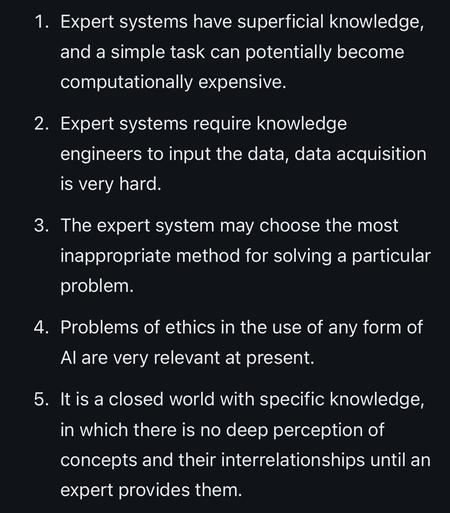

What I’m getting at is that it doesn’t really matter if LLMs improve the quality of their results to match a novice human worker.

When you remove the subsidies from incredibly rich investors and the massive FAANG war chests, and the momentary early adopter hype from people willing to pay for trash for the novelty, when you take into account the training costs in hardware, energy, and environmental costs…

The math just doesn’t add up, and I don’t believe it ever will. VCs and war chests are able to artificially prop stuff up for a very long time in the (false) hope that it’ll pay off but… the math will never add up. And if and when regulation (like copyright law) catches up, it’s going to be a BLOODBATH

@zkat Frustratingly, the hope isn't necessarily false for the VCs — but they're hoping for an acquisition or an IPO, not a working product.
@neia that’s fair. Sometimes it’s easy to forget that scammy early adopters often make out like thieves, even if the thing as a whole is a massive failure (see: cryptocurrency and NFTs, which made a few people extremely rich and many more people much poorer)
@neia What I don’t quite get yet is what FAANG gets out of it. They don’t just get to exit and call it a day. I guess this is just more short-term gains in the form of rising stock prices (and executive compensation based on releasing anything branded AI, regardless of whether it earns anything)? I can see how FAANG companies would take a significant stock price hit if they decided not to pursue this hype cycle, but it’s still coming at a huge cost. The level of sacrifice in all sorts of dimensions these companies are having to make just to be able to keep funding this moonshot is incredible.

@zkat @neia it’s because they were able to sustain incredible growth over three decades as software was able to “eat the world.” That process is for the most part complete—e.g. social media companies couldn’t keep adding users indefinitely.

Prior to this, they were desperate—e.g. Facebook going so hard on the Metaverse they renamed themselves.

However, the prospect they could replace workers with LLMs is too alluring and profitable to give up on, even if impossible