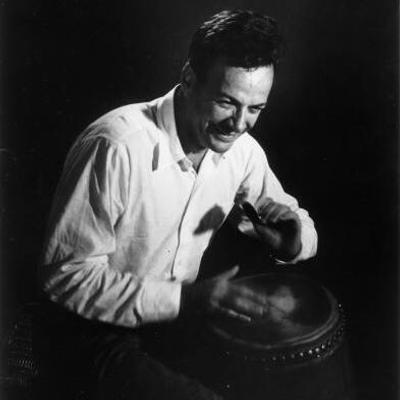
If you love Richard Feynman you've got to watch this video...

... where Angela Collier will ruthlessly dissect the mythology he built around himself. You probably won't agree with everything she says, and you may hate some of it, but it will still be thought-provoking.

I didn't know about what she calls "Feynman bros": lazy male students who read Surely You Must Be Joking, Mr. Feynman! and try to adopt the flashy womanizing persona he depicts there, instead of working hard on physics. I can easily believe they exist. So if you know a youngster who likes physics, don't give them that book. Instead do what my uncle did: give them The Feynman Lectures on Physics.

I didn't know these books and indeed every book 'by Feynman' was actually written by his Caltech colleague Robert Leighton or his son Ralph Leighton based on audiotapes of lectures or conversations. I still don't know how much of a role Feynman had in crafting these concoctions.

I *did* know that he once flew into a rage and tried to choke his second wife.

I did not know he was good with children, eagerly answering letters from them, etc. It's nice that Collier points out this good side.

I *did* notice, from his anecdotes, that he put a huge amount of work into trying to seem like a manly man rather than a nerd.

I didn't fully notice that almost none of his anecdotes feature the famous physicists he worked with at the Manhattan Project. Collier points out that this leaves him free to make things up.

I think she overlooks how he eagerly *points out* that he used tricks to seem smart. He explains the tricks to show they're not so hard.

I could go on....

(1/2)

https://www.youtube.com/watch?v=TwKpj2ISQAc

the sham legacy of Richard Feynman

Link to Patreon — one exclusive video per month:https://www.patreon.com/acollierastroI have merch: https://store.dftba.com/collections/angela-collierLink to ...
YouTube

Michael Gottlieb (@feynmanlectures), editor of the new edition of the Feynman lectures, has written a letter strongly disagreeing with some things Collier says in her video. You can see it here:

https://www.feynmanlectures.caltech.edu/info/other/Letter_to_John_Baez_regarding_Angela_Colliers_sham_video.pdf

I was not implicitly endorsing all of @acollierastro's claims in my first post. I merely said what I wanted to say.

Nor am I implicitly endorsing Gottlieb's claims here. I hope Gottlieb and Collier can discuss this without using me as an intermediary.

(2/2)

@johncarlosbaez @acollierastro

So far I've watched half of her video, for lack of time.

Now you are giving me something else to read, which I'll do, too. When I have enough time.

@johncarlosbaez @acollierastro

So I've read the letter. It doesn't say anything about the "you are joking" book.

Whether Feynman wrote it or not, it is a bad book.

@MartinEscardo I watched the whole video, and I'm glad I did. I was going to skip the end, because I thought I had got the main points out of it, but I went to finish it after reading this letter. There's interesting new stuff there; I was impressed at how it was handled. (I'm not impressed with the letter.)

@johncarlosbaez @acollierastro

@MartinEscardo @johncarlosbaez @acollierastro
I read it in high school and liked it at the time, missing and/or minimizing a lot of the red flags that Collier discusses. Later, I spoke to a Brazilian physicist who hated the way Feynman (through Leighton) misrepresented Brazilian science and my awareness started to shift.

@johncarlosbaez @acollierastro @feynmanlectures
> I hope Gottlieb and Collier can discuss this without using me as an intermediary.

Here in this golden friendly Utopia of the Internet? What could go wrong?

@johncarlosbaez
Gottlieb's letter to you is, I would say, needlessly unkind to you, but people do tend to react strongly on issues close to their heart.

@johncarlosbaez Without wanting to fully endorse or invalidate anyone's statement (if I agree completely with anybody, I lose my academic license), I do want to say that pointing out that the red books had a third official coauthor hardly invalidates the general thesis that they were necessarily collaborative works that shouldn't feed a cult of personality for one man.

Regarding the book of exercises, all my experience with physics courses tells me that the homework problems were likely invented and worked over by many people, with the chain of attribution lost. Looking at Caltech's website,

https://www.feynmanlectures.caltech.edu/info/ ,

the "Exercises for The Feynman Lectures on Physics" are attributed to Caltech, and they are said to include many problems from an older book attributed to Bob Leighton and Robbie Vogt. My overall sense, from the Gleick book and other bits I've read, is that trying to make exercises to go with Feynman's lectures was a whole big job that required multiple people.

@bstacey @johncarlosbaez

It's absolutely true that FLP was a collaborative work, as I am always trying to point out, because I think Leighton and Sands don't get enough credit for their part, though, on the other hand, their part was almost entirely editorial - they contributed very little original material, but almost exclusively polished the material Feynman presented to make it readable as a written text.

As for the exercises, a small minority of the exercises for FLP Volume I (Mechanics) were in use at Caltech before Feynman gave his lectures, and many of the rest are, as you write, attributed to Leighton and Vogt. On the other hand, according to Gerry Neugebauer, in his Prefaces to the first editions of the FLP Volume II (E&M) and III (QM) exercises, about 1/2 of the E&M exercises and 3/4 of the QM exercises are attributable to Feynman himself, while the rest came from various other people (mentioned in the prefaces).

@feynmanlectures @johncarlosbaez I finally found my copy of the Exercises (it was at home instead of at the office). Just to underline the collaborative aspect, for those who are reading this thread without the book at hand, the preface to the E&M part says "The idea for about one-half" of them came from Feynman, while the preface for the QM part says "The ideas for about three-fourths" of them were so. The preface for the book overall says, "The exercises for Volumes II and III have been supplemented with several new problems", which I'm assuming weren't covered by Neugebauer's remarks and might change the percentages a little bit.

@bstacey
> (if I agree completely with anybody, I lose my academic license)

😆

@johncarlosbaez

@dougmerritt @bstacey - why are Doug (and then I) just reading this now?

@johncarlosbaez @bstacey
I don't know the deeper answer to that, but the shallow answer is that I was looking at bstacey's timeline and I went back as far as December.

Why you and I hadn't seen it before, I have no idea.

@johncarlosbaez
P.S John, I left you a private message (last night in my timezone), and it may have gotten swamped by other notifications you've gotten since then.
@dougmerritt - I responded to a private message of yours last night.
@dougmerritt @johncarlosbaez I don't know either.
@bstacey @dougmerritt - I suspect I just forgot the joke "if I agree completely with anybody, I lose my academic license".

@johncarlosbaez @acollierastro @feynmanlectures I watched all three hours of Angela's video, and that letter doesn't do anything to address the important parts.

She outlined plenty of evidence that the "Surely you're joking" stories are false. The problems those books cause are independent of truth of the stories, and the letter says nothing about that.

@overeducatedredneck @johncarlosbaez @acollierastro

My letter mainly concerns the distortions, omissions and lies Angela makes about the books I edit, author and publish.

Please detail the "evidence" you refer to that the stories in SYJ are false.

@feynmanlectures @johncarlosbaez @acollierastro Her evidence is in the video. I'd tell you to take it up with her, but given your defense of SYJ, I hope she's already blocked you. As I'm going to. As JWZ says, *plonk*.

@johncarlosbaez @acollierastro @feynmanlectures Perhaps I'm missing the main point that Angela Collier is making by getting confused by these revelations that are made where there is nothing to reveal because it is all out in the open. It is not true that "every book 'by 'Feynman'" was written by a Leighton, but even of the ones that were, it was very explicitly pointed out how the books came to be. My 1977 printing of 'The Lectures' has a lengthy preface where he uses the words like 'I' and 'my' when talking about his lectures, and 'we' when talking about transcribing and editing the books. That is followed by a lengthy forward by Leighton who talks about how it came together and all the people involved in the project. The 'Surely You're Joking' and 'What Do You Care What Other People Think?' are explicit in how they were transcribed by the younger Leighton from recordings of telling the stories. The latter, in fact, has a preface from Leighton that says 'My motivation is simple: ever since hearing my first Feynman stories, I have had the powerful desire to share them with others." If you want to know Feynman's involvement in those concoctions, you can just read the dust covers and prefaces, or better yet, listen to the audio stories yourself which have been also published. If telling the stories to someone who writes them down somehow discredits the authorship, I anxiously await her videos tearing down Stephen Hawking's books and papers too.

1/3

@johncarlosbaez @acollierastro @feynmanlectures

Feynman clearly didn't like the process of writing books, or had no desire to (or both). His other works, like 'The Lectures', were transcriptions of talks and lectures he gave. 'QED', 'The Character of Physical Law', and even my copy of 'Statistical Mechanics A Set of Lectures' were all compilations of his lectures put down on paper. And it's all spilled out in the prefaces, forwards, editor's notes, and acknowledgments. The statistical mechanics book is part of a Foundations in Physics series intended to give leading physicists of the day to explain topics they are expert in (there are also Feynman books in that series on QED, 'The Theory of Fundamental Processes', and 'Photon-Hadron Interactions). It consists of lectures he gave on statistical mechanics sponsored by Hughes Research Laboratories in 1961.

2/3

@johncarlosbaez @acollierastro @feynmanlectures

I'm not sure what Angela Collier was expecting for Manhattan Project stories. I read a lot of biographies and autobiographies in the 80s from many of those physicists and I can't say there are lots of tell-all stories from them from those days, particularly since materials from those days weren't even fully declassified by the time Feynman died. What stories does she think were made up?

3/3

@zornslemmon - there are definitely anecdotes involving physicists at the Manhattan Project, not "tell-all" stories but interesting tales. For example Groueff's "Manhattan Project: The Untold Story of the Making of the Atomic Bomb" describes Feynman's interactions with Hans Bethe, which made people call Bethe "The Battleship" and Feynman "The Mosquito". And in fact, contra Collier, even "Surely You're Joking" discusses how Feynman picked up calculational tricks from Bethe.

https://www.youtube.com/watch?v=e4e1jdt-n8U

Hans Bethe: How I met Feynman at Los Alamos

YouTube

@zornslemmon The book covers more or less shout Feynman's name, making him look like the author (the Lectures, of course, list the others on the front, but the title is the eye-catching thing). Many people don't read forewords and prefaces, especially if they are "here's a probably boring story of how this book came to be" esp compared to the spicy content of the book. And people buying the books almost surely don't read the preface etc to find out the actual text was compiled not by Feynman. And if the reader is a young teen then these factors are even more so.

I'm pretty sure I've read at least some of Surely You're Joking, and I didn't remember anything about careful claims about the authorship. Given that the book's voice is in the first person, this is not unreasonable!

@highergeometer Of the only books that seem to be under scrutiny here, 'The Feynman Lectures on Physics' lists the authorship prominently as Feynman - Leighton - Sands on the cover and spine, with the most prominent part on both the cover and the spine (on my copy at least) is 'Lectures on Physics.' If Collier is trying to use those books to bulwark an argument about ghost writers, then that is entirely dishonest.

It is clear Collier doesn't read prefaces or even dust covers ("Feynman died on February 15, 1988, after a long battle with cancer. During his final years he and his friend Ralph Leighton prepared this manuscript, his last literary legacy"), where this information is also given.

If Collier wants to make arguments about the intents of someone who has been dead for almost 40 years, even if she doesn't want to look at the source material, she should at least spend a few minutes looking at Wikipedia to validate her arguments.

who quoted ad hominems in this thread i swear it's somewhere.

don't imply dr collier didn't read the dust covers or other any source material (wiki? really?), please. it doesn't reflect well on you.

@zornslemmon "If Collier is trying to use those books to bulwark an argument about ghost writers, then that is entirely dishonest."

I'm not sure I can parse your comment. Use which books? The video shows the two large stacks of books that I infer Collier bought and read in order to ensure she had actually read the material she wanted to critique.

In areas I'm interested in where authorship is more complicated, namely Tolkien's posthumous publications, people are very careful to delineate things. So you get things like The Silmarillion, as a book "by Tolkien" (who wrote >95% of the raw text), "edited by Christopher Tolkien", and "with the assistance of Guy Kay". You have works like the Nature of Middle-earth which lists Tolkien as the author, and very clearly Carl Hostetter (on the cover) as the editor. And so on. SYJ and WDYC could have been advertised on the cover as "Reminiscences of Feynman, edited by Leighton". Or at the least "by Feynman, edited by Leighton"

The lectures are a more complex textual situation, since presumably Feynman wrote lecture notes for himself, and at very minimum he chose the topics and the order and so on, if he didn't write any substantial notes. I don't mind the fact the lectures are clearly attributed to all three authors. But, to compare to examples in mathematics I know, you get books that are based on lectures by person A, and with the textual core the notes on said lectures written by person B. And these roles are usually delineated fairly up-front, if not on the books cover.

How much Feynman contributed to proof-reading the manuscript, or editing the text transcribed and compiled by the others, is not clear. I wouldn't presume to assume he did or didn't.

@zornslemmon That said, I feel there's a wider cultural issue of how "authorship" is determined in science papers, namely how the person who is the boss of the lab gets to be an "author" on papers that are physically written by others, based on experiments done by others, with, sometimes, rather minimal intellectual oversight by the boss (maybe they suggest looking at some particular idea/test etc, and give some feedback on the draft—not saying this is typical, but it happens).

The types of contributions to the FLP are different, and this is I think indisputable. I think Collier's point is that, in conjunction with the informal books not being authored by Feynman, that he didn't actually write the books with his name in the title feels different than if the lecture notes were the only data point.

But this is my interpretation, I'm not presuming to claim this was her intent, and I would absolutely avoid any claims about dishonesty, since that assumes deliberate mistruths, and is a very strong accusation.

@johncarlosbaez @acollierastro @feynmanlectures
This quote from the letter would go nicely in the dictionary definition of “ad hominem”:

“Some people, who perhaps feel inferior, perhaps because they don't have much of anything positive to contribute, draw attention
to themselves by dissing famous people, and Feynman is a popular target in this respect.”

I doubt much productive discussion can follow from that.