 blibla
Hell Yeah
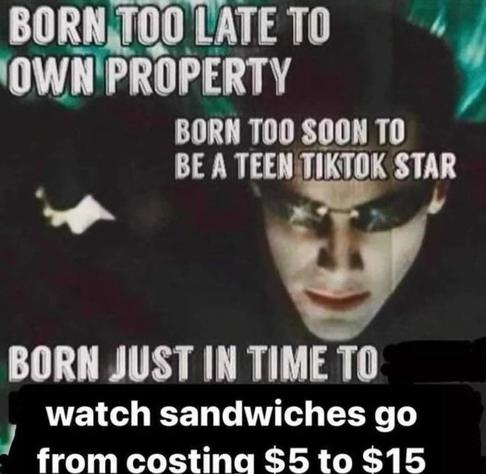
From personal experience, it’s a personal failing and not an environmental issue. The only time I have issues with food spoilage like described above is when I over buy, forget about, or get tired of something. If I properly plan out my meals (lol) and space out purchases and freeze leftovers when necessary, I have very little issues with spoilage.
And having sandwiches regularly without having ingredients go bad is something I do all he time.
When ever I hear how expensive it is to cook I know I’m dealing with a young person who’s clueless. Have parents not been teaching their kids to cook?!
Reminds me of visiting my niece and her husband for dinner. They never cooked but made a nice meal that night. But they said it just wasn’t economical when they totaled the price vs. portions. They did the math and proudly claimed it was cheaper to eat out. My wife and I were stunned.
Well, duh? Now you have leftover ingredients. Add to those and plan another meal. FFS, they had to buy salt and figured that into the total meal price. They literally started with nothing. Yes, it’s expensive to spin up a fridge and pantry, but once you’re rolling it’s cheap to eat.
I was taught to cook so poorly I had to start from scratch and learn how to make food taste good. There’s no shame on not having been taught basic life skills, but cooking is definitely a skill worth learning. Begin by talking to the laziest home cooks you know, figure out their tricks because we tend to live off cheap and easy stuff
eg. black bean tacos: two cans of black beans, rinsed, cooked in water and store bought taco seasoning until it’s been sufficiently absorbed, put on store bought tortillas, salsa, sour cream, and cheese are optional, I’m partial to jarred nopales as well. Experiment at will.
Yeah…I almost never order out unless I have company in town or I’m completely out of food to cook after work and I’m lazy (which is like once/mo). And even then I’ll usually scrape something easy together like cereal or pasta/red sauce or even just toast/butter if I’m really desperate.
I’m not constantly throwing out food or eating the same things. Just every week or so I’ll grab enough to make like three separate dishes plus a few staples and just like that I’m set to scrape together something new or eat at least three different set meals. Or I can run down to grab one extra ingredient and make an entirely new dish combining what I have.
I definitely get eating out is delicious and much easier, but let’s not pretend it somehow saves you money lol
Did you know that refrigerators don’t stop food from going bad, they just slow the process? And before you mention the freezer: not everything can be frozen. Like most produce, for example.
Even with a fridge, most of the groceries the SO and I buy end up going bad before we can use all of the ingredients. It’s cheaper to just eat out most of the time.
most of the groceries the SO and I buy end up going bad before we can use all of the ingredients.
So what you mean to say that for YOU it’s cheaper to eat out given your current eating and cooking habits. But you are generalizing this for everyone. There are lots of reasons buying groceries and cooking may not be working for you. If you really want to save money, there is absolutely no question that it’s cheaper than paying someone to cook for you every meal. Just because you haven’t figured out how to do that doesn’t mean you can say that’s universally true.
This said, it sounds like eating out all the time is working for you and you are happy with it.
So this may not apply to you, but… If you do want to optimize for cost, I’d suggest:
Also, has no one heard of a freezer?
If you want to get fancy, vacuum pack it. I’ll admit, I cannot stand even the slightest freezer burn. It makes me gag immediately. Vacuum packing basically eliminates that.
You can do a pretty decent job with a ziplock and a water bath until you can afford one.
Put the food in the ziplock and submerge it in a tank of water up to the top of the bag while its still open. Then seal the bag while the lower part is held under water. Helpful to have an extra set of hands if you have someone available to seal while you hold the lower part under water.
Obviously not as good, but it does help.
Are you under the impression that families are going to the grocery store every day and trying to eat everything within 48 hours of picking it up from the store? No, people are buying the week’s worth of stuff and might not be getting to actually cooking it until 6 days later.
Buy a week’s worth of food, with each perishable item in quantities small enough to go into a few meals per week, out of the 21 meals you’ll be eating that week.
Fresh vegetables and fruit last a week or two. Fresh meat lasts a week. Eggs last a few weeks. Most dairy products last a week or two.
Make meals out of a combination of fresh ingredients, dry goods (pasta, rice, beans, breads), canned/preserved foods/sauces/condiments, frozen foods. With basically one perishable feature ingredient per dinner, it doesn’t take that much planning to feed yourself for maybe 10-25% as much as it costs from takeout or restaurants. Even if your food waste is double as a single person, that’s still 20-50% the cost.
The ingredients spoil?! Either you don’t have a fridge or don’t have a clue how to cook. Or maybe turn your fridge temp down?
Lunch meat lasts a month, easy. Cheese? Multiple months. Bread? Depends. 1-day to 2-weeks, forever if frozen.
I get ham slices every trip. Any idea how many things you can do with those?! Fry them for eggs benedict, with melted cheese on a bagel, chop into an omelette, ham and cheese melt, part of a charcuterie board, 20 different kinds of sandwiches, and more.
All of that only talking about one of the ingredients you have bought. Learn to cook or pay someone a premium to do it for you. That’s how it works.
Millennials and on par with gen X. Also top third as a country.
Economist put together a nice article or you can dig through the omb data. economist.com/…/generation-z-is-unprecedentedly-r…

Home ownership rates don’t need to take inflation into account. At the end of the day gen z, as individuals, own housing at roughly the same rate as gen x. The standard of living is higher and yes you can have this with inflation up and disposable income down people can still buy houses and do.
The US has weathered this global shift incredibly well, yet this sentiment displayed put Trump in office. It hurts me to see this disconnect and to see concepts like doom spending cheered.
Sure, but exclusively focusing on housing as an indicator for how rich a generation is gives a skewed perspective. Gen Z isn’t implicitly richer for owning a home, as they were able to use the low interest rates during covid which made mortgages less of a burden. They also have more opportunities to work from home, which allows them to buy cheaper houses in less desired areas.
However, just owning a home doesn’t mean you can actually get by.
It’s somewhat telling that despite all of those advantages, the average age at which people buy their first home is at a record high.
Right, so the "where" is the USA.
If we take https://en.wikipedia.org/wiki/Generation_Z#/media/File:Generation_timeline.svg definition of the generations and table 12 from here, we can compare the values 16 years apart to see generations at equivalent ages. 2023 is the most recent data on that table, so millennials would be 27 to 42. We can't match that perfectly with the 5 year bins on the table, so I'll just average every bin that that generation covers a majority of. With that, we get:
2023 2007 1991 Gen Z 23.6% x x Millennials 47.9% 24.8% x Gen X 72.0% 53.4% 15.3% Boomers 78.5% 76.9% 49.1%We can compare generations at the same age by looking along the topleft-bottomright diagonal. This shows gen Z having a lower ownership rate than Millennials did 16 years ago. Millennials were doing better than gen X 16 years before that, but have now fallen behind both gen X and the boomers.
Sure enough, the entirety of the discussion of homeownership in the article you linked is:
American Zoomers’ home-ownership rates are higher than millennials’ at the same age (even if they are lower than previous generations’).
Not sure what data they're using since that doesn't tally with the above, but that's still second-worst, and the actual worst is the generation the post is actually talking about.
The wording is highly biased and the article is poorly sourced. Here’s another link for the article referred to: archive.ph/wJJZv .
The Fed working papers ctrl-f “generation” -> : federalreserve.gov/…/has-intergenerational-progre… - the pdf paper includes the figures with non-biased language and here’s the conclusion:
Using data from 1963 through 2022, we evaluate whether younger generations are seeing slower income growth relative to the generations that came before. We confirm that there has been a slowdown in intergenerational progress, except for Millennials who saw their incomes grow slightly faster than Generation X but still more slowly than Baby Boomers and the Silent Generation. Intergenerational progress has remained positive for all generations. Positive growth has been maintained for Generation X and Millennials in spite of their stalled growth in hours worked. We investigate the role of two potential explanations for perceptions of worsening outcomes for Millennials despite their observed income growth relative to previous generations. First, we find that the higher household incomes of Millennials relative to Generation X, through their 20s, is a result of dependence on their parents rather than a rise in their own market incomes. By age 31, however, less than 10 percent of Millennials are still dependent on their parents and by then their own market incomes exceed that of previous generations. Second, we find that the rising cost of college offsets only a small portion of the income gains achieved by Millennials, especially when accounting for the growing generosity of financial aid. Our results focus on aggregate comparisons across generations, as opposed to direct comparisons between individuals and their own parents. Each type of comparison provides important information about absolute improvements in economic wellbeing across generations. Future research should continue to consider alternative measures of wellbeing for evaluating intergenerational progress, including consumption, wealth and social wellbeing (e.g., Fisher and Johnson 2022). Results on changes in wellbeing over time, including the intergenerational 26 progress made in rising incomes, should inform discussions about how best to promote wellbeing in the future.
Gratitude - I learned something despite the misleading trailhead.

 Diplomjodler
 TonyTonyChopper
 puppycat (she/her)
 Amputret
 CronyAkatsuki
 UnderpantsWeevil
 BlursedTarot