 Stylus
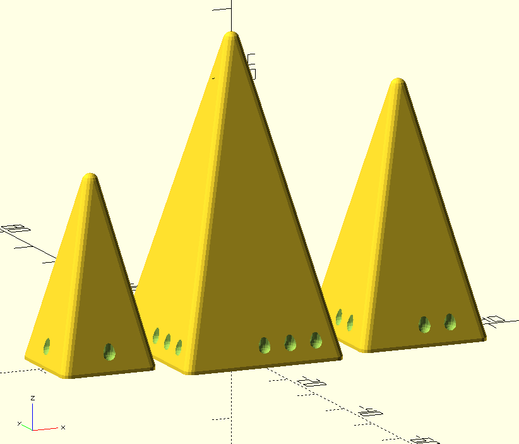
why yes, I am designing my own Looney Pyramids in OpenSCAD. These game pieces are used in a variety of (mostly abstract strategy) games, and can be placed on top of each other in "trees" or "nests"
There are multiple designs on thingiverse & printables, including an OpenSCAD design.
I've printed several other designs and, unavoidably, thought "can I do this better?" My WIP has two features I didn't spot in any of the 3 designs I looked most closely at, to improve taking apart the pieces after they've been nested (a kind of stack where the 1-pip is under/inside the 2-pip, the 2-pip is under/inside the 3-pip, or both).
First, the bottom part of the pyramidal shape is replaced with a vertical surface right at the build plate, to try to ensure that elephant foot doesn't make the parts as-printed interfere when shoved together.
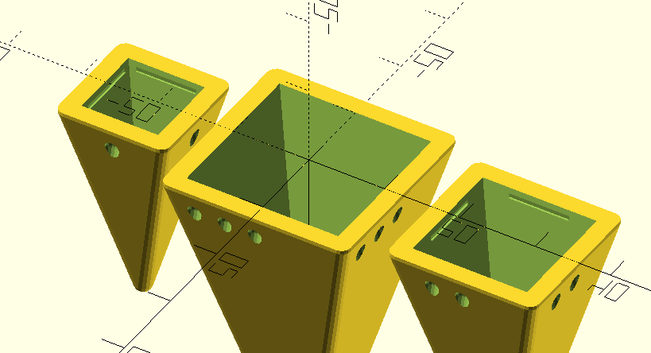
Second, there's an interior feature to dig a fingernail into when trying to separate a pair of pyramids.
I don't have any official pyramids but my pieces don't quite match the geometry of any of the other sets I've printed.
If I end up satisfied with the design I'll post it up on printables.

pyramids - home
What are Looney Pyramids? Looney Pyramids are multi-purpose game pieces used for playing numerous different abstract strategy tabletop games. These colorful plastic pyramids were created in 1987 and are conceptually similar to a deck of playing cards. If you have a set of these pyramids in your bag, you'll always have a game to play! The pyramids come in 3 sizes, referred to simply as Small, Medium, and Large pieces, and are available in a plethora of colors. How Do You Play With Looney Pyramids? Games for the pyramids are many and varied.
 James Young
 nycki
nycki