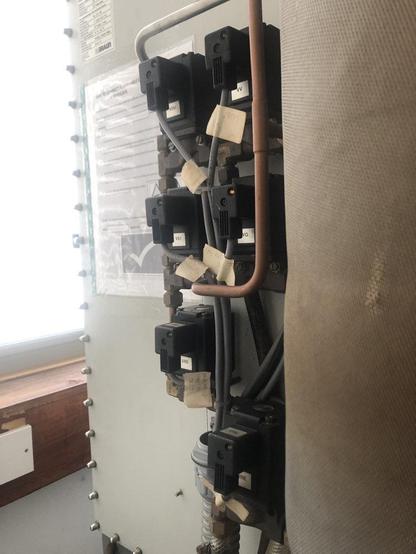
Saturday. My glove box remains dead after a mysterious cockup while I was on holiday that caused one glove to be torn and the catalyst to sinter into multicoloured lumps. It doesn't get much worse than that!

But after several abortive attempts to fix things, I woke up at 02;30 in a cold sweat about it. And then a possible solution dawned. So, back to the lab to try it out.
That glovebox has run for 30 years on the same catalyst. I'd hate to lose it. #chemistry #InInsomniaConsilio
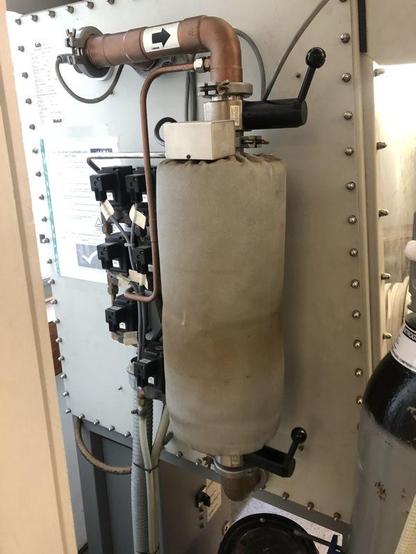
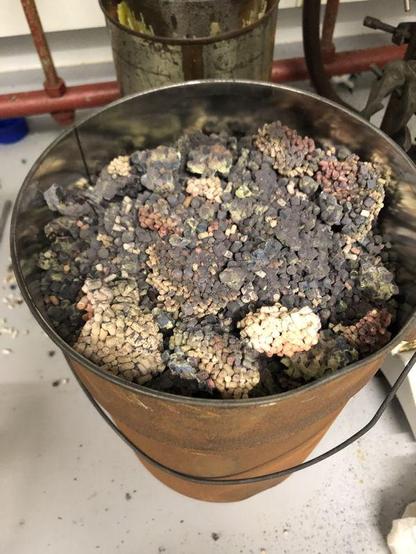
After multiple vicissitudes the correct replacement circuit breaker for my #glovebox has finally arrived. When it was installed, the blower that runs the recirculation in my glove box came back to life. 🍾🍾🍾 So now I need to purge the box with a cylinder of nitrogen and regenerate the catalyst which I have completely replaced. It's been a 2 ½ month emotional roller coaster. Fingers crossed we'll have the atmosphere down around 5 ppm O2 before the end of the week. #chemistry #academiclife

#Glovebox purged with 100 bar (7 m3 of nitrogen). Now the catalyst is heating up waiting for its nitrogen/hydrogen feed to reduce it down and activate it. We might have a working box by morning.

And then the shite jihad will begin. Time to clear out a lot of ancient samples and abandoned schlenks. There's a fair bit of rather manky white phosphorus and alkali metal in there so there may be some fun to be had…  #chemistry #academiclife

I return to my #glovebox to discover that the catalyst heated but the gas did not flow through at all - the flow rate seemed correctly set at the start. Does this mean that there's a deeper problem still lurking?

A whole day wasted. I'll have to try again tomorrow. Fingers crossed.

#GloveBox Saga. So the regeneration cycle is on for the catalyst on my #glovebox. Because I'm out of town I've got a couple of students primed to take photographs of solenoid valves to see whether the lights go on in the right order and whether when VRE opens the gas actually flow. If the light is on but gas doesn't flow then it's back to ordering another replacement part. How many weeks might that take? #sigh #chemistry #academiclife

And so my #glovebox is is undead!! Atmosphere well below 5 ppm of oxygen. Now the cleanup begins.

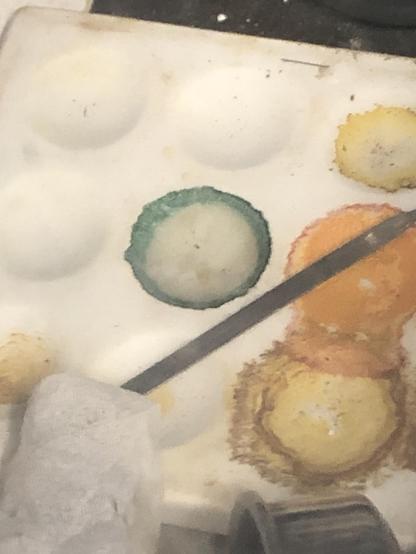
The spots are a very sensitive organometallic compound used as an indicator. Green is good. Orange is baaaaaad. #chemistry #academiclife

I'm taking stock of this whole affair. The first thing is that the original oxygen and moisture-scrubbing catalyst last for 30 years! I know people who insist on changing theirs annually. So although the box is messy as hell it's actually been well looked after.
There was one serious wrong turn - we mis-diagnosed some of the symptoms and wasted £300. In the end the part that needed replacing cost £15 and a little soldering. Plus the replacement catalyst that was lying spare in a cupboard. 1/2
The atmosphere is now as good as I've seen it in years. There's bit of a white film on the window that needs wiping off and ancient samples that I don't suppose I'll ever use again.
Once we've done our shite jihad I suspect that my #glovebox will be good to go for another decade or two - I've seen second hand microprocessor controllers on eBay and relays, fuses and so on are easy. Someone will inherit an old but solidly working box when I go.
So quick, let's get some #chemistry done. 2/2

So I am now gradually clearing old samples, some of them 20 years old, out of the #glovebox. I had kind of assumed that they were mostly dead.
Not quite. A few grams of brown NaMeCp caught fire after 5 or 6 minutes in air. And two samples of K4Si4 went off with a flash/bang when I dropped them into a wet beaker. More are waiting. #yikes

Depressing to think of the embodied emissions, but at least no one else has to deal with the surprises in future… #chemistry #academiclife #shitejihad

@sellathechemist That sounds like an interesting morning that I would enjoy! ☺️
@FaithfullJohn You should have seen the vial labelled Na/K alloy that was mostly full of off-white powder so "dead". But not quite.
There was still some metal somewhere in there because when I squirted in water in the fumehood, a whole series of jumping and jiving blobs of flaming yellow/orange ectoplasm materialised…
@sellathechemist It's all a lot less emissions than a private jet flight...
@sellathechemist Every time you posted about this, I thought glovebox was a car glovebox, and was confused until I read on
@sellathechemist I need to know more about very sensitive organometallic compounds used as indicators
@botvolution It's a reduced titanocene. You mix two spatula tips of red titanocene dichloride with one spatula tip of zinc in dry toluene under nitrogen. You then stir it for a day or so and the solution gradually goes green as the zinc dissolves, throwing its two electrons at two titaniums. The result is a beautiful deep green trimetallic complex that is very sensitive indeed. You put a spot down and wait for the solvent to evaporate. If it stays green you're set! If it discolours… #sigh
@sellathechemist @botvolution I think we used to use diethylzinc in heptane as a glove box check. If it fumed when you uncapped the bottle, it was bad.
@mike_malaska @botvolution Yes. I used to have a bottle of diethylzinc in toluene. Maybe once I've tidied up I might revive the practice. There's someone in the Department who has some so maybe I can filch a few mls to make up a kit.
@sellathechemist @botvolution The one thing I'll recommend NOT to do. Do not ever rev up a Tesla coil in the glovebox to "check for leaks" or "just to see what happens". There were stories of a former postdoc who tried this and really bad things happened. Was anectdotal.

@sellathechemist @botvolution and the thing I can "recommend". I once had a poorly secured stopcock blowoff in the antechamber. The flask contained precious cyclopentadienylcobalt bis(ethylene). [Dangerous prep. Not commercial]. We saw the chamber pressure pop up as the air burp hit it. Pump noise as it struggled a bit.

Then...pump noise quieted and became SUPER performant. Pumped waaaay down. We think we either plated cobalt on piston head or polyethylene. Was improved for about a year.

@sellathechemist
After a bit of goo-gerling I think this is for detecting O2 ?
@botvolution Apologies. Didn't give enough context. Yes. We want to have as little moisture and oxygen in our box as we possibly can. The Ti/Zn complex is very sensitive to oxygen so it's a really useful spot test. Moisure is a little trickier - I used to keep some diethyl zinc in the box - you open the lid and if there's significant moisture it smokes gently.
Nowadays most glove boxes are equipped with O2 or H2O sensors. But my box is 30 years old and at the time I didn't have the funds…