 marie
marie mhoye
mhoyeI love the implicit "answer this right or we'll drive a robot over a stranger someday" part of the whole prove-you're-a-human captcha experience.
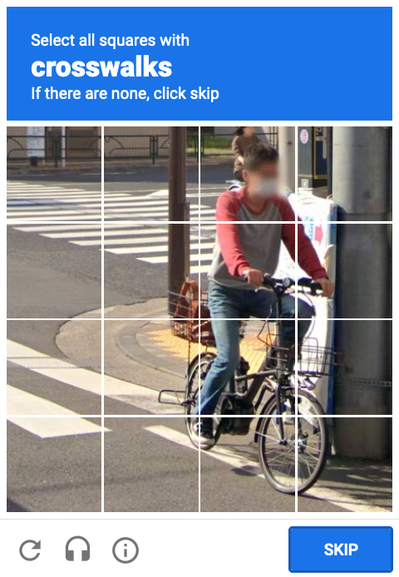
@Depemig It's not a conspiracy at all. "CAPTCHA" stands for "Completely Automated Public Turing test to tell Computers and Humans Apart". It was born at Carnegie-Mellon in the early 2000s and Google's been using it to train image recognition algorithms, digitize books, all sorts of things since 2012 or so.
https://phys.org/news/2012-06-captcha-story-squiggly-letters.html
@ampersine @mhoye @ampersine
Thanks for all of your links. Appreciated. I really thought this was nonsense.
Maybe, I simply couldn't believe detecting hydrants is such a challenging job for self-driving cars! ;)
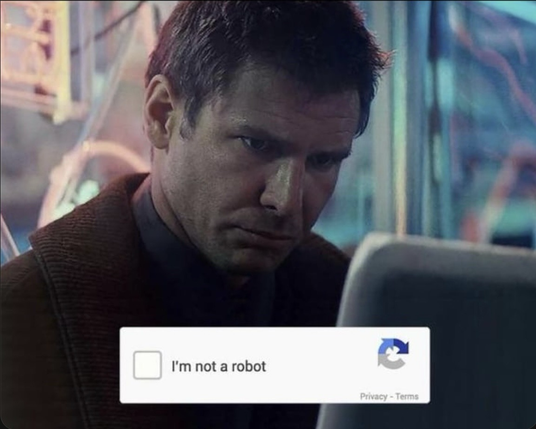
That, or Harrison Ford shows up to 'Retire' you for a wrong answer.
I'm looking, but no square shows a 'cross walk'.
Shouldn't I be able to see Kamala Harris walking off-stage after having given her most gracious concession speech?
Perhaps I should try looking for a burdened messiah, walking up the hill to Golgotha?
I might try looking for crabs, but I think their gait is more of a 'side step' rather than any type of 'cross walk'.
Tell ya what, I'm going to put my glasses on, re-read the instructions, and get back to you.
@mhoye I also love that we’ve reached the point where you can answer these correctly and sometimes have the machine tell you you’re wrong. (E.g. Unmarked crosswalks are a thing, despite what the machine says).
It’s just a wonderful microcosm of the world when the machine trumps your human judgement, and you have to knowingly answer wrong to pass the gate.
Attached: 1 image "The #CAPTCHA lays on its back, its squares baking in the hot sun, beating its legs trying to turn itself over, but it can't. Not without your help. But you're not helping."
@mhoye what’s always confused me about these CAPTCHAs is that they already know if you’ve clicked the wrong square. If they already know, what’s the point of asking me to verify the images?
I guess it increases the verification of existing training data? It’s just weird. Half the time, squares feel ambiguous, anyway.
 Gilles DePemig
 Covidiocracy
 J.elgato
 ʙᴇɴ ᴄᴏᴛᴛᴇяɪʟʟ
 kaia
kaia michael aubert
 Bruce
Bruce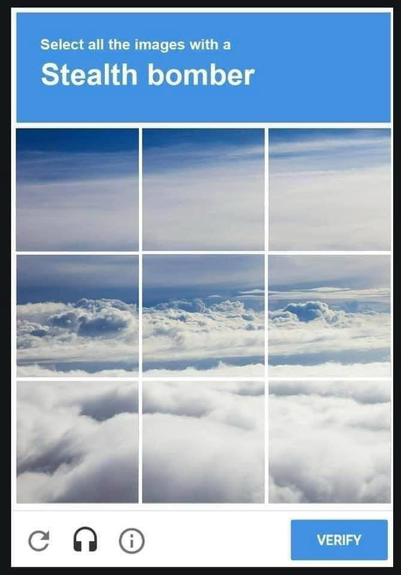
 TimePencil
 Coles Street Pothole
 Z̈oé
Z̈oé GunChleoc
 Evan
Evan Philip Mallegol-Hansen
 Dec [{(
 )}]
)}] SoonRaccoon
 Gary Houston
 AN/CRM-114
 Dennis Clark
 Sean Tilley