
Seeing this posted everywhere, but isn't this obviously a bad use of data? Like, you have a bunch of questions asking a highly polarized public whether things are good currently on a variety of indicators. Surely the divorce from reality runs in the opposite direction once the administration flips, at least to some extent, no?
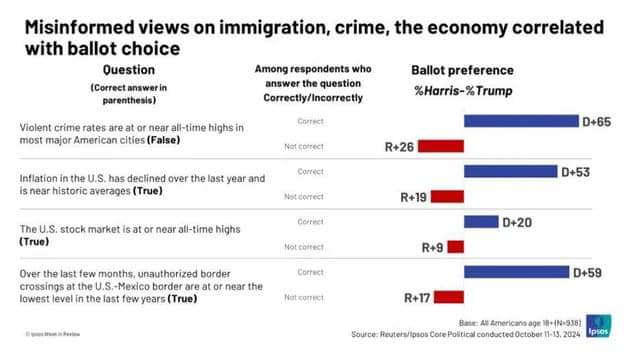
Or, likewise, suppose these were questions like "Inflation was been much worse under the current administration than the last," I bet most of the Republicans would get it right, whether or not they had familiarity with the data.

@ZachWeinersmith

I think you're right, to some extent. But these questions are a little more concrete than something like, "is the economy better or worse than four years ago?" These questions are about information, not vibes.

I think it's also important that some of these are claims that the GOP has been lying about. Not just saying, "we'll makes streets safer" but claiming that crime is at an all time high and that the Dems (who are in power) will crash the markets.

@ZachWeinersmith This data presentation conflates two issues -- (1) was the most recent election won based on misinformation, and (2) are Republicans more detached from reality than Democrats.

(1) It would be useful to have percentages of the electorate that got each question correct/incorrect, and not have to infer from outcome.

(2) You are right, this is a one-sided view that does not answer the question. But the answer is yes, extremely. Here is one look at that: https://www.briefingbook.info/p/asymmetric-amplification-and-the?publication_id=1002034&post_id=138749341

Asymmetric amplification and the consumer sentiment gap

How excess Republican partisanship contributes to the gap between economic fundamentals and consumer views on the economy

Briefing Book