Seeing this posted everywhere, but isn't this obviously a bad use of data? Like, you have a bunch of questions asking a highly polarized public whether things are good currently on a variety of indicators. Surely the divorce from reality runs in the opposite direction once the administration flips, at least to some extent, no?
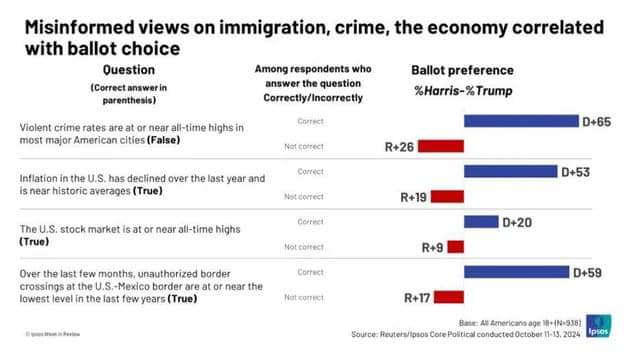
Or, likewise, suppose these were questions like "Inflation was been much worse under the current administration than the last," I bet most of the Republicans would get it right, whether or not they had familiarity with the data.

@ZachWeinersmith

I think you're right, to some extent. But these questions are a little more concrete than something like, "is the economy better or worse than four years ago?" These questions are about information, not vibes.

I think it's also important that some of these are claims that the GOP has been lying about. Not just saying, "we'll makes streets safer" but claiming that crime is at an all time high and that the Dems (who are in power) will crash the markets.

@ZachWeinersmith This data presentation conflates two issues -- (1) was the most recent election won based on misinformation, and (2) are Republicans more detached from reality than Democrats.

(1) It would be useful to have percentages of the electorate that got each question correct/incorrect, and not have to infer from outcome.

(2) You are right, this is a one-sided view that does not answer the question. But the answer is yes, extremely. Here is one look at that: https://www.briefingbook.info/p/asymmetric-amplification-and-the?publication_id=1002034&post_id=138749341

Asymmetric amplification and the consumer sentiment gap

How excess Republican partisanship contributes to the gap between economic fundamentals and consumer views on the economy

Briefing Book
@ZachWeinersmith IDK, people still think urban crime is still exactly at 1960s-1980s levels, which hasn't been true in over 30 years.
@ZachWeinersmith That hypothesis is easy enough to test.
@ZachWeinersmith Yeah I definitely don't think this data is super useful tbh. I think most Americans are genuinely too busy/disinterested in politics to keep up with specific statistics about the economy or other issues, and on both sides (both informed and misinformed) the majority of the respondents likely just answered with the view that most correlates with their current experience (especially for the economy questions). It seems like a fairly easy guess to say that the people who voted democrat lean towards those who are doing well/better today than under trump 4 years ago, and as such would tend to answer the questions about the economy positively, since that fits with what they're experiencing. And vice versa it seems like those who are struggling right now would answer the questions about the economy in a negative way, and would also lean towards voting for the party that isn't currently in power (or those that are struggling and would vote democrat were less likely to show up).

@ZachWeinersmith I do wonder what the results would have been if they included a question about food insecurity, since that *has* risen over the past few years since covid-era SNAP benefits were rolled back. I imagine that republican voters would likely appear more informed on that vote, and democrat voters less informed, simply by virtue of the answer lining up with their experiences.

Edit: Oh you basically mentioned this exact idea with the inflation thing in your reply lol, missed that.

@ZachWeinersmith I'm reminded of this article from 538 a couple years ago. 2020 there is a partisan flip, however in 2016, only one party had an immediate flip when the administration changed. I think 2020 is difficult to assess given there was a pandemic and once things calmed down with that, people were feeling much more optimistic, but it could still very well be that these questions are becoming reactionary for both parties as you suggest. https://fivethirtyeight.com/features/republicans-pessimistic-views-on-the-economy-have-little-to-do-with-the-economy
Republicans’ Pessimistic Views On The Economy Have Little To Do With The Economy

In 2016, the media extensively covered Trump supporters’ “economic anxiety.” Will this misperception continue in the lead-up to 2024?

FiveThirtyEight
@ZachWeinersmith I should add that this is a pretty narrow slice and the overall trend across more elections could show that it really is much more partisan than this single graph would suggest, as well as recognizing my own bias towards the Democratic party as I say all this
@ZachWeinersmith I mean, no? It's not like democrats are now going to be the ones to be more likely to believe that global warming or school shootings are a hoax. You don't suddenly become the ignorant idiot party when you're out of power.
@ZachWeinersmith yeah, a basic rule in surveying is: if your question could make the respondent change their vote, you need a better question. I don't think any of these pass that test
@ZachWeinersmith You mean Democrats will develop *delusional* views on the criminality of Trump and his entourage/backers/handlers?

@ZachWeinersmith when nigh all social media is owned by sociopaths, people will remain not only ignorant but misinformed.

It's Italy under Mussolini, Spain under Franco, Germany under Hitler all over again.

@ZachWeinersmith (FYI this goes through 11/8/24, the label ending in October is just a spacing issue)