To find dragons, search in deep, dark caves 🐉

Was looking through the Comet 67P/Churyumov-Gerasimenko image archives ahead of the tenth anniversary of the landing Philae probe landing on 12 November ☄️🛰️

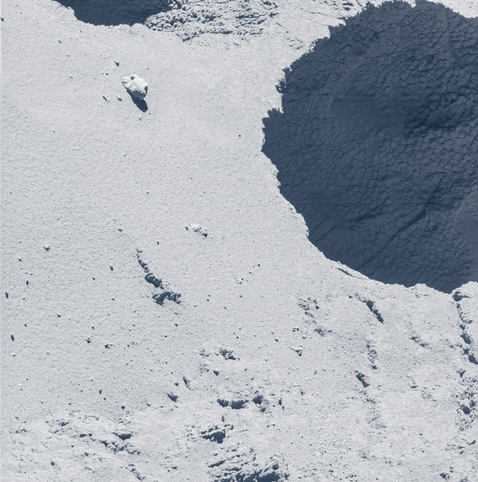
Discovered this nice wide & narrow-angle pair from 22 May 2016 from 6.3km, centred on the 220m wide, 185m deep Seth_01 pit 📷

Zoom in, crank up the brightness, & look at that lovely scaly texture 🐲🙂👍

Credit: ESA, Rosetta, MPS for OSIRIS team, Mark McCaughrean

1/

#RosettaLegacy
#SpaceScience

There are many such pits on the surface of Comet 67P/C-G, but they're not due to external impacts.

Rather, they're akin to sinkholes, where volatile material inside the comet, close to the dusty surface is heated & escapes into space, leaving a large void underneath which can then collapse.

https://sci.esa.int/web/rosetta/-/56121-comet-pit-formation

2/

ESA Science & Technology - Comet pit formation

Comet pit formation

The pits were found to be active, with jets of material coming out of them.

https://www.esa.int/Science_Exploration/Space_Science/Rosetta/Comet_sinkholes_generate_jets

3/

Comet sinkholes generate jets

A number of the dust jets emerging from Rosetta’s comet can be traced back to active pits that were likely formed by a sudden collapse of the surface. These ‘sinkholes’ are providing a glimpse at the chaotic and diverse interior of the comet.

And the interiors of some of the pits were seen to have a peculiar semi-regular texture, with lumps & bumps about 3 metres in size.

Similar structures were found in exposed locations elsewhere on the comet & were christened "goosebumps".

The theory was that these were perhaps the characteristic-sized primordial lumps of material that agglomerated to form the comet in the first place, billions of years ago.

https://sci.esa.int/web/rosetta/-/55305-comet-goosebumps

https://sci.esa.int/web/rosetta/-/55295-getting-to-know-rosetta-s-comet

4/

ESA Science & Technology - Comet goosebumps

Comet goosebumps

However, later work looking at the wider array of structures & fractures on the network emphasised the importance of thermal processing on material with water in it, as Comet 67P/C-G has plenty of.

In this model, a kind of freeze-thaw [edit: badly worded: a thermal expansion & contraction of a solid – no liquid phase] cycle takes place, causing material to crack & fracture on characteristic length scales.

Similar structures are well-known on Earth & Mars.

https://agupubs.onlinelibrary.wiley.com/doi/full/10.1002/2015GL064500

5/

Work was done by Atree et al. a couple of years after the Rosetta mission ended on figuring out how this thermal fracturing process would work in detail on comets like 67P/C-G.

https://www.aanda.org/articles/aa/full_html/2018/02/aa31937-17/aa31937-17.html

6/

And a full observational paper was written around the same time by Auger et al., titled:

"Meter-scale thermal contraction crack polygons on the nucleus of comet 67P/Churyumov-Gerasimenko"

https://www.sciencedirect.com/science/article/abs/pii/S0019103516300410

Unfortunately this is behind a paywall at Icarus (boo!), so you likely won't be able to read it, although you can get an impression of the graphics here:

https://ui.adsabs.harvard.edu/abs/2018Icar..301..173A/graphics

7/

Meter-scale thermal contraction crack polygons on the nucleus of comet 67P/Churyumov-Gerasimenko

We report on the detection and characterization of more than 6300 polygons on the surface of the nucleus of comet 67P/Churyumov-Gerasimenko, using ima…

So, once a sinkhole forms on a comet, like this one in the Seth region near the neck between the two lobes, the exposed interior material gets processed by sunlight & forms this characteristic scale "crazy paving".

Later, like the rest of the comet, it gets covered in dust as material is lifted off the comet, the gases escape, & some of the dust falls back down.

This cycle repeats each time the comet gets near the sun, changing the colour of the surface.

https://www.esa.int/Science_Exploration/Space_Science/Rosetta/The_colour-changing_comet

8/

The colour-changing comet

Rosetta’s comet has been seen changing colour and brightness in front of the ESA orbiter’s eyes, as the Sun’s heat strips away the older surface to reveal fresher material.

The Filacchione et al. paper on the way that Comet 67P/C-G changes its colour during its orbit & periodic journeys into the inner solar system can be found here, but is also paywalled, unfortunately:

https://www.nature.com/articles/s41586-020-1960-2

9/

An orbital water-ice cycle on comet 67P from colour changes - Nature

Spectral analysis of the VIRTIS dataset shows two opposite seasonal colour cycles in the coma and on the surface of comet 67P/Churyumov–Gerasimenko, indicating an orbital water-ice cycle.

Nature

Back to the pits & the dragon scales or "thermal contraction polygons", I'm not aware of an image which shows them quite as clearly as the one at the end of that movie sequence.

It was taken by the OSIRIS narrow-angle camera at just 6.3km distance, resulting in a resolution of about 12 centimetres per pixel, giving a nice view of the 3 metre-sized scales.

For reference, the original image name is:
N20160522T221253020ID4FF22

& the wide-field one is:
W20160522T221252757ID4FF12

10/

These & other Rosetta OSIRIS images can be downloaded in full-resolution & dynamic range (the latter being particularly important in this case, to see inside the 185m deep Seth pit) either from the OSIRIS gallery or ESA's Planetary Science Archive:

https://rosetta-osiris.eu
https://psa.esa.int

There are doubtless other treasures still to be found in there, but just be careful not to wake any sleeping dragons 🐉😬✌️

11/

And thanks to both Nick Thomas & Ramy El-Maarry, both heavily involved in Rosetta science & with many other planetary missions, for taking a look at this movie yesterday & sending kind comments.

I mean, just because I hadn't seen 67P/C-G dragon-scale images this good before didn't mean that they weren't out there in the literature, but it appears that this is among the best yet found.

Mark that as a win for the curious & dynamic-range-hungry astronomer 🙂👍

12/12