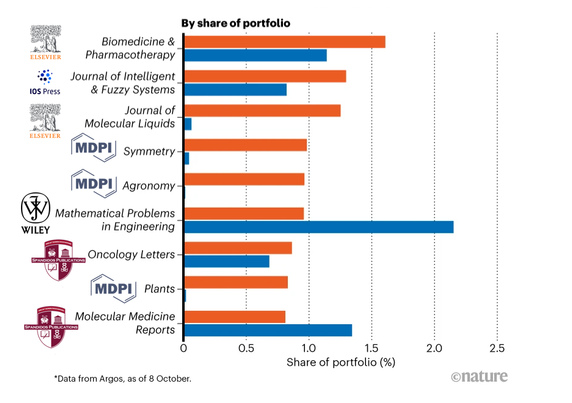
how did a (Springer) Nature Publishing Group journal become the worst journal around?

And do we see here some effidence of bias among researchers about quality?

Interesting data summarozed here by @richvn: https://www.nature.com/articles/d41586-024-03427-w

#publishing #quality #ethos

Journals with high rates of suspicious papers flagged by science-integrity start-up

Scitility’s tool Argos identifies work whose authors have a record of misconduct.

@egonw @richvn Springer Nature are 'leading' by volume, and Elsevier are 'leading' by share of portfolio. LOL

(I annotated one of the figures just to make this clearer)

I think it is significant that all of them in this graph are journals from for-profit publishers.

@egonw @richvn Sad to see Symmetry in there.

Let us not forget that individual papers within these journals can still be brilliant, highly citable, highly cited works e.g.

Klingenberg, C.P. Analyzing Fluctuating Asymmetry with Geometric Morphometrics: Concepts, Methods, and Applications. Symmetry 2015, 7, 843-934. https://doi.org/10.3390/sym7020843 (over 450 citations according to Google Scholar)

Analyzing Fluctuating Asymmetry with Geometric Morphometrics: Concepts, Methods, and Applications

Approximately two decades after the first pioneering analyses, the study of shape asymmetry with the methods of geometric morphometrics has matured and is a burgeoning field. New technology for data collection and new methods and software for analysis are widely available and have led to numerous applications in plants and animals, including humans. This review summarizes the concepts and morphometric methods for studying asymmetry of shape and size. After a summary of mathematical and biological concepts of symmetry and asymmetry, a section follows that explains the methods of geometric morphometrics and how they can be used to analyze asymmetry of biological structures. Geometric morphometric analyses not only tell how much asymmetry there is, but also provide information about the patterns of covariation in the structure under study. Such patterns of covariation in fluctuating asymmetry can provide valuable insight about the developmental basis of morphological integration, and have become important tools for evolutionary developmental biology. The genetic basis of fluctuating asymmetry has been studied from empirical and theoretical viewpoints, but serious challenges remain in this area. There are many promising areas for further research that are only little explored at present.

MDPI
@rmounce @richvn indeed! they are just average numbers, exactly like the journal impact factor

@rmounce @richvn BTW, also note the quote from the company of the Argos tool: "but Scitility aims to sell a version of the tool to big publishers and institutions, who could plug it directly into their manuscript-screening workflows."

I think the lack of human attention to quality and automated screening may actually have gotten us into this situation, and I fail to see so far how more automatic screening will actually solve the created problem

@rmounce @richvn finally, I think it's a missed opportunity to mention @OpenAlex which makes much of some of this data available without an account under an open license

That Scholia/Wikidata/Synia is not mentioned that also provides free and open and FAIR access to this data too, I can understand. #Wikidata only covers ~20k articles of the ~50k retracted articles. Even if it gives more context than OpenAlex.

@egonw @rmounce Yes sorry @OpenAlex in retrospect I should have mentioned you as another of the open data sources involved. (To be clear though, the idea of scoring for risk depends not on OpenAlex but on Retraction Watch and Cabanac's Feet of Clay).
@richvn for future reference, and with the note that #Wikidata will likely not contain all retracted articles, this page gives an overview of what Wikidata knows about retractions: https://synia.toolforge.org/#retraction (Synia is a new~ish UX around Wikidata by @fnielsen from DTU/DK)
Synia

@egonw @rmounce Idea is that such tools announce their findings to editors (not that it's an automated decision based on what the tool shows).