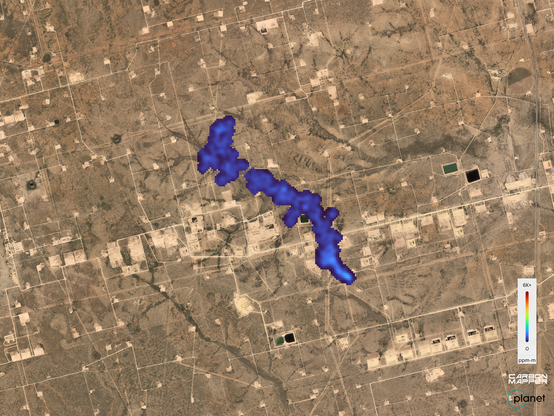
"MethaneSat’s instrument has a resolution of about 140 metres, compared with Sentinel 5P’s of about six kilometres (3.7 miles), enabling it to monitor the smaller #leaks that combine to make a large part of the total.

#MethaneSat could also be used in the future to track #methane from coalmines, landfills and farming, which are the other main sources of human-caused emissions."


https://www.theguardian.com/environment/2024/mar/04/satellite-to-name-and-shame-worst-oil-and-gas-methane-polluters

Satellite to ‘name and shame’ worst oil and gas methane polluters

Leaks are driving 30% of the climate crisis and MethaneSat will provide the first near-comprehensive global view

The Guardian

"Once in operation, the spacecraft will scan about 50,000 square miles (130,000 square kilometers) of Earth’s surface per day. #CarbonMapper scientists will analyze data from Tanager-1 to identify gas plumes with the unique spectral signatures of #methane and #CarbonDioxide — and pinpoint their sources. Plume data will be publicly available online at the Carbon Mapper data portal."

https://scitechdaily.com/nasa-launches-super-emitter-spy-tanager-1-to-track-down-climate-culprits/
#Tanager1

NASA Launches Super-Emitter Spy: Tanager-1 To Track Down Climate Culprits

Tanager-1, a satellite equipped with advanced NASA technology, has been launched to monitor methane and carbon dioxide emissions globally. Developed by the Carbon Mapper Coalition, this mission aims to detect and quantify emission sources with high accuracy, contributing significantly to climate

SciTechDaily

No more secret greenhouse gas emissions:

First Greenhouse Gas Plumes Detected With #NASA-Designed Instrument

"The nonprofit #CarbonMapper has released the first #methane and carbon dioxide detections from the #Tanager1 satellite. The detections highlight methane plumes in Pakistan and Texas, as well as a carbon dioxide plume in South Africa."

https://www.jpl.nasa.gov/news/first-greenhouse-gas-plumes-detected-with-nasa-designed-instrument/

First Greenhouse Gas Plumes Detected With NASA-Designed Instrument

The imaging spectrometer aboard the Carbon Mapper Coalition’s Tanager-1 satellite identified methane and carbon dioxide plumes in the United States and internationally.

NASA Jet Propulsion Laboratory (JPL)

"The study also identified potential *persistent* #methane #emissions related to human activity."
They include:

- oil and gas fields on the west coast of Turkmenistan;
- the Permian Basin, which is America's highest producing oil field, spanning the border between Texas and New Mexico;
- three coal fields in Shanxi province in China, as well as Kuznetsk, one of the largest coal mining areas in Russia.

https://phys.org/news/2025-02-satellite-analysis-uncovers-persistent-methane.html

Satellite data analysis uncovers top 10 persistent methane sources

A list of the top 10 global regions where natural or anthropogenic sources emit methane on a continuous, "persistent" basis was recently published in Atmospheric Chemistry and Physics.

@saskboy

Thank you for this link!
Wow, Texas.
Wow, Pennsylvania.

@CelloMomOnCars North Dakota will be a major offender, as will Saskatchewan, when they get around to it.