
US states sue TikTok, claiming its addictive features harm youth mental health

https://www.theguardian.com/technology/2024/oct/08/us-states-tiktok-lawsuit-mental-health

On closer inspection, this case misuses neuroscience so severely that it seems like it could potentially make it illegal in the US for young people to have fun.

Seriously

/1
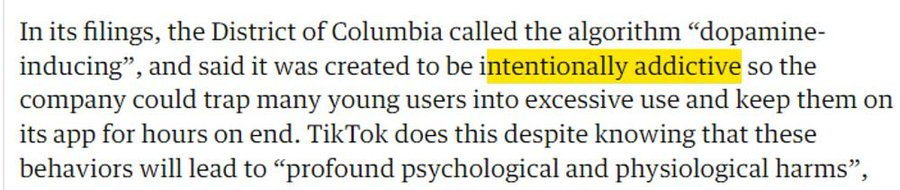
US states sue TikTok, claiming its addictive features harm youth mental health

Lawsuits allege platform’s ‘dopamine-inducing’ algorithm can lead to anxiety, depression and body dysmorphia

The Guardian

There are so many neuropsychological flaws in this case

E.g. filings state TikTok is designed to be "intentionally addictive". The conclusion here is that TikTok, a software construct, causes addiction.

Many would agree that this is valid. But, do you know who *doesn't* think it's valid?

THE AMERCIAN PSYCHIATRIC ASSOCIATION!

/2

The American Psychiatric Association (APA) produces the DSM (Diagnostic and Statistical Manual of Mental Disorders), a core text which lists all the mental disorders, and their diagnostic criteria, acknowledged by the APA.

Various forms of addictions are in there. But 'TikTok addiction' is not.

/3

You may disagree. You may think the DSM/APA are too restrictive/narrow/biased/etc. And you may be 100% correct to think this. That's a very salient arument.

But even so, in the here and now, the point remains that US states are suing TikTok, in US courts, on the grounds that it causes an addictive disorder, one that, according to the US medical system, doesn't exist

/4

I'm no sort of legal professional, let alone a relevant American one, but I can't help but assume that this is a tricky conclusion to sell to anyone.

/5

There's also the a basic parroting of the usual 'TikTok [or insert SM app of choice] is seriously bad for young people's mental health!' claims, despite even the most extensive research finding little to no evidence that this is actually the case.

https://psycnet.apa.org/record/2025-31872-001

Yes, many 'concerned parents' passionately believe this to be true. But you'd *hope* that STATE LEVEL LEGAL CASES would require a higher threshold of evidence than 'loads of people say so!'

/6

And for the inevitable replies:

YES, I have read Jonathan Haidt's Anxious Generation

YES, he's done much research. But so have I, and countless professional researchers. We all think he's wrong.

NO, he doesn't 'make some good points'. He says what you assume is true. That's a very different thing. 'Validating your feelings' is not the same as 'accuracy'.

It is, however, the same as 'massive book sales', depressingly.

/7

But here's the thing; all these complaints are peripheral. The real problem with the case against TikTok is:

Assuming reporting is accurate, a key factor of the complaint is that TikTok 'induces dopamine' in young people. And that is seemingly bad enough to warrant suing

/8

So, piecing together the available info presented in the news reports, the case against TikTok is apparently:

- TikTok induces dopamine in the brains of young people

- Dopamine is involved in pleasure, reward, and *addiction*

- Ergo, 'inducing dopamine' is damaging, legal penalties should apply.

Me:

/9

Pains me to say this, but let's *leave aside* the fact that dopamine does SOO much more than just 'trigger pleasure'.

And here's a Psyche article (that I also wrote) about how complex the pleasure response is in any case, if interested

https://psyche.co/ideas/the-fascinating-science-of-pleasure-goes-way-beyond-dopamine

/10

The fascinating science of pleasure goes way beyond dopamine | Psyche Ideas

Pleasure and happiness are too important for our mental health to be reduced to the single brain chemical dopamine

Psyche

Ultimately, this legal case against TikTok, if successful, could set the precedent that you can be sued for 'inducing dopamine' in the brain of a young person.

That has *horrifying* ramifications. Ones that'd make Orwell's worst fever dreams seem like a mild inconvenience

/11

Because once you make 'inducing dopamine' (in context of the pleasure/reward response) a legally punishable act, logically anything else that does it is similarly liable.

And what 'induces dopamine' in the brains of young people, and is thus legally liable?

Well...

/12

- Any other social media used by young people (not just China-owned ones)

- Any game they enjoy (video, or otherwise)

- All popular films/TV/comics/books/media

- Any food they enjoy

- The very concept of friends or meaningful relationships

Basically, ANYTHING enjoyable

/13

To finally get to the point:

If the US states suing TikTok for 'inducing dopamine' succeed, they are technically setting the precedent that doing/saying/creating anything that young people enjoy can get you sued

All to 'protect young people's wellbeing'.

Ironic

/14

For the record: I don't expect this to actually *happen*. How would you even tangibly demonstrate that something a young person experiences leads to a direct corresponding inducing of dopamine?

But that a major lawsuit includes this stuff at all reveals how bad things are

/15

Because this isn't some ranting angry parent Facebook. This is the legal top brass of some of the most powerful US states, taking on a massive global tech platform.

And even *they* are treating the usual "PHONES IS BAD! PROTECT THE KIDS!" paranoia as established fact.

/16

They say "A little knowledge goes a long way".

But here, the small nugget of neuroscientific info 'Dopamine is involved in the pleasure response' has gone all the way to anchoring 'Legal case that could outlaw fun for young people'.

It's a damning indictment of the discourse, and the apparent disregard people, even those in VERY prominent and powerful roles, have for the very concept of questioning whether their assumptions about brain stuff (and beyond) are actually correct.

/17

FWIW, if you prefer an audio-visual explanation of these same points, I recorded a video and put it on TikTok, for added irony

https://tiktok.com/@deanexplainsbrain/video/7424923282475863328

NB: I'm not saying TikTok is 100% safe and cool by any means. It has many problems and concerns. But this legal case is very much the greater of two evils, in this particular instance.

/18

TikTok - Make Your Day

And, as ever:

For a more evidence-based explanation of how phones/social media/tech affect us, one that's suitable for parents and young people, check out my new book:

Why Your Parents Are Hung-Up on Your Phone and What To Do About It

http://amzn.eu/d/dwdr8Kz

NB: No mention of dopamine!

/end

Amazon.co.uk

@Garwboy when do kids get the right to sue their state law offices and representatives for wringing their lives and fun away from them?
@Garwboy I mean, they also say "a little knowledge is a dangerous thing". Which seems more appropriate here! Idiots
@Garwboy So, if well-being induces dopamine, couldn‘t you sue the lawmakers?
@valkenberg @Garwboy The motivation to sue requires dopamine and is thus illegal.