Half of all science publishers quit within 10 years. Women quit more than men. Bunch of quitters!

https://www.nature.com/articles/d41586-024-03222-7

🤔Quit? Or were driven out?

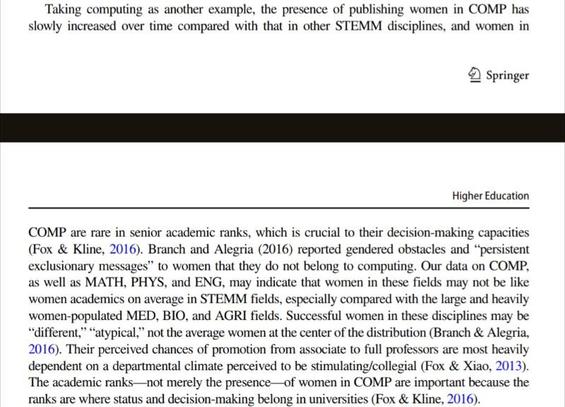
My favorite* part is that women in CompSci, Engineering, Math, and Physics, are less likely to stop publishing than women in less sexist academic fields. Possibly because we run young girls in Math/CS/Eng/Physics through a sexism gauntlet from day 1, so by the time they're grown women the survivors cope with gendered hostility better.😮

(*Least)

Nearly 50% of researchers quit science within a decade, huge study reveals

Twenty years of publishing data across many countries and disciplines show women are more likely than men to leave research.

@mekkaokereke I think there's a lot of extrapolation going on, lots of students publish and then move to industry post graduation, where they won't publish ?

@ColmDonoghue I personally have seen far too many cases where students might want to stay in research positions or go into teaching; but have to take higher-paying industry jobs because they need to pay down student loans.

One student took a job with McKinsey - knowing just how evil that company has been - because they needed the money.

They quit as soon as they could afford to.

This operates at the same time as systemic sexism & racism in academia, as @mekkaokereke rightly pointed out.

@michael_w_busch @mekkaokereke in Europe? Where these data are from? Where tuition is of the order of a grand a year?

@ColmDonoghue @mekkaokereke These data are not just from Europe.

Kwiek & Szymula 2024 considers all 38 OECD countries: https://link.springer.com/article/10.1007/s10734-024-01284-0

Covering the United States, Canada, Mexico, Australia, Japan, South Korea, and a few other countries as well as the EU.

The supplementary material details how the USA has the second-highest overall rate of people leaving their cohort out of those 38; with a higher than average difference between men and women.

Quantifying attrition in science: a cohort-based, longitudinal study of scientists in 38 OECD countries - Higher Education

In this paper, we explore how members of the scientific community leave academic science and how attrition (defined as ceasing to publish) differs across genders, academic disciplines, and over time. Our approach is cohort-based and longitudinal: We track individual male and female scientists over time and quantify the phenomenon traditionally referred to as “leaving science.” Using publication metadata from Scopus—a global bibliometric database of publications and citations—we follow the details of the publishing careers of scientists from 38 OECD countries who started publishing in 2000 (N = 142,776) and 2010 (N = 232,843). Our study is restricted to 16 STEMM disciplines (science, technology, engineering, mathematics, and medicine), and we track the individual scholarly output of the two cohorts until 2022. We use survival analysis to compare attrition of men and women scientists. With more women in science and more women within cohorts, attrition is becoming ever less gendered. In addition to the combined aggregated changes at the level of all STEMM disciplines, widely nuanced changes were found to occur at the discipline level and over time. Attrition in science means different things for men versus women depending on the discipline; moreover, it means different things for scientists from different cohorts entering the scientific workforce. Finally, global bibliometric datasets were tested in the current study, opening new opportunities to explore gender and disciplinary differences in attrition.

SpringerLink

@michael_w_busch @ColmDonoghue @mekkaokereke

...why am I not surprised that Germany ranks worst in Europe?

Maybe it's because the state education ministries have "maintaining a decent churn rate" among junior academics as an explicit policy goal. #IchBinHanna

@michael_w_busch @ColmDonoghue @mekkaokereke my senior was really interested in majoring in physics in college. He wanted to be a researcher- until he looked at the potential salaries.

@urbanfoxe @ColmDonoghue @mekkaokereke Researcher salaries for physics majors are often quite high, but not necessarily for research in physics.

Unless one is willing to work on weapons projects; which I as a physics major was not but which some of my classmates in undergrad were - or were pressured into for financial reasons.