#DogWalkingGeology a superb example of a retrogressive reaction front from this morning's walk with Spud at Uisken. To the top+right is garnet amphibolite preserving clean high temperature (about 650-700 oC) metamorphic minerals. The paler green grey rock at bottom+left has formed by later hydration of the amphibolilte at 350-400 oC. The boundary between fresh high grade rock + completely altered low-grade rock is sharp over a distance of a few cm. #Geology #Metamorphism #Retrogression #Mull
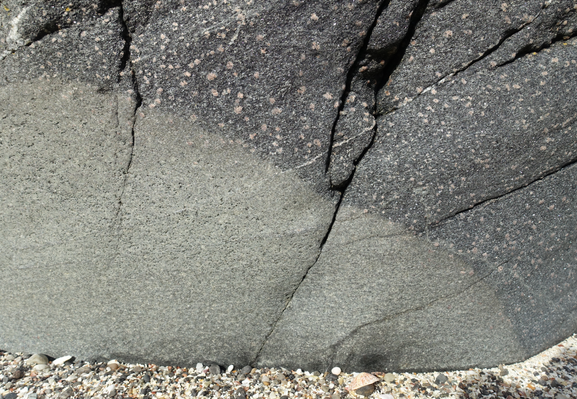
... (contd) πŸ€“ Techincal details for those interested: The high grade assemblage is middle-upper amphibolite facies The garnets grew about 450 million years ago during the Caledonian Orogeny. The greenschist-facies retrogressed assemblage is undated, but probably late-Caledonian.πŸ€“
@FaithfullJohn That is very nice. Are relict textures of the high grade facies visible in the retrograde facies; perhaps kelyphitic rims on garnets in the transition zone?
@geomannie not sure. There are plag decompression rims on garnets in many of the Mull amphibolites. But they're mostly quite coarse and simple rather than kelyphitic or symplectic. But these rocks here are different: I don't think anybody has ever recorded them, or done any detailed examination.
@FaithfullJohn Wow! I hesitate to suggest taking a saw to the outcrop, but I'd love to see some thin sections spanning the retrograde hydration front.
@silicatefondue it's amazing how homogeneous, pervasive and even the replacement is, especially as the amphibolite is a very crystalline, low-porosity/permeability rock. I think it could be nicely and unobtrusively sampled by hammer on less beautiful outcrops nearby..
@silicatefondue @FaithfullJohn Love to see some polished sections and thin sections of you do!