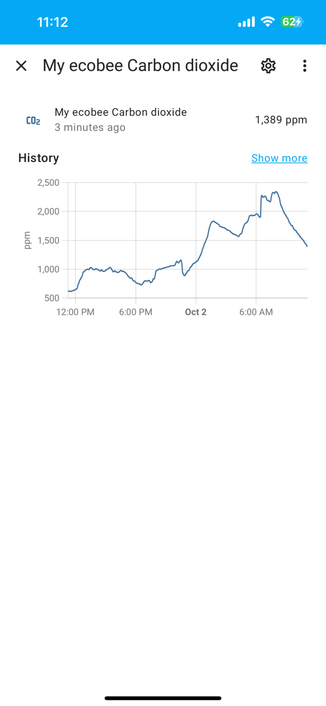

I put an air quality meter in the house yesterday since my son was diagnosed with asthma over the weekend. I've never had one before but does anyone know is this normal for co2 level in a home?? #homeassistant
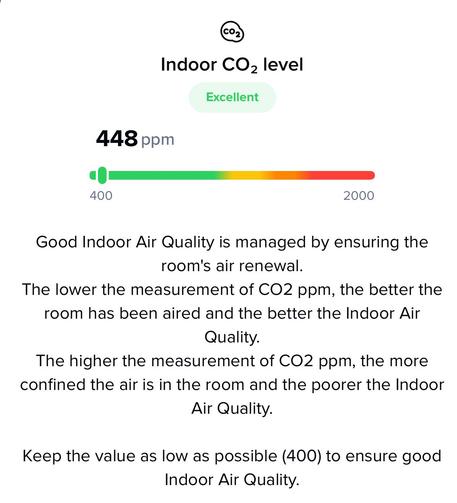
@bacon under 1000 ppm good, under 1500ppm acceptable,
Above open the windows to get rid of the co2
@ErikBussink that's what I've read too. I'm not sure what's causing it to rise like that though.
@bacon Closed windows, people sleeping & pets & plants

@bacon Hell NO! Around 400ppm is "an empty room" in the countryside, maybe 900 if you live in a metropole. Can you find out what's your "official" PPM outside, from a weather service? 1900 could still be plausible for you (OSHA says outdoor-value+1000 is okay), but I hardly reach 1000 with guests in the house.

Edit: looking at the full chart: someone sleeping in a small badly ventilated room?

@fm_volker the device is sitting in our family room which makes me wonder what's happening in the bedrooms at night if it's that high when the rooms empty.

@bacon @fm_volker I have the same issue. The level doesn’t fall readily because there’s very little air exchange with outside. I plan to get an energy recovery ventilator, because our house is sealed fairly well and it’s rarely good enough weather to open a window here. If I want to, I open windows on one side of the house and turn on the kitchen exhaust fan and the co2 will drop to 800 or so in a few hours. It comes right back up once the windows are closed.

Atmospheric CO2 is around 427 ppm these days.

I just uploaded a graph of my CO2 sensor in the hallway between bedrooms and the kitchen/living room. It moves around a bit, and it is heavily influenced by people in the house and on the same floor. This got me to start running my HVAC fan at night as we sleep with doors closed with humidifiers on. My house was built in 1980 and is by no means "sealed up tight". We have no mechanical ventilation other than a single bathroom fan that rarely runs. I think the CO2 data is better for identifying trends and getting an idea of how much ventilation can help, but it is by no means cause for alarm. Collect more data...