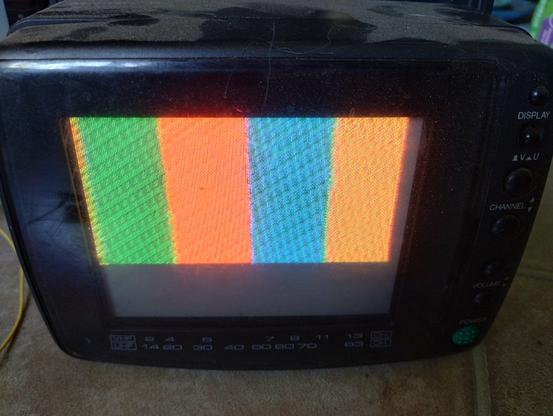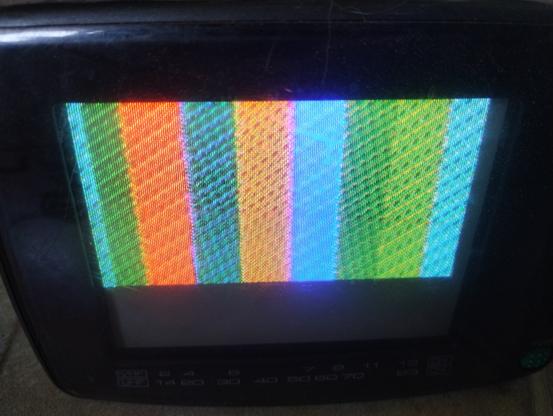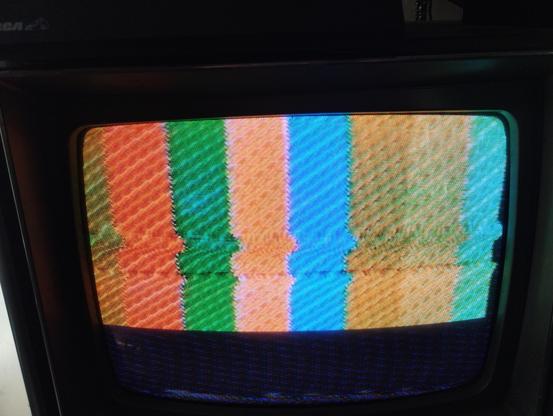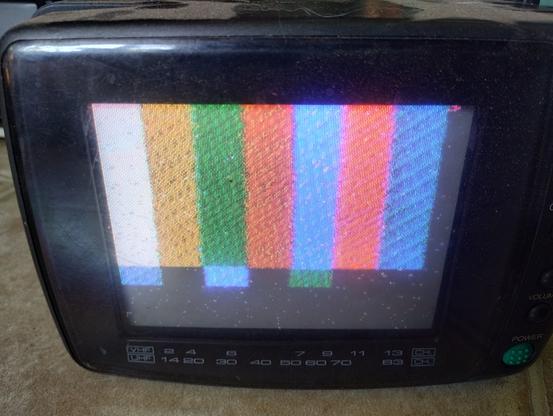
Since there are no more analog TV stations on the air in this country, I have no way of testing sets I find it thrift stores anymore.

So, I finally decided to try the code that Charles Lohr developed for tricking an ESP8266 into transmitting analog TV signals over the air with its RX pin.

This is actually someone else's version of his code because he wrote his code to be compiled in the esp8266 SDK environment and I don't know how to use that. This code compiles in the Arduino IDE and it does work!

This is being transmitted over the air. This is not a composite video signal.

I need to see if I can learn how to use the SDK so that I can see the really nice demos that Charles wrote on a TV.

If I get all this working where I want, I think I will package the esp8266 in a little housing with a battery, and on off switch and an antenna so I can easily take it with me to a store

GitHub - cnlohr/channel3: ESP8266 Analog Broadcast Television Interface

ESP8266 Analog Broadcast Television Interface. Contribute to cnlohr/channel3 development by creating an account on GitHub.

GitHub
First stabs at making this library do something on my own
More colors, but the code is bogging down the esp
Yay colors!
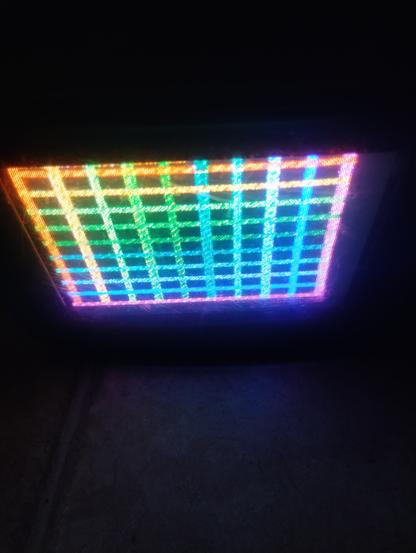
Here's most of the color pallet rendered on two different TV sets
Working on color bars here
Bicolor bouncing balls
This is so much fun to play around with
I think I'll write one more little demo and stuff this inside an enclosure with a battery and an antenna
That horizontal bar across the top isn't supposed to be there. It might just be a bug in the library, but the rest looks the way it should

@MLE_online Your portable Hypnotoad broadcaster is coming along nicely.

Artwork by https://www.deviantart.com/genghisdani/art/Hypnotoad-351437537

Hypnotoad by genghisdani on DeviantArt

@MLE_online Can it do audio as well?
@foundthefault No, it can't. I saw someone asking the author of the code about that, and he said that generating the video demands so much of the processor that there's nothing left to do audio with
@MLE_online Whomp, I guess there will be no chiptunes with your piracy then.
@MLE_online Emily, you continue to amaze me with all the things you do. I love following your account.
@MLE_online need more video! They don't hit the corner!!
@MLE_online Imagining an alternate history where the DVD player had two bouncing logos and they changed colors when they hit each other instead of the corner.
@foundthefault they should explode and make a bunch of tiny DVD logos
@MLE_online That’s so awesome. I would not have guessed generating that signal “by hand” would be possible.
@MLE_online me seeing just this picture "huh that seems like the colour bars from the esp8266"
@xssfox what?
@MLE_online i just remember my colour bars looking near identical when i was testing it out
@xssfox ok, you were also playing with this
@MLE_online yeah, didn't really do much with it but was fun
@MLE_online
I'm really impressed with this project. That it works at all is amazing. I started to ask what the actual video hardware capability on your device is, and then I went, "duh!"
@MLE_online Let me know if you need anything! I'm most easily available on Discord at @cnlohr - and there's a discord server of people who know about this.
@MLE_online wait, they made orange phosphor black and white TVs?
@slyka lol, no. It's a color TV. The box is red, but the color renders poorly on my phone
@MLE_online ohh, that makes a lot more sense. I do kinda want a an amber phosphor TV now though…
@slyka I have one half built. I just need to finish it ...

@MLE_online

Ok, this is rad. Imagine if we got analog tv working again as an alternative to corporate broadcasting! Pirate Radio, but with TV instead of music!

I totally want to start a pirate TV station now. We could have movie nights and who would stop us?

@MLE_online oooooh thank you!!! I wanna play with this too
@vxo @MLE_online now I just need to draw a network 23 logo and my bucket list will be complete

@MLE_online I think it is a clever hack, but you know you can take one of those video->TV gizmos that select channel 2 or 3, and feed the "RF" out into a simple transistor amplifier. That will broadcast on the selected channel if you just connect it to a wire.

Also a number of cheap FPV drone cameras just broadcast on the TV frequencies at a different frequency than "real" TV. A mixer will fix that :-).

@ChuckMcManis yea, but that's more complicated and I still need a video source, so that's two things I have to carry around and power. This is just one
@MLE_online That's a good point. Back before "ez" wireless connectivity became the norm we were always trying to get a view from our robots so we had these small cameras that generated composite video.
@MLE_online what code editor/environment do you use for your Arduino stuff?
@grtyvr The arduino IDE
@MLE_online I like PlatformIO with VS Code. Huge supported boards library and can do both Arduino framework as well as ESP framework.
@grtyvr I installed it a while back and I had no idea how to use it. It was felt very unintuitive to me
@MLE_online it takes some time to learn. Like any tool. But it is sooooo much more capable than the Arduino IDE. Syntax highlighting, link to where functions are defined, easier to deal with multiple file projects, multiple build targets for the same code... It is worth the time spent to learn it.
@grtyvr It was just so confusing. I didn't even understand how to get started with it. Maybe I need to watch more tutorials
@MLE_online It is confusing. Part of the problem is a lot of the PlatformIO stuff is configured via files, and not via a GUI. I read a few tutorials to get started. Now I do my Python coding in VS Code as well as some Jupyter notebook editing. VS Code is a great tool. PlatformIO is also a great tool to manage multiple dev boards and frameworks with. The integration between them is tight and it makes for a good dev experience imo.

@MLE_online
I am fascinated by stuff like this.

In 1975 this would have taken a whole room full of equipment and now we can do it with parts that are so cheap that you can literally buy them with found couch money

@mav @MLE_online

In 1975 it was a home computer and an RF modulator built from a kit. So, still not portable but it would at least fit on your desk.

https://en.m.wikipedia.org/wiki/TV_Typewriter

I wonder if there's a way to do something similar with STM32?

TV Typewriter - Wikipedia

@MLE_online Since nobody cares about analog TV signals anymore, that means we can set up ad hoc analog TV stations anywhere we want and do what we want with them, right?

* BRB, getting ready to stream some Minecraft on VHF

@dragfyre in most areas of the CONUS the VHF TV channels aside from 6 are going to be vacant. 6 is an odd case thanks to the ATSC3 DTV+FM "franken-fm but more legit now and written into the standard" oddity. There's one of those here in Sacramento but I haven't viewed or listened yet because it's directional into a part of town I'm rarely in
@MLE_online
@vxo @dragfyre I thought the FCC finally shut the Frankenstations down. The one down here went off the air over a year ago
@MLE_online @dragfyre the original NTSC analog ones are gone but the new ATSC3 ones are here to stay. they're so dang weird. I wonder if the IF bandwidth on bog standard cheap market-dump FM receivers is narrow enough to avoid getting a bunch of hiss from the adjacent digital carrier
@vxo @dragfyre I guess I have no idea what an ATSC3 Frankenstation is
@MLE_online @dragfyre It's bizarre. So, normally an ATSC3 digital signal has a COFDM carrier that's 6 mhz wide. The special case reduces that to 5.5 Mhz with it shifted lower in the channel, leaving 500 Khz free at the top for the FM audio carrier to be run up there.
The description of this on Wikipedia suggests that maybe the licenses for it were a one-time thing? https://en.wikipedia.org/wiki/ATSC_3.0#Analog_audio_fallback
ATSC 3.0 - Wikipedia

@vxo @dragfyre So they are digital tv stations with analog audio?
@MLE_online @dragfyre Yeah! Theoretically, those cool old radios that had TV sound on the VHF channels should work with it too.