 Track_Shovel
Installation
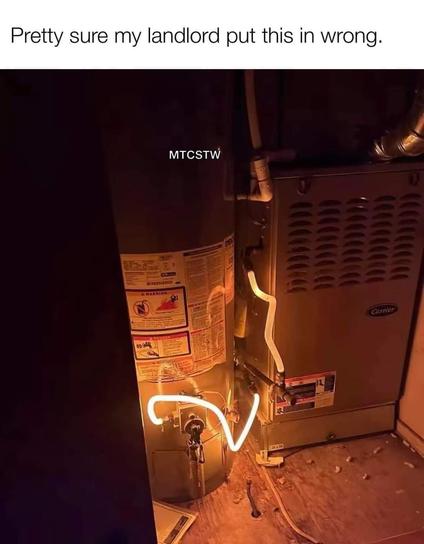
Some part of me believes that water cannot get so hot that it would cause metal to Glow.
I would be happy to be proven wrong.
I mean, unless you're saying that the pipe is heating the water inside of it? Which at that temperature that water would be expanding to over a thousand times its size and would probably blow that line to smithereens.
Steam has no limit to how hot it can get. Until it eventually transitions into plasma of course. By then the oxygen and hydrogen would have separated, I imagine. Then it’s no longer water.
Superheated steam was a problem in some steam locomotives, as running the water level too low would allow the boiler to reach temperatures that would compromise the integrity of the metal.
Only liquid water has the boiling point as a “limit”.
https://physics.stackexchange.com/questions/715701/how-hot-can-steam-be
Apparently 3,000 C might be the limit, but idk.
I don't trust it entirely because it is a stack exchange website, there's not any hard evidence to back up the claim.
The only way that immediately springs to mind is so unlikely to happen. It requires multiple faults/mistakes.
1: The chassis of one of the two units became live (connected to "hot" for you Americans) but was also not grounded in any way.
2: The chassis of the other WAS grounded and created a circuit for the current to flow.
3: There was no RCD (GFCD or whatever you guys call it) on the circuit.
In this way, that pipe would be the only thing connecting the two devices, and the resistance is causing a huge amount of heat (just like an incandescent bulb, or a heating element does by design).
Probably other possibilities, but it's just the first thing I could think of that could potentially produce this result. But, that's a lot of safety features to have either failed or just simply not been in place for this to be possible. So, frankly I hope I'm totally wrong.
I would have thought so, but I think it depends on how thin the skin of the pipe is. I would also have expected a breaker to trip under that much load. But, based on that happening, I'd not be surprised if there are bypasses and/or broken breakers.
When we moved into the house we're in now, the RCD (GFCI) didn't work at all. I pressed test, nothing. Had the electrician over to change it. He tested the actual actuation using earth leakage. Nothing. So, faults can happen too.
I want to be wrong, though. Because that's a pretty bad state to get into, I think.
Normal person reading that: particle accelerator from TEMU
Me: oh god, there are TEMU particles??
This happens when the metrical goes out in a house. Usually the waterlines will handle it, but if the house has pex the ground will go through the gas lines.
Especially if a high voltage line comes down on a gas meter for whatever reason.
Definitely run away and call professional… everyone i guess.
While it looks scary as fuck, wouldn’t it not actually explode unless the gas pipe melted through? There’s no oxygen in the fuel, so it can’t combust. I guess as the gas heats up, it’s also possible the for the tank or lines to spring a leak.
Either way, I’d be nopeing out and calling emergency services.
unless the gas pipe melted through
That looks pretty damn likely imminent to me…
I think you’re right. I was curious, so I looked it up.
The melting point of copper is 1,085°C, and judging from this chart, its definitely getting close:
You ever see gas hookups in the US?
We use black pipe for most of the run. Cast Iron. The actual hookup itself is a flexible pipe…SS or Aluminum I think. Been a long time since I had gas. Sometimes they have like a rubbery-epoxy-ish coating but I assume that’s now quite gone and stinky.
Oh, huh. That’s interesting. I’m from the great white north, and our gas hookups are copper from what I’ve seen. If this is indeed iron, then the melting point would be higher: ~ 1,540°C.
Interestingly that colour temperature chart is supposedly fairly consistent across different metals.
This makes no sense at all.
Why would only these two specific pipes get hot, so hot to glow, but not the other lines connected to it? And not the fittings around it? It’s all copper, so even if the power itself doesn’t heat them up, why would being connected to an extremely hot pipe heat it up. Since it’s you know copper and being good at transferring heat is what it’s known for.
And why would the lower resistance part be the part that get hottest? Low resistance means less loss, so those parts would in fact be the coldest of all.
Plus thin walled copper pipes can’t get so hot they glow without melting or at the very least lose all structural integrity and break.
And a downed power line with a short to ground would almost immediately turn off. It’s when there isn’t a direct line to ground those things are dangerous. As soon as it shorts, it gets turned off at the source to prevent further damage, fire and not cause issues upstream.
Either it’s Photoshop or someone has wrapped led lighting around some pipes.
Both of the lines that are lit up are flexible aluminum couplings. They’re required in some areas as the final connections to the appliances. They’re in line with cast iron gas pipe and fittings. They are much more thin and way better at conducting heat.
Source: former HVAC tech
Thanks for the clarification, pipes look like copper but might be cast iron.
Still doesn’t fit with the explanation, aluminum has more resistance than copper, but not that much more. The resistance of cast iron is an order of magnitude higher than aluminum. So it would still be the lowest resistance in the circuit and thus the coolest part.
And cast iron is pretty good at conducting heat. Not as good as copper or aluminum, but still pretty good. We’ve been using the material to make pans and pots for cooking because of it’s thermal properties. So the heat wouldn’t just stop at the fitting, but continue on at least some ways.
Moreover it’s physically impossible to get aluminum hot enough to glow like this and still keep it’s shape. It melts at 600 degrees C, well below the point where something gets red hot, let alone yellow like this. If the aluminum were to be this hot, it would be in a puddle and at risk of burning.
Sorry, I meant to type higher resistance. On my water heater, the equivalent part that is glowing in the picture is a really thin flexible corrugated gas pipe that surely can carry much much less current than the iron gas pipe feeding it before it went really high resistance. I could totally see it glowing like this with enough current.
My gas pipe to the house comes out of the ground inside a plastic protective pipe sleeve, so I can imagine it possibly not having enough of a low resistance path to earth to trip one of the cutout fuses on the primary distribution line. Granted, mine also has a big ground wire bonding it to the house ground, which I would think would help here…
/shrug I was just sharing what I read. It was supposedly the explanation as to why local breakers on the house didn’t trip.

 𝔻𝔼𝕍𝕀𝕃𝕀𝕊ℍ
 St3alth
 zqwzzle
 MentalEdge
 bizarroland
 r00ty
r00ty Sparky
 gedaliyah
 Catoblepas
 KingJalopy
  Jo Miran
 Anivia
 linearchaos
 I'm back on my BS 🤪