 Matt Massicotte
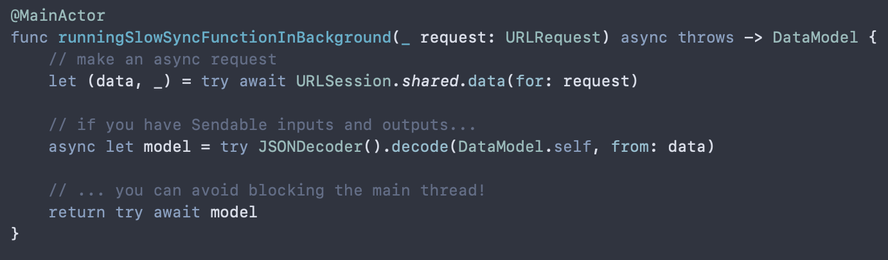
Here's a neat trick with `async let` I didn't realize. You can use it to avoid blocking on synchronous work.
@markmalstrom Hard to say for sure because some details there aren’t finalized yet. But I’m pretty sure yes.
I still find this incredibly verbose though…
@markmalstrom I think I want something more like the example at the bottom of this post.
https://forums.swift.org/t/pitch-inherit-isolation-by-default-for-async-functions/74862/119

I'm genuinely surpised to hear these suggestions, because my experiences have been exactly the opposite. I haven't yet encountered a situation where I've wanted some kind of stateless background type. But I have regularly found places where I have this one tiny bit of synchronous work that can be expensive and can and should be done off-actor. JSONDecoder is a fantastic, real-world example. This is the critical concept. I was just imagining what would happen if we made this change without t...
Does this do what you’re wanting? (It wouldn’t have some of the subtler benefits of child tasks, but otherwise I think just adding ‘Task’ and ‘.value’ to that example makes it work.
let result = try await Task {
// this runs on the global executor
try nonIsolatedExpensiveWork()
}.value
@mattiem @markmalstrom I love the easy readability of
let result = try await {
// this runs on the global executor
try nonIsolatedExpensiveWork()
}
Maybe even not so much the executor aspect of it, but just being able to start the async closure straight away like that.
Could the executor be specified similar to what we do with MainActor now? Something like this
await { MainActor in … }
await { GlobalActor in … }
await { CurrentActor in … }
@pasi You can get really close with an immediately-invoked closure today! But what you cannot do is work in the background.
 Mark Malstrom
 BJ Homer
 Pasi Salenius