 Daring Fireball
Juli Clover Limited Her iPhone 15 Pro Max to the 80 Percent Charging Limit for an Entire Year
https://daringfireball.net/linked/2024/09/24/clover-iphone-15-battery-limit
https://daringfireball.net/linked/2024/09/24/clover-iphone-15-battery-limit
@daringfireball I’m still running my iPhone 13 Pro. I can’t limit my iPhone to an 80% maximum but I’m going to try when I get an iPhone 18(?).
I’m guessing this 80% max thing will be more useful for folks like me.
Yeah same for me and my old 6S 🥲 On 13pro now myself, but battery is now at 84%. So if I intend to use it 2-3 more years I would have to get a new one.
(Unfortunately there is a loose contact on the charging socket for some weeks now, so I’m not sure if I will wait for the 18 or 19.)
Heck, my iPhone 12 Mini has been limited to 80% for probably the last 3 years*. Where’s my DF writeup? 😉
*I didn’t even need to do anything, it just degraded to that point all on its own 🙂
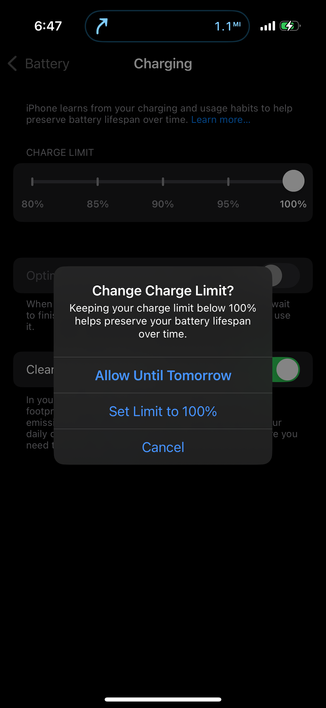
Sorry, but you are absolutely wrong this time. My iPhone 15 Pro Max is 99%. I got it day one. 289 cycle count.
I’ve been doing this since the 12 Pro Max. Each year, 100% health.
I decided to try it and I can say conclusively that charging to 80 works.
My wife gets iPhone current - 1.
My oldest daughter gets iPhone current - 2.
My youngest daughter gets iPhone current - 3.
My MIL gets iPhone current - 4.
After that, I just give them away to friends and sometimes acquaintances. Sometimes I trade in via Apple or Gazelle.
For example, I gave the son of a guy I work with my old iPhone 6+ a few years ago.
Pretty much a cottage industry. Family is on board since they all get yearly upgrades.
@davidhmccoy 👆🏻 This is a perfect summary of what John is missing. Even if you’re upgrading every year, it’s not like the device disappears from the face of the earth.
If @gruber, and others who upgrade every year, throw the old one in the trash, I agree with him: The setting doesn’t matter. But I mean, then we have a bigger problem. 😛
@gruber @davidhmccoy I wasn’t saying there was any.
I was saying that “Not looking at the life of the phone past year 1, is the only way to conclude that the 80% setting doesn’t matter”.
Now, I can get finding it worth it to burn the battery a bit quicker to enjoy the 100%. (I’ve needed it on my Mini!) The battery would probably need to be changed a year or two sooner, with the economical and ecological costs that entails. But not the end of the world, I reckon.
@[email protected] @[email protected] I wasn’t saying there was any. I was saying that “Not looking at the life of the phone past year 1, is the only way to conclude that the 80% setting doesn’t matter”. Now, I can get finding it worth it to burn the battery a bit quicker to enjoy the 100%. (I’ve needed it on my Mini!) The battery would probably need to be changed a year or two sooner, with the economical and ecological costs that entails. But not the end of the world, I reckon.
True. I also run a bright screen. I turn off the auto-brightness. I want that thing blazing so I can enjoy my many lock screens(check my posts).
I treat 80% as my 100%, that is, I keep it topped off at 80%. Originally with the 12 Pro Max, I would check it constantly and unplug it. I saw that worked, but man! It as labor intensive.
I have automations that turn off my iPhone charges at 80% and that alert me to when it hits 80 or hits 65%. The charger turn on at 74% /1
At this point, if I’m in the car and it hits 80, I just pull the plug from the AC port. Don’t even really think about it anymore.
I then get the next phone, and pass it down the line. “You’re going to LOVE the better camera! And it’s so fast!”…as I’m unboxing my new iPhone.
I remind everyone to 1)get a new case, if necessary and 2)eyeball the “new” phone before I wipe the old one.
/end
@daringfireball I don’t think the battery degrades at the same rate over time. If you buy a new phone every year, go ahead and charge it to 100%, but if you’re on a 2 or 3 year cycle, limiting it to 80% still looks interesting.
Also, having a good battery health percentage increases resale value.
@daringfireball @gruber My 15 pro max from last year is still 100% health, 211 cycles, limited to 80% charge all year.
I don’t think I’ve ever had battery anxiety, I just pick it up in the morning and use it. If I drive anywhere, it charges in the car (up to 80%).
When do I use that health? Maybe I don’t. But the next user of the phone (handed down to a teenager) surely will.
@daringfireball
iPhone 15 Pro Max.
80% limit since day one.
Heavy user.
Battery Manufactured July 2023
Battery First Use September 2023
Battery Health:
• 98% March 31, 2024 (215 cycles)
• 89% June 21, 2024 (321 cycles)
It dropped to 88% in early July where it has since stayed.
• 88% September 20, 2024 (457 cycles)
The 9% drop in 82 days was simply wild.
iPhone 16 Pro Max, Max Charge 95%
• 100% September 24, 2024 (5 cycles)
See you in a year.
@daringfireball I think comparing 94% vs 89%after 1 year is the wrong metric to look at. The real question is how many years does it last before it’s degraded beyond usable limits (eg 50%).
Assuming linear deterioration, that’s the difference between a 5 year lifetime and a 10 year lifetime, which is massive.
@daringfireball Your logic/advice is right, though I am handing off the phone to a loved one and it def made a difference.
My 14PM was at 87% health at a year. 15PM 95% after a year of limited to 80%
@daringfireball In my experience, batteries become unreliable already below 85 and surely below 80% "Maximum Capacity". A 4-7 difference in a 15 points scale is not as insignificant as you pretend.
Such setting may seem useless for someone who changes their phone every year, agreed, but I bet in the longer term it makes a good difference.
@daringfireball To add another data point: iPhone 15 Pro Max. 80% charging limit (with a few days here and there set to 100%). Nightly charge on a slow Qi charger (Anker) - I always try to charge using the slowest possible method to keep the battery temperature low.
Battery heath: Normal
Maximum capacity: 100%
Cycle count: 189
First use: September 2023
@daringfireball I have kept mine on the 80% charging limit setting since purchase (except a couple times when I was traveling away from power sources and needed to have the 100%)
135 cycles, 99% life remaining.

 John
John 
 Wu Evar 🇪🇺🇺🇦
 Brian Dear
 Yossi
Yossi David H. McCoy
 John Gruber
 Erlend
 cdhermann
 Rick Baumhauer
 Jan Wedekind
 @
@ Work Less
 Eddy Poon
 Alex MacK
 Edmund
 veee
veee Cyrille Cailac
 oelna
oelna Damon Ferguson
 JonTatum
 Jason Martin
 MarkV
MarkV David Beck
 Sean
Sean Stoinov
 Raouf Dool
 Paul
Paul Sumocat 🐈⬛
 valkraider
 Mario
Mario Gregnee