The Trillion Dollar Question Nobody is Asking

Apple Investors are keen observers of metrics of financial performance. We have to track top line, bottom line and many lines in between. Updates to the data are delivered every quarter through official documents such as the 10K and statements made in conference calls. These data are then analyzed and opinions are formed on the viability, sustainability, and prospects for the company.

https://www.asymco.com/2024/09/08/the-trillion-dollar-question-nobody-is-asking/

The Trillion Dollar Question Nobody is Asking

Apple Investors are keen observers of metrics of financial performance. We have to track top line, bottom line and many lines in between. Updates to the data are delivered every quarter through off…

Asymco

@asymco
“I pointed out how important employees are to the company and my belief that their commitment is probably management’s greatest concern.”

Hah! No. Based on my 21 years there and my friends who are still there, management commitment to engineering has never been lower. They are strangling the engineering staff in the name of profits, particularly with deeply limited hiring. Hiring freezes are no a permanent thing not just a year or two. Policies like return to office designed to constructively dismiss employees are still in place. The supply of irritating CYA legal courses for engineers grows every year. They have concluded they don’t need engineering except to preserve the status quo and would rather make the money on finance and services.

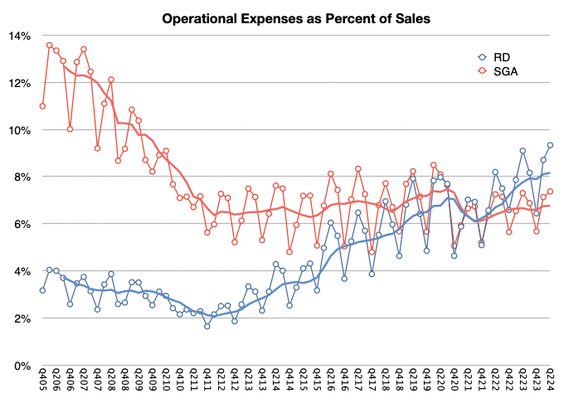
@iollmann In 2006 R&D spending was $714 million. In the last 12 months it was $30,912 million. In the relative terms of percent of sales this graph shows the difference between spending on R&D vs. SG&A. R&D is primarily engineering resources and SG&A is everything else (notably for Apple, retail).

@asymco
While I can see the point of dividing by sales here, the day to day experience of how the average engineer is treated by management is not divided by sales. Also, as you’ve shown previously, engineering expense precedes sales, so would be expected to go up in a growing company, which it certainly grew over that time. So, dividing out by sales has a time component, and is not quite this simple.

The plot might also be a lot more instructive if it included the capital return program. We may ask which groups in that plot created that value and which did not.

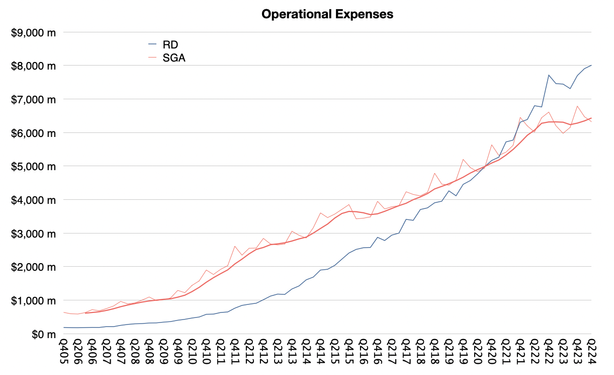
@iollmann The R&D level relative to sales puts it in a certain light. This is R&D and SG&A spending in absolute terms.