Good morning to readers, Kyiv remains in Ukrainian hands.

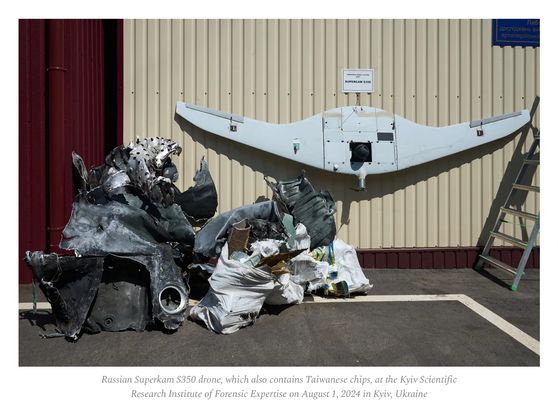
#Russia still continues to receive modern #Taiwanese chips to manufacture its deadly weapons.

We visited a forensic lab to find out how chips from Ukraine’s allies are found inside #Russian weapons.
It’s 11 am, on a normal working day in Kyiv.

You're sitting in the corridor of your office because an air raid alert has been announced due to a missile threat. Suddenly, you hear loud explosions outside.

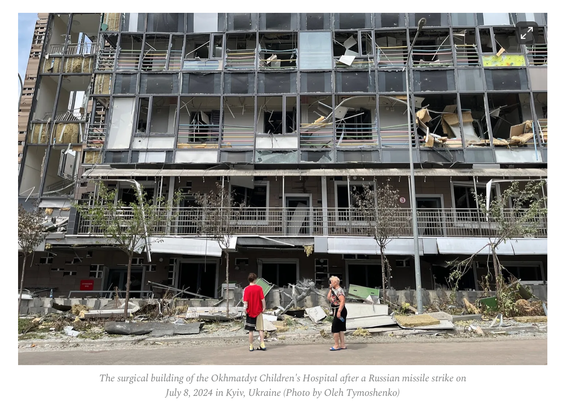
Half an hour later, you're at the site of the attack, where a #Russian missile hit the main children's hospital in Kyiv.
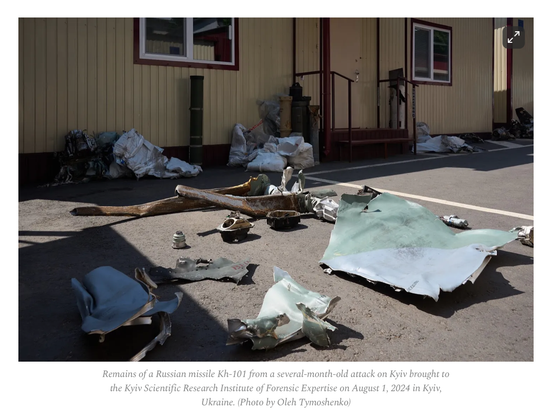
A few days later, the U.N. officially said that the #Okhmatdyt Children's Hospital was “most likely” directly hit by a modern #Russian Kh-101 cruise missile. Two people were killed and sixteen injured. Many more children, undergoing treatment, are displaced.
Critically, the missile included dozens of electronic chips from non-Russian manufacturers. Surprisingly, investigators found #Taiwanese chips inside the remnants of the Kh-101 missile.

Back in June 2022, #Taiwan imposed sanctions on Russia, including a ban on direct supplies of modern chips that could be used in weapons.

However, the #Russian Kh-101 used in the attack against #Okhmatdyt was only manufactured a few weeks before the attack.

To find out how Russia, in the third year of its full-scale invasion of Ukraine, circumvents sanctions and obtains modern electronics for its missiles and drones, follow the link:

https://www.counteroffensive.news/p/how-taiwanese-chips-find-their-way

How Taiwanese chips find their way into Russian weapons of death

We visited the lab in Kyiv where they take the wreckage of Russian missiles, pulling apart the Western components that make it possible for them to rain violence down on Ukraine.

The Counteroffensive with Tim Mak

@timkmak is there actually a way for these sanctions to be effective?

I don't know a ton about the legal and regulatory aspects of dual-use designation beyond a passing familiarity of ITAR and the types of products it applies to, but I do know electronics, and those boards are only going to need a few restricted parts, with most only needing automotive or industrial grade specs (mechanical shock, operating temperature) rather than rad-hardened aerospace stuff. ten ICs may enable ten bombs.

@timkmak it seems to me that setting up front companies under the guise of acting as a replacement parts distributor for industrial devices would allow them to quickly source large quantities of the necessary parts. possibly even operated by unwitting local businesses and citizens who are approached for an entirely legitimate sounding business venture, and who don't know about restrictions. POs come in for replacement parts, they ship them out, parts get re-marked and shipped into Russia.
@timkmak which sounds very similar to what they're doing here. but given that just a few parts goes a long way in this space, and it's going to be exceptionally hard to catch just a few dozen tiny parts going across the border, I'm struggling to see how sanctions can be impactful other than as a deterrent for overt mass-sale. what am I missing?
@timkmak also worth noting that the geographic distribution of sources you mentioned is essentially a geographic distribution of where IC manufacturers operate, but that's only somewhat relevant to my question.
@timkmak (and, to be absolutely clear, I do actually want these sanctions to work, I'm just not understanding how they could possibly stem the tide given how few controlled parts they need per unit and how impossible it is for customs to catch them crossing borders)