I love reading ancient cuneiform tablets. Classics such as "Fuck you, this copper sucks." (Ea Nasir), "I should get more new clothes, my dad's employee gets new clothes twice a month and it's embarrassing.", and of course "The sesame harvest will die — let nobody say I did not warn you!", which is absolutely a set up for "Per my last clay tablet.".

Social media & email may be
part of the problem. But if we're still like this when we have to carve our petty bullshit into clay then it's clear that we're the problem. It's us.
@tilde @paninid Someone I know was studying clay tablets from a school for young scribes and “sloppy attempts at the same character multiple times that eventually devolve into doodles or just randomly stabbing the clay multiple times because the writer got bored” was a common pattern.
@tilde @paninid Also if y’all think meme culture or thirstposting is new, may I introduce you to Classical Japanese poetry? LOL
@MisuseCase @tilde @paninid oh please give us some examples.

@Dany @tilde @paninid One of the ways Japanese nobility communicated was by sending each other short poems called waka (imagine Tweets but also with a required syllable structure). They also had a bunch of poetic conventions drawn from old poetry anthologies, native mythology, and Chinese classics that they were all expected to know and use.

/1

@Dany @tilde @paninid So with this particular form and poetic conventions, they’d write love poems, jokes (lots of puns), and commentary on current events.

They would also riff off each other’s poems. Like, a poem that was particularly trendy or considered particularly bad would become a meme template for a while - like that “plums in the icebox” poem we all know.

And yes people would get roasted for bad/inappropriate poems.

/2

@Dany @tilde @paninid There are a lot of examples in the classical Tale of Genji where people would write parodies of each other’s poems. And since it’s about a romantic hero there is a lot of suggestive or erotic poetry.

There’s also an older lady of the court in the story who writes a poem on her fan like “The grass in this mountain pass is long, for no man comes to mow it…” which is a thirst post.

/3

@Dany @tilde @paninid And historically there were lots of love poems written between women! The imperial court of Kyoto back in the day was a hotbed of Sapphic romance.

Also yes there were letters and poems that were the equivalent of “U up?”

/end

@MisuseCase The Pillow Book is wild. It's like... analog MySpace, maybe? The paper version of people who just tweet a running commentary of their lives? IIRC she totally takes some digs at Murasaki (been a few years since I read it). Turns out the Heian court had the same general social structure as a modern US middle school.

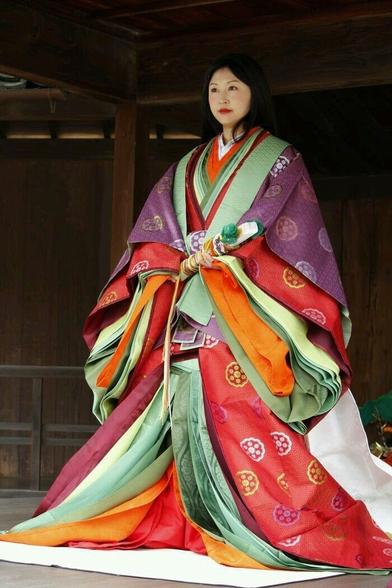
(Not literally ofc, but like... they were so cliquey. They wore 15+ layers of robes that had to be color-coordinated according to seasonal styles that changed every few weeks...)

@xelle The cliques are reflected in Genji too, since he’s part of one political faction and his father’s most powerful wife (not the Empress!) is in the opposing faction. And there were all the rivalries between different Imperial consorts and their retinues, between the Empress and the Priestess of Ise, etc.

And yeah, OMG, the *clothes.* The narrative in Genji is fixated a lot on the clothes, haha

@MisuseCase I read somewhere that the modern Japanese name for those outfits (literally "twelve-layer-robe") came about in part because the layering got so absurd that it had to be legislated down to 12 layers max. I'm guessing at least one person died of heatstroke before that.

@xelle Maybe. But there was also stuff like people wearing more layers than the Empress, occasional attempts to cut down on the court budget, and the fact that you had to be unusually tall for the time to pull off wearing more than 12 robes (so not everyone could do it and it might cause resentment).

I’ve heard of at least one movie set in the Classical Era where they went way over budget just because of the clothes.

@MisuseCase @xelle I only now got to read this entire thread. Thanks for this very amusing peek into this particular part of Japanese culture.