 Zoltán Ács
 Robin Green
Still one of my favorite memes.
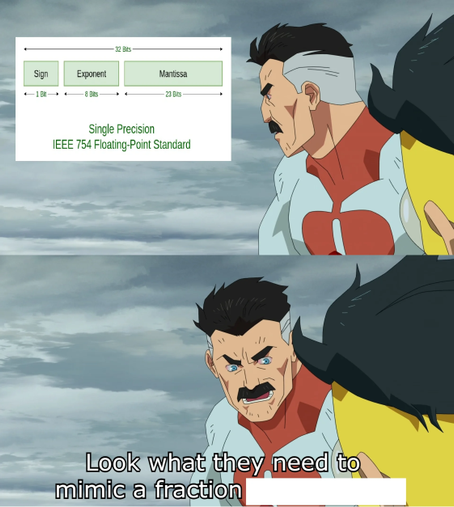
[Image description] two panel comic made with screenshots from the show Invincible
[Panel 1] Omni-man and Invincible look at the sky, where is superimposed a graphical representation of how a floating point number is stored in memory on digital systems: a sign, an exponent, and a mantissa.
[Panel 2] Omni-man looks at and speaks to Invincible, the subtitles reading "Look at what they need to mimic a fraction". The rest of the usual quote, "of our power" is blanked out.
@fatlimey Excellent!
Also oddly timely, as literally less than 24h ago I was explaining to my partner how IEEE 754 floats work. Is there something I need to know about my privacy?
Floating-point arithmetic is considered as esoteric subject by many people. This is rather surprising, because floating-point is ubiquitous in computer systems: Almost every language has a floating-point datatype; computers from PCs to supercomputers ...


 aliceif
 Siph
Siph 
 Shane Kitt
 Zeh Fernando
 AlisonW ♿🏳️🌈♾️
 I Forget
 Argent Stonecutter
 Hadriscus
 chrysn
 Brian Okken
 Random Geek
 nightoo
 Cyber Yuki
 Vince (biometrically enrolled)
 webbed undergrowth🕸:flaglesbian::verifiedplural:
  Furbland's Very Cool Mastodon™
 punIssuer
 patrislav ♾️ #RIPNatenom
 Shane Celis