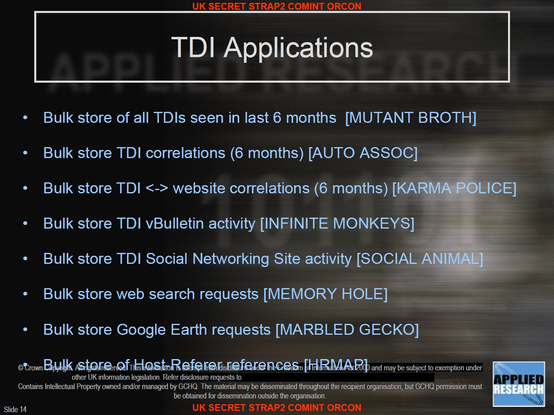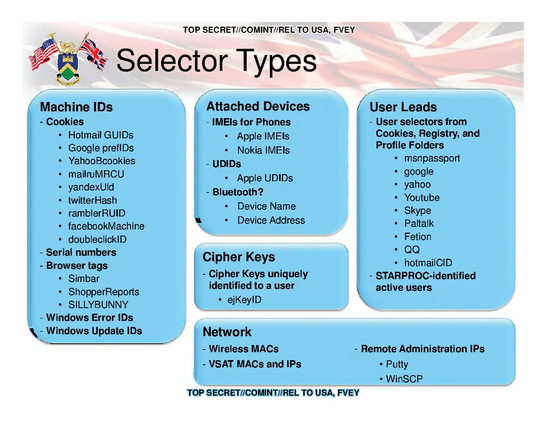
Revisiting 2 of the 5 docs from the Snowden leaks that mention 'cookies'.

GCHQ 2009 on 'target detection identifiers':
https://snowden.glendon.yorku.ca/items/show/188/

NSA 2011 on 'selector types':
https://snowden.glendon.yorku.ca/items/show/172

...featuring cookie/browser IDs from Google/Doubleclick, Facebook, Microsoft and many more.

It's breathtaking how the surveillance marketing industry has still managed to claim for many years that unique personal identifiers processed in the web browser are 'anonymous', and sometimes still does.
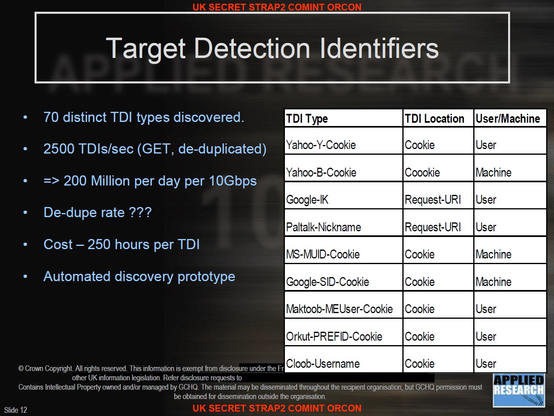
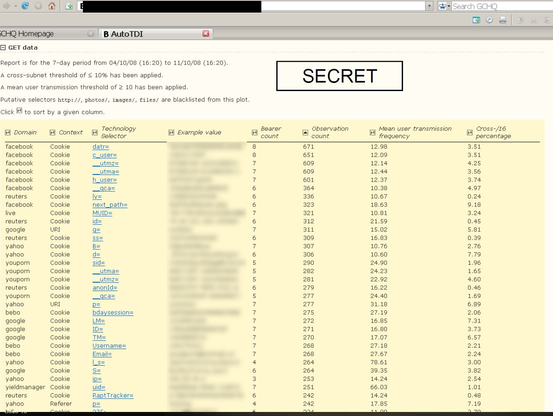
Target Detection Identifiers · Snowden Archive

@wchr If it's helpful to understand why companies (and agencies) are so motivated to do this and how much money is at stake for them, there are publications on why matching people across multiple devices matters, especially to the advertising industry. It comes down to that they want to measure the impact of ads and such on people, not on browser/app instances, so matching a person to all the devices they use makes a huge difference in revenue. Here's one example:
https://research.facebook.com/publications/people-and-cookies-imperfect-treatment-assignment-in-online-experiments/
People and Cookies: Imperfect Treatment Assignment in Online Experiments - Meta Research | Meta Research

Identifying the same internet user across devices or over time is often infeasible. This presents a problem for online experiments, as it precludes person-level randomization. Randomization must instead be done using imperfect proxies for people, like cookies, email addresses or device identifiers.

Meta Research