5am talk tomorrow "No, that's not a UFO, that's Starlink" for the IAU General Assembly, about how astronomers are doing ALL of the public education for satellite companies while they destroy the sky, the atmosphere, and Low Earth Orbit for profit. Meanwhile, every fucking article that talks about SpaceX includes the line "SpaceX did not respond to a request for comment." Do better, SpaceX. You suck.

I hope I am tired enough that I avoid rage-screaming over Zoom.
...especially because my family will all be asleep while I'm giving the talk and probably wouldn't appreciate me rage-screaming in the house with them.

It's just after 5am, I've been signed in to the (empty) Zoom room for 15 min (as I was directed) but nobody is here yet to test my presentation, and I can't hear the sound in the room (but I *can* hear annoying hold music). And I heard that in the previous session all the remote speakers had no sound. So...I'm not real confident this is going to work...

Why are hybrid meetings so hard to implement?

Ok, I think that they can now hear us remote speakers in the room? Maybe? That was a very fast tech check for 5am! But I'm glad to know I'm not the only remote speaker this session, and I'm not until the very end, so hopefully everything will work perfectly by the time they get to my talk.
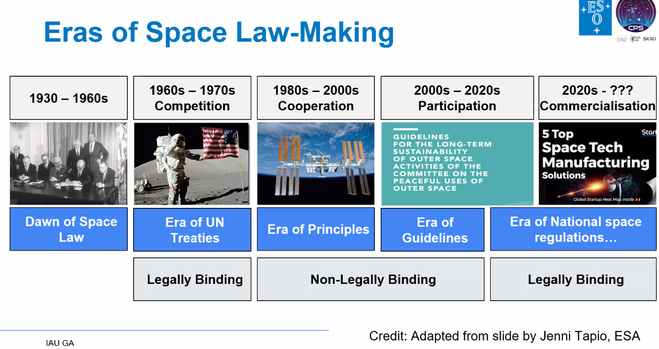
Andy Williams showing the current state of things. "We're not really in a treaty-making era anymore" but we *are* in a national-law making era, and so looks like going through individual countries is important. (Which is crappy, because there are a lot of countries...)

Yana Yakushina ran a big analysis of individual countries' rules around dark skies, quiet skies, and reduction of impacts to astronomy.

She didn't say this outright, but my takeaway is that astronomy IS space exploration and thus should be protected by the Outer Space Treaty. But some countries have pushed astronomy to the sidelines.

She says the primary area for national-level legislation that is effective is environmental law and space law, and sometimes protection of cultural heritage

Valdivia Lefort: general recommendations on how to get dark and quiet skies protections to happen at the national level. Notes that countries that DO have protections already usually focus on terrestrial light pollution only, with no provision for satellite light pollution.

Focusing on talking about the environmental impact of satellites is going to be most powerful. (Just referenced a paper I'm a co-author on, yay)

Tamara Blagojevic: starts with a reminder that very small actions and words can make a big difference. Social norms eventually become legal norms. Gave some environmental law examples for different countries

(side note: this is all super interesting...I thought the best way forward to was to wait for international rules on satellites, but these policy talks seem to be 100% focused on individual countries. Hm, will have to digest this for a bit...)

(oof I thought my talk was at 6am, it's not until 7am...this is a longer session than I thought...might have to skip a talk somewhere and make more tea)
Beatriz Jilete: talking about ESA's zero debris requirements, which are great! These include a requirement to provide data on what mitigations they've put in place to not disrupt astronomy. Sat operators are supposed to predict and mitigate the visual brightness of their satellites (this would be great). Will take into account WHOLE megaconstellations, not individual sats like the US seems to be doing.

Carolyn Crichton: "I may step away from the mic but you should still be able to hear me because I'm very loud and American" haha

Switzerland has good dark and quiet skies rules, why? Part of SKA, and also have companies building megaconstellations. EPFL(?) Space Sustainability Hub - looking at satellite streaks in large datasets, looking at satellite atmospheric pollution

Lightning talks

John Barentine: look back to Project West Ford: US military launched millions of tiny metal shards into upper atmosphere, astronomers were PISSED and fought back effectively with very strong statements from IAU (contrast that with today when IAU "doesn't want to be political")

Giorgio Siringo: spectrum management at ALMA. Notes that right now there is no radio interference from satellites at ALMA frequencies, but that could change anytime since sat companies have already gotten licenses to use ALMA frequencies.

Pedro Sanhueza: why aren't we talking more about environmental impacts of satellites? Why aren't countries enforcing env. regulations?? This is SO important.

Q from audience: no satellite operator has managed to get their satellites as faint as mag 7 (as Starlink originally promised), how do you enforce that with the ESA rules? They have asked sat operators to do maneuvers to make sats fainter over specific observatories (which is great, but what about, you know...the rest of the world??)
Nice highlight from John Barentine's talk: "The notion of science vs. internet access is a false choice"

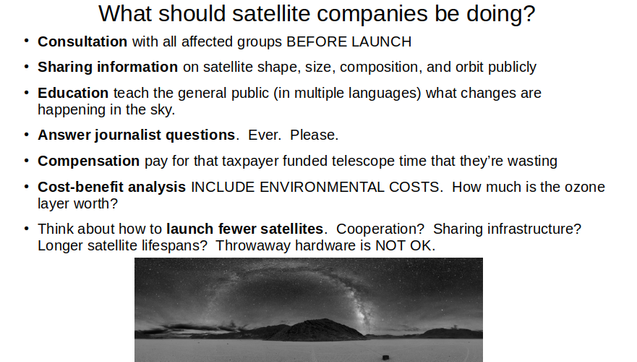
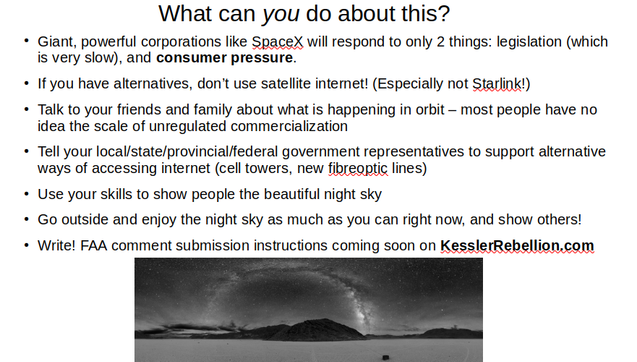
Ok my talk is done. I started by saying that my goal was to make everyone in the audience angry, and then tell them some actions they can take. I pointed out how it's astronomers who do ALL the public education for SpaceX, because SpaceX doesn't respond to journalist questions ever. UFO sightings/Starlink trains? Reentries/weird rocket plumes? Space junk? Astronomers are answering everyone's questions.

Here's my slides with my wish list for sat companies and actions for individuals:

Now for a Q&A session where 2 of the panelists are there in the room, and I'll be on Zoom. Interested to see if this works well or is a disaster...
Well that was interesting, actually worked ok. Now is the industry hub and I think I'm going to throw up if I stay because the first speaker is a former SpaceX executive (also I need to milk goats).

@sundogplanets

"(also I need to milk goats)."

🤣