 fossilesque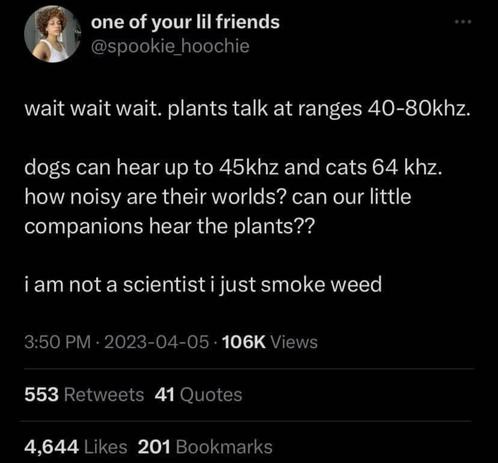

 🇰 🌀 🇱 🇦 🇳 🇦 🇰 🇮 🏆
I was told to touch grass, but when I did that it yelled “sexual harassment.”
 BreadOven
It only said it tickles feet. Gotcha.
 NatakuNox
Still going to do the splits
 Swedneck
ah but how can you prove that the implication wasn’t that it’d lick anything that touches it? you can’t extrapolate exclusivity from only one data point, it’s more sensible to assume slutty grass
It doesn’t say “it licked my feet” which would be one data point. It says “what if it licked your feet”, that is asserting that one condition and no others.
 Björn
BjörnMaybe it was Henry the anti assgrab crabgrass. youtu.be/1n7NB-lPJuU
Sexual grassment
 OpenStars
“I can hear the innermost thoughts of plants” - yup, sounds crazy to me! (Therefore let’s do it - make it happen!:-)
This is what happens when you get too high and Dr Dog - Listening In is playing
Plants talk? As in rustle with movement or communicate through sound? Can plants hear? The world is amazing, I’ll be on Wikipedia for a few.
 ℍ𝕖𝕝𝕝𝕤𝕥𝕠𝕣𝕞𝕪
There are high frequency sounds that they emit when they experience certain stimuli, for example when not having enough water or leaves being torn. As far as I know some other plants or insects might be evolutionarily tuned to recognize those sounds and react to them. So yes, in a way plants can talk.

Digital Bioacoustics - Lemmy.World
Welcome to c/DigitalBioacoustics, a unique niche in the vast universe of online forums and digital communities. At its core, bioacoustics is the study of sound in and from living organisms, an intriguing intersection of biology and acoustics. Digital bioacoustics, an extension of this field, involves using technology to capture, analyze, and interpret these biological sounds. This community is dedicated to exploring these fascinating aspects of nature through a digital lens. As you delve into c/DigitalBioacoustics, you’ll notice it’s not just another technical forum. This space transcends the usual drone of server rooms or the monotonous tap-tap of keyboards. Here, members engage in a unique fusion of natural wonders and technological prowess. Imagine a world where the rustling of leaves, the chirping of birds, and the mysterious calls of nocturnal creatures meet the precision of digital recording and analysis. Within this domain, we, the participants, become both observers and participants in an intricate dance. Our mission is to unravel the mysteries of nature’s soundtrack, decoding the language of the wild through the lens of science. This journey is not just about data and graphs; it’s about connecting with the primal rhythm of life itself. As you venture deeper, the poetic essence of our community unfolds. Nature’s raw concert, from the powerful songs of mating calls to the subtle whispers of predator and prey, creates a tapestry of sounds. We juxtapose these organic melodies with the mechanical beeps and buzzes of our equipment, a reminder of the constant interplay between the natural world and our quest to understand it. Our community embodies the spirit of curious scientists and nature enthusiasts alike, all drawn to the mystery and majesty of the natural world. In this symphonic melding of science and nature, we discover not just answers, but also new questions and a deeper appreciation for the complex beauty of our planet. c/DigitalBioacoustics is more than a mere digital gathering place. It’s a living, breathing symphony of stories, each note a discovery, each pause a moment of reflection. Here, we celebrate the intricate dance of nature and technology, the joy of discovery, and the enduring quest for understanding in a world filled with both harmony and dissonance. For those brave enough to explore its depths, c/DigitalBioacoustics offers a journey like no other: a melding of science and art, a discovery of nature’s secrets, and a celebration of the eternal dance between the wild and the wired. Related communities: https://lemmy.world/c/awwnverts [https://lemmy.world/c/awwnverts] https://lemmy.world/c/bats [https://lemmy.world/c/bats] [email protected] [/c/[email protected]] https://lemmy.world/c/birding [https://lemmy.world/c/birding] https://lemmy.world/c/capybara [https://lemmy.world/c/capybara] https://lemmy.world/c/jellyfish [https://lemmy.world/c/jellyfish] https://lemmy.world/c/nature [https://lemmy.world/c/nature] [email protected] [/c/[email protected]] https://lemmy.world/c/opossums [https://lemmy.world/c/opossums] https://lemmy.world/c/raccoons [https://lemmy.world/c/raccoons] https://lemmy.world/c/skunks [https://lemmy.world/c/skunks] https://lemmy.world/c/whales [https://lemmy.world/c/whales] Please let me know if you know of any other related communities or any other links I should add.
That explains why my fuzzy terrorist always wants to bite them.
Yes, if the plant is screaming at having its leaves torn, my little psychopath would absolutely be like “bite it harder!”
 Crackhappy
Wait… If the plants are whispering to my cat late at night. Is that why the little fucker spazzes out and goes crazy all over the house at 3 am?
Well, during the day plants are busy working (photosynthesising, defending, sticking pollen to bugs), they only have a chance to get socially chatty at night.
And cats love plant humour.
Except that of succulents. They crunch too much.
That and all the ghost activity at 3am
 Match!!
what hz do ghosts talk at?
8000000!
I’m something of a “not a scientist” myself
Same. Would like answers.
Did some searching. The paper from 2019 that discussed this -
We recorded 65 dBSPL (dB of sound pressure level) ultrasonic sounds 4 inches (10 cm) from tomato and tobacco plants, implying that these sounds could be detected by some organisms from up to several feet (meters) away.

Plants Produce Ultrasonic Clicks under Stress | Biology | Sci-News.com
A team of biologists at Tel-Aviv University, Israel, has discovered that stressed plants emit sounds -- similarly to many animals -- using ultrasonic clicks not detectable by human ears, and found that these sounds carry information about the physiological state of the plant.
I would like some weed. As a nonscientist, answers come secondary to weed.
Its legal to “not be a scientist” where I live
Sorry to link to CNN but I was skeptical and here’s a good enough summary

Did some checking, out of curiosity.
And yeah. Interesting as hell.
We recorded 65 dBSPL (dB of sound pressure level) ultrasonic sounds 4 inches (10 cm) from tomato and tobacco plants, implying that these sounds could be detected by some organisms from up to several feet (meters) away.
Plants Produce Ultrasonic Clicks under Stress | Biology | Sci-News.com
A team of biologists at Tel-Aviv University, Israel, has discovered that stressed plants emit sounds -- similarly to many animals -- using ultrasonic clicks not detectable by human ears, and found that these sounds carry information about the physiological state of the plant.
Your move, vegans
CARROTS CAINT FIGHT BACK
Pineapples dissolve your mouth. Anything with capsaicin is non really asking you not to eat it.
…and anything with that many spikes on it is visually threatening your gullet, but it’s still delicious.
 craigers
Been waiting 17 years to pull that out, lol. Perfect.
I was absolutely expecting this song. I’m always expecting this song, but especially when I am fast asleep. The cries of the carrots…
They can also fight you.

Oh good. I was worried they were defenseless.
 Rozaŭtuno
“I am not a scientist, I just smoke weed” needs to be a shirt.
 tetris11
I’m not sure what it actually means though
“High thoughts,” almost like shower thoughts, but driven by weed and, in my experience, learning an interesting fact or tidbit.
Gotcha. “I’m not an expert, but I have profound thoughts” is the message
imagine a shirt that says “I’m not a scientist”. it’s basically that but if you smoke weed you are obligated to tell everyone unprompted, so this is for weed smokers who want a shirt that says I’m not a scientist.
 SLVRDRGN
a further idea:
Front of the shirt says “I am not a scientist”
Back of the shirt says “I just smoke weed”
It would be really neat if someone made a sensor that could tell you whether your plant needs to be watered.

 Linkerbaan
An RPI to measure moisture seems complete overkill. There’sESP Home for small sensors instructables.com/Building-a-Wireless-Soil-Moistu…

Building a Wireless Soil Moisture Sensor With ESPHome and Home Assistant
Building a Wireless Soil Moisture Sensor With ESPHome and Home Assistant: In this Instructable I'll guide you on how I build a wireless soil moisture sensor system using the ESP8266 ESP-07 module and integrate it with Home Assistant through ESPHome. This project is perfect for anyone looking to optimize their garden irrig…
 AbsentBird
Pi picos are pretty good for iot projects like that. ESP are more power efficient, but a pi can be more self sufficient. I think it depends on the project.
The linked project recommended a Pi3 though.
Ah, that’s just overkill.
Yeah, I’ve messed around with water sensors before. I just thought it would be neat to measure it via stress on the plant itself.
 nifty
niftyHow do we know that sound signals recorded aren’t just from the release of biomolecules? Using the nervous system to produce sound is a more intentional process than the release of biomolecules for chemical signaling, which is something even simple multicellular organism do
You’re right that it doesn’t have to be talking. But it is a sound cats and dogs can hear. They do hear the plant noise, which is cool.
Right, but what’s the source of the sound? If it’s not intentionally produced, but rather a chemical reaction or reaction byproduct, then it says something different about plant communication
I agree, I just don’t think it’s that relevant to the post, which was more about how our pets experience the world.
The sounds produced by plants aren’t used for communication, at least as far as I’ve understood it. They are, as you say, just sounds produced as part of other processes. They aren’t talking any more than a tree talks when in creaks in the wind.
It’s cool to us.
I can absolutely confirm that neither cats nor dogs particularly enjoy hearing multiple frequencies in that range, as I use ultrasonic noisemakers to train dogs and cats. Both species have had individuals that reacted as though I had just beaten them, and all the individuals reacted in such a way that it was clear that they would do just about anything to never hear those noises again.
That being said, I wonder if they could hear that frequency all the time and were freaked out that a human was shouting in plant language.
You were probably saying “fuck me” in a sultry voice. I sympathize with the animals.
The unpleasant reaction could be to the shape of the sound rather than just the frequency. Like a sin wave isn’t a pleasant sound, though it’s not bad at lower amplitudes.
Possible. I couldn’t tell you since I can’t hear it, and am uncertain if I have a microphone that could detect that frequency
Do they show similar signs of distress around plants in general? Are they reluctant to enter forests? Do they randomly destroy plants?
Lol I thought it would be clear until that last question, which is something both cats and dogs are known to do on occasion.