 Patricia Aas
1/ Fine. Milton Friedmans: The Optimum Quantity of Money
For the record: It is my opinion that this man should've stood trial for crimes against humanity.
1/ Fine. Milton Friedmans: The Optimum Quantity of Money
For the record: It is my opinion that this man should've stood trial for crimes against humanity.
5/ Part 3: "Effect of Once-and-for-all change in the nominal quantity of money"
A helicopter drops 1000$ on the society (for real it says that)
Everyone thinks this is a freak one-off event
By yet another freak accident, everyone gets exactly the amount they had before, effectively doubling their money.
He now assumes they will all spend it
"The assumption that he was in a stable equilibrium position before means that he will now want to raise his consumption and reduce his cash balances until they are back at the former level" (this guy is a trip)
They can only trade with each other. So when one spends another gains (which tbh should cause that person to need to spend more which would cause someone else to get more and they'll all just go nuts in some messed up infinite loop?)
Basically he just draws the conclusion that "obviously" prices will double.
8/ Part 5: "Effect of a continuous increase in quantity of money"
New scenario: "Money rains down from heaven at a rate that produces a steady increase in the quantity of money, let us say, of 10% per year."
And of course (?????) prices increase by the same amount annually.
This part is hard to understand, but I think he's saying that you will spend more because you know your money will be worth less over time?
Dear lord, if our main character got half his money destroyed he would just consume less to fill up his bank account to the equilibrium level again. He'll be happy to do it.
I don't know, something about the fact that he knows the helicopter will come makes him use 1 dollar and 10 cent, apparently this is so obvious we'd all do it, but I don't even understand the text.
Prices increase by 10% per year and he's decreasing his holdings to 1/12th of his yearly income... For reasons?
Oh wait I missed a bit: prices rise because people think prices will rise?
bbl
10/ Cont. Part 5: "Effect of a continuous increase in quantity of money"
Apparently there is a "equilibrium path of prices" I guess that is our magic price increase (inflation). Basically a magic force will manipulate all of the actors back to their original states.
Ok... you need to reduce the money in the bank by 20% (to 1/12 of yearly income) to... mumble mumble something equilibrium. Then after that balance has returned to the force and everyone can continue with 10% increase a year.
And some stuff about overspending and underspending while you try to hit your perfect spending which is 10% per year.
Some people might've gotten richer than others and a very confusing story about an errand boy.
11/ Part 6: "Welfare effects"
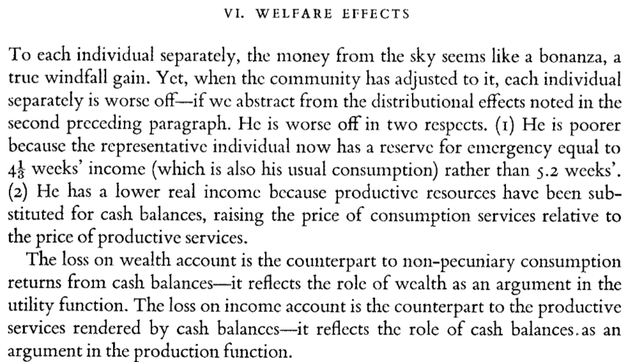
Our hero is now worse off because he has less money in the bank (for reasons that allude me, but Friedman thinks are obvious) and... "He has a lower real income because productive resources have been substituted for cash-balances, raising the price of consumption services relative to the price of production services."
I don’t understand, feel free to explain it to me. Anyway, lets continue.
Ah, he is trying to play with functions so apparently the bank account thing is wealth and is a part of the "utility function" and the income thing something something "production function".
Oh dear I'm losing interest...
We'll put a pin in it. I'll pick it up tomorrow, maybe I can muster more interest in the worst Star Trek episode ever then.
12/ Cont. Part 6: "Welfare effects"
Ok, I'm back. Lets try it again!
I thnk where he lost me was with the errand boy story in the previous section. So lets look at that.
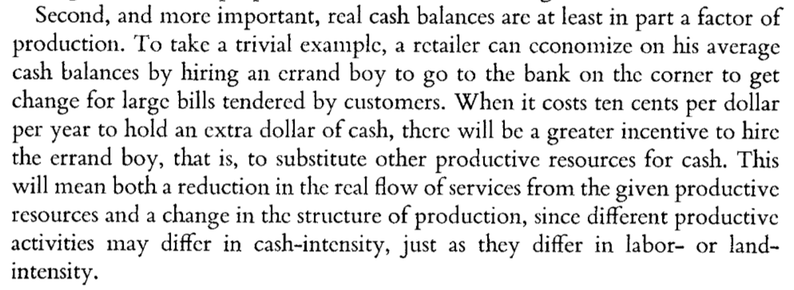
14/ Return to Part 5: "Effect of a continuous increase in quantity of money"
So maybe it's my English not being at native speaker level, but I can't parse that. Can anyone explain what it is that he is saying?
15/ Return to Part 5: "Effect of a continuous increase in quantity of money"
So the context seems to be that we have inflation of 10% so that means that prices increase at a rate of 10% per year, which to me would suggest that it is better to keep "your money" or "wealth" in stuff that would maintain their value because they would increase with the other prices.
So maybe he is saying that he doesn't want to hold petty cash, or keep it very low, because any constant cash amount is losing it's value. So the retailer thinks that keeping very little cash and instead hiring someone to run to the bank when needed, will be more profitable?
Is that a reasonable interpretation?
16/ Back to Part 6: "Welfare effects"
Ok, based on the previous interpretation that also explains why our hero reduced his savings by 20% (feels a bit arbitrary, but most people like to have some buffer at least, if they can), since keeping money (in the bank or in cash) means it loses 10% in value every year, so it makes sense to me that he doesn't feel like saving more than necessary.
17/ Cont. Part 6: "Welfare effects"
So the assertion is that he is worse off in two ways:
1. He is poorer because he has less savings
And the thing I didn't understand yesterday.
18/ Cont. Part 6: "Welfare effects"
I don't know what that means, but I think it is related to the previous story of the errand boy. That businesses are hiring people (productive resources?) over keeping cash around. But I don't know why that would affect prices of anything, and I don't think I know what "consumption services" and "productive services" are.
19/ Cont. Part 6: "Welfare effects"
Lets see if we can continue anyway.
Looks up English words:
non·pecuniary. : not consisting of money.
21/ Cont. Part 6: "Welfare effects"
Ok, lets try: Nobody wants to hold cash because cash is rotting at 10% a year. So for our hero personally he has reduced his savings to what he needs short term, and so has businesses.
consumption services:
"Consumption differs from consumption expenditure primarily because durable goods, such as automobiles, generate an expenditure mainly in the period when they are purchased, but they generate “consumption services” (for example, an automobile provides transportation services) until they are replaced or scrapped. "
https://www.britannica.com/money/consumption
So the car loses in value, but the "utility" of "having a car" is not losing value? Maybe?
22/ Cont. Part 6: "Welfare effects"
How is this paragraph so hard to grok? I'm starting to think I'm missing some assumed definitions.
The page cited in the previous post has some explanations further down and I think maybe we have hit a central concept: "The rational optimization framework"
"consumers’ preferences are assumed to be captured by a utility function"
And breaks down that function:
1. "that the urgency of consumption needs will decline as the level of consumption increases (this is known as a declining marginal utility of consumption)"
2. "that people prefer to face less rather than more risk in their consumption (people are risk-averse)"
3. "that unavoidable uncertainty in future income generates some degree of precautionary saving."
So maybe this is about 3? The utility of savings is less when money loses value?
23/ Cont. Part 6: "Welfare effects"
Maybe: that he has less savings feels bad because he is less secure in the event he might lose his job? And something about having money in your account and productive services, which I'm just going to give up on.
I'm giving up on this whole section to be honest.
What makes sense to me is:
A) savings (in money) make little sense when they are falling in value
B) stuff that is useful over time makes sense to buy because the use you get is constant and buying a new one is progressively more expensive.
C) Tbh buying stuff seems like a good idea in general, especially durable stuff that might be resold later, because prices are increasing, it's just money that is losing value.
So spend your money fast for all your daily needs, and save in things, like your home or gold or whatever.
@Patricia it affects everything in your life from grocery shopping to retirement planning. It makes taking and issuing credit very risky at best, and unavailable at worst. It makes renting agreement very risky for both parties, and in periods of inflation instability usually unavailable. Saving is something only the wealthy can do
It can lead to desperate measures like price controls that disincentivize production and sales
It's in every conversation all the time and you cannot escape it.

 Nina "Erina" Satragno 💫