 Patricia Aas
67/ To be fair, I think that issue is pervasive in the whole field. They are not able to separate ideology from models of the economy. And then they infuse in morality and destiny and Right and Wrong in these models until it’s more mythology than science.
And I don’t mind ideology. I have a great helping myself. But when you’re already in a non rigorous field, mixing opinions into “models” makes the whole thing even less serious.
A complex system is what it is. You find out the shape of it empirically. You can form hypotheses, design experiments and test. You don’t sit in a corner and Devine It. You might have a famous “shower thought” but then you test.
And seriously, these people (economists) don’t test ANYTHING.
68/ I really thought I’d be more convinced by leftist economists. But they are methodically all very similar. And it is the methodology I have issue with in this whole… project(?).
This field has imo structural issues and they aren’t fixed by the practitioner being less of an ass.
The problem is they believe in these simplistic models and that is standing in the way of developing the kind of tooling, discipline and humility needed when working with complex systems imo.
https://social.vivaldi.net/@Patricia/112719504676456386
Patricia Aas (@[email protected])
When you quote me I hope you pick the best quotes: “And I posit that the NOK is weak because the planet is fucked and everybody knows it.” https://social.vivaldi.net/@Patricia/112719497998588756
https://en.wikipedia.org/wiki/Bretton_Woods_system

75/ Chapter 5: “‘Winning’ at trade” is interesting, but doesn’t really go into the depth I’d like (but I guess after reading 4 Econ books in a row I’m not the target readership). The chapter is very “political” and idealistic rather than descriptive, but that was a tendency we saw earlier too. The basic idea is that a trade deficit isn’t a bad thing. She goes on to envisage a world economy that is more… equitable? It argues for developing countries to focus more inward, and diversifying their economies, perhaps making them less vulnerable to the global markets. It argues against losing control over one’s own currency (its MMT, so obviously). It makes clear that the dollar gives the US an outsized influence and leverage over the rest of the world.
She criticizes both democrats and republicans, but seems to have a soft spot for Bernie Sanders. He hired her to work at the Capitol, so I guess that makes sense.
The MMT premise seems to be that you don’t have to “have the money” to fund guaranteed full employment or “entitlement programs”, because the control over the currency means that the government always “has the money” to pay.
76/ The “winning vs losing” at trade is explicitly directed at Donald Trump. But she spends a lot of time emphasizing that American workers have lost jobs (“well paid union jobs” comes up several times) when production moved offshore.
It feels to me like she is arguing for a midpoint, a more protectionist approach, but not measuring in trade deficit/surplus, but instead in… standard of living?
She gets slightly into the topics of “The Shock Doctrine” in that the international trade organizations and the world bank became dominated by extremist (my word) capitalist forces.
1. She is clear that the challenges that face us in the years to come are global, and that we have to work together to solve them, as partners instead of competitors.
2. She is not proposing some sort of bloody global revolution.
3. She is slowly selling me on the idea that guaranteed employment, benefits and entitlement programs are a safeguard against radicalization. I have mostly thought of these things as the “right thing to do” rather than a way to maintain peace.
4. The ideology is inclusive instead of divisive, and therefore doesn’t rest on the boogeyman approach of both the fundamentalist left and right. She doesn’t use immigrants or poorly veiled antisemitic tropes (the evil rich man of various formats) to paint some other group as the enemy.
79/ But the book is supposed to not just be a work of ideology, but provide a way through this mess we’re in, in the aftermath 🤞of a global economy dominated by extremist capitalism.
And that premise is based on this currency “trick”, and there I am not yet convinced tbh.
That train of thought reminded me of this Norwegian song
https://youtu.be/9QxGKTTtYgM?si=G9in1FTPPu2q49_a

Noen å hate
“Han der er ikke sånn som deg
Fort deg bort og ta han
Det er like godt som sex
Å banke en stakkars faen
Er det ikke deilig å ha noen å hate?
Føles det ikke godt å ha noen å hate?
Er det ikke herlig å slå dem flate?
Er det ikke deilig å ha noen å hate?
Hør lyden av nakker som knekker
Hør lyden av kjøtt som sprekker
Det er bare å følge fingeren som peker
Dit hvor de voksne leker
Er det ikke deilig å ha noen å hate?
Føles det ikke godt å ha noen å hate?
Er det ikke herlig å slå dem flate?
Er det ikke deilig å ha noen å hate?
Han der er ikke sånn som deg
Fort deg bort og ta han
Det er like godt som sex
Å banke gørra ut av en stakkars faen
Er det ikke deilig å ha noen å hate?
Føles det ikke godt å ha noen å hate?
Er det ikke herlig å slå dem flate?
Er det ikke deilig å ha noen å hate?
Er det ikke deilig å ha noen å hate?
Føles det ikke godt å ha noen å hate?
Er det ikke herlig å slå dem flate?
Er det ikke deilig å ha noen å hate?”
“He's not like you
Hurry over and get him
It's as good as sex
To beat a poor bastard
Isn't it nice to have someone to hate?
Doesn't it feel good to have someone to hate?
Isn't it great to knock them flat?
Isn't it nice to have someone to hate?
Hear the sound of necks snapping
Hear the sound of meat cracking
You just have to follow the pointing finger
Where the adults play
Isn't it nice to have someone to hate?
Doesn't it feel good to have someone to hate?
Isn't it great to knock them flat?
Isn't it nice to have someone to hate?
He's not like you
Hurry over and take him
It's as good as sex
Beating the crap out of a poor bastard
Isn't it nice to have someone to hate?
Doesn't it feel good to have someone to hate?
Isn't it great to knock them flat?
Isn't it nice to have someone to hate?
Isn't it nice to have someone to hate?
Doesn't it feel good to have someone to hate?
Isn't it great to knock them flat?
Isn't it nice to have someone to hate?”
84/ Ok, chapter 4 “Their red ink, is our black ink”. I think it was Keen in one of his podcast episodes who said something that I hadn’t considered. From memory: as a country’s economy grows, whatever that means, the money supply would need to grow too.
Looking at population growth alone that makes sense to me. And that means that my mental model of a fixed “amount of money we have” isn’t correct. It would, at least over longer periods of time, need to be elastic in some way. And I can’t see how that could be a global zero sum game either, since many countries that were poor a century ago, and are still poor today, often still have a “bigger” economy than they did a century earlier.
 Iker
Ikerhttps://www.ineteconomics.org/perspectives/blog/rapid-money-supply-growth-does-not-cause-inflation

 Mrs Beanbag
https://social.vivaldi.net/@Patricia/112741719404734036
Patricia Aas (@[email protected])
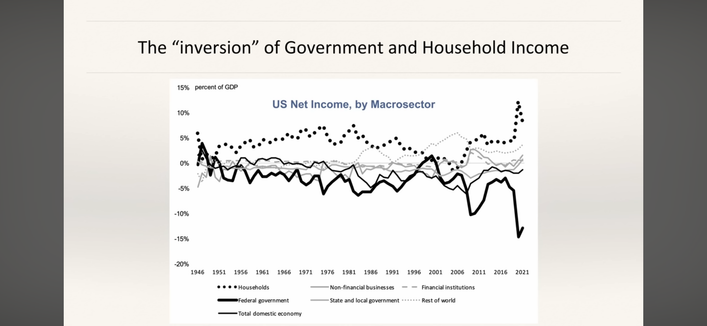
91/ Oh here he goes into another side of this (very US centric): that the increase in household wealth as a result of deficits tends to be tied to real estate and stock values, and that results in wealth distribution inequality, because most poor people don’t own homes nor stocks. https://youtu.be/wuonrlKefRM?si=7TUvGs-JeUI2AWW5