2/ Only barely through the introduction and the start of chapter 1, but it got interesting so I wanted to start the thread. (I’ll get back to Harvey when the polls are done)

So, the premise here seems to be that you (a country) have your own national currency. The thing she is going to get to, as far as I can understand these things right now, is that “deficits are a myth”.

And I think this is related to the Piketty (I can’t believe this is useful now) stories about how states erased their debts through inflation: Germany and France were the examples. And Germany are today apparently very skeptical of this approach.

3/ The reason that I had to post is that she started talking about this question I had earlier. Basically: it seems risky to me to take out loans in a currency you don’t control since you can no longer use inflation to erase it.
https://social.vivaldi.net/@Patricia/112707420539468262
Patricia Aas (@[email protected])

24/ ok, I give up on this part and tbh I’m not sure it’s important. He has drifted into one of the features of FIAT/normal money being an instrument by which a state can eliminate its debt in that currency by tanking the value of its currency. Given this, why would anyone lend a state money in its own currency? Sweden wants to borrow money, why wouldn’t you lend them euros? It seems a bit risky to use their currency. Though I believe these “loans” are actually in the form of government bonds, so in that case the borrower has taken control of the currency in which it is expressed. I bet the developing nations debt is not expressed in their own currency, just to make sure we can erase our debt, but they sure as hell can’t erase theirs.

Vivaldi Social
4/ She literally says: “and they need to refrain from borrowing, that is taking on debt, in a currency that isn’t their own”

5/ So maybe we’ll get a glimpse into this mechanism.

Unfortunately, we have seen examples of countries that didn’t have this option, like Haiti and I guess also Greece (because they were using the Euro). Feel free to chime in here.

I’m also interested in how she deals with what made Germany so intent on not going through that again. I wish Piketty had spent more time on that.

6/ Ok, this is fun. Basically it’s a different way to look at a national currency: for a government that can literally “print money” money only has “value” if you can do something with it. And taxes are such a thing. So taxes aren’t a way to make people pay for stuff, it is a way to create a need for your currency.

Right now the value of the Norwegian kroner (NOK) is a hot topic here in Norway. And I’ve tried to understand it but I just haven’t been able to. Maybe this will help. One of the things that I’ve learned is that the Norwegian government requires that the oil industry pays its taxes in NOK and this is actually one of the major “buyers” of NOK.

7/ I really enjoy that a central part of her narrative is basically that “everyone knew this, except economists because they didn’t talk to anyone else” which tbh I think is one of the foundational problems with the “field” (read pseudoscience)

8/ This first chapter was super interesting. I have to think about it for a bit, but I really recommend reading this chapter. Especially a story about chores in the beginning made sense to me.

Moving on to the next chapter which is on inflation, which I am really curious about because Norway has increased interest rates lately, but it seems to me that instead of being tied to our own economy the variables seem to be the exchange rate of NOK (which seems to be affected by a general sense of fear and not our economy) and for some reason our central bank is obsessed by numbers about the US economy. And that doesn’t make sense to me.

9/ I think my sleep deprived brain won’t be able to grok inflation today. I’ve restarted the chapter probably 5 times by now. I’ll try again tomorrow.
10/ I am trying to understand chapter 2 again, it is called “Think of inflation”. She is speaking very much from a US perspective, and so my attempt to map to Norway in my head is not always working. But I think Norway fits the criteria:
1. Has its own currency: NOK Norwegian kroner
2. The currency is not tied to a foreign currency (as opposed to Denmark who has now tied its currency DKK to the Euro)
3. Does not have debt in a foreign currency. (I don’t think we do, we have a massive sovereign wealth fund instead, which is only (mostly?) invested abroad)
11/ I am wondering how much these “models” are suited for a global economy. The US might be able to control its inflation inside its own country, by dramatically reducing importation. But if a country is a massive importer, I don’t see how you can control inflation… or it depends on What Inflation Is. Which is… what I’m struggling with. I think their simplistic models are crashing with the Real World here.
12/ People have told me before that inflation is what happens when the “economy is overheated” (too much spending/consumption) so increasing interest rates are a way to “cool down the economy”. But that makes zero sense for Norway right now.
13/ I don’t see any sign of the Norwegian economy being “overheated”. What I see is the opposite tbh. People seem to be struggling financially much more than I’ve seen in decades.
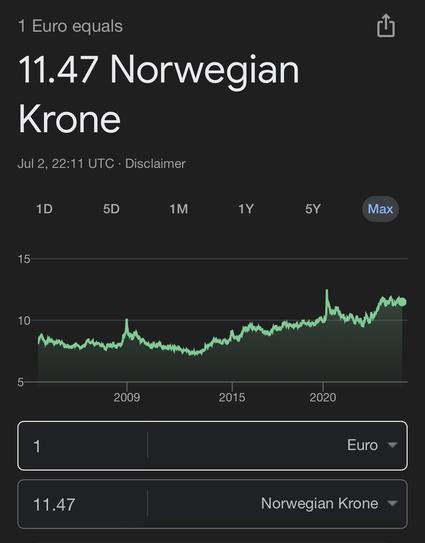
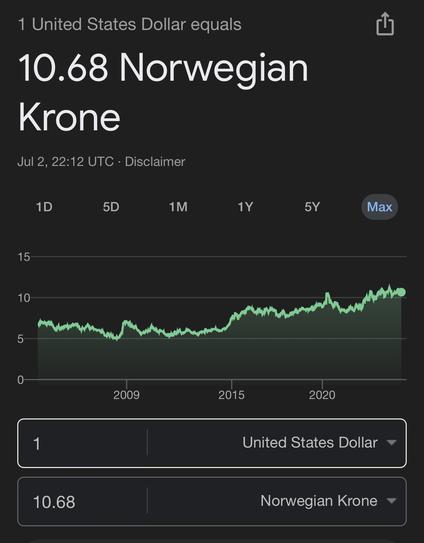
14/ What is a problem is that the NOK to USD/Euro exchange rate weak. So imports are more expensive. But to “fix” that the central bank has raised the interest rate. Which means people who were already struggling with higher prices now also get hit with higher interest rates.
15/ And young people and families are being hit the hardest because they are either renters (and rents are increasing because of the interest rates and the cooling of construction because of the higher import costs and higher intrest rates) or early homeowners with big mortgages.
16/ Meanwhile the politicians are on TV saying “Well Actually The Economy Is Going Great”. But the only sectors that seem to be doing great are those who are exporting (being paid in foreign currency) and that’s because they are raking in on the NOK being weak, and that’s not “the economy” that’s just gambling.
17/ So basically, I don’t see that the interest rate is the appropriate tool for strengthening the NOK. Except to put on a show for people who think Milton Friedman is a person who had anything reasonable to say.

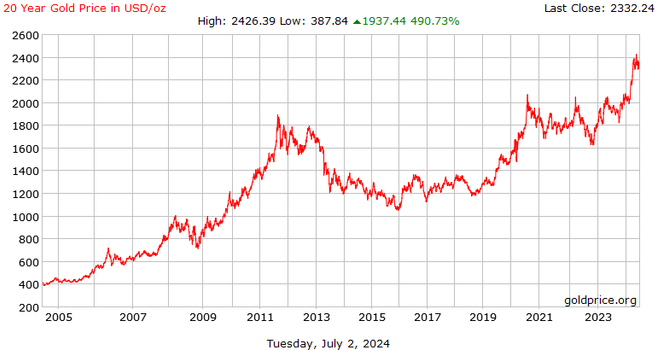
18/ In my opinion the most logical thing is that the NOK is down for the same reason gold is way up: people are scared. Russia invaded Ukraine, Israel is pushing for a regional war in the Middle East and… let’s be honest here: the US might elect a fascist dictator in a few months.

Basically NOBODY will make the decision to buy NOK no matter what the interest rate is. They are putting their money where they think it’s safe and that isn’t a tiny economy by the polar circle.

19/ I’m starting to conclude that this is yet another Friedman-model fuckup.
20/ To be honest, I’m not even sure that MMT would work for a tiny economy based mostly on imports of household goods and selling bottled up carbon emissions to the world.
21/ I am getting increasingly disillusioned with economics as an explanation model for anything other than a bunch of powerful people who like to hear themselves talk.
22/ And people are so keen on simple explanations they are willing to close their eyes to reality.

23/ One thing that is very Norwegian, and relevant here, we are a high-trust society. On every level. But for this particular matter: we trust our government much more than most other populations. And if they say the interest rate has to go up, we say: OK.

But what if they’re just wrong?

24/ but I think the currency lens is probably the right one, but not MMT (or maybe I’ll change my mind when I’m further in). From the little I have read we (the Norwegian government) are both the biggest buyers AND the biggest sellers of our own currency: we sell massive amounts of NOK to the oil companies, because they need it to pay tax, but now we have a lot of NOK that are mostly going into our sovereign wealth fund, which invests (mostly/exclusively?) outside of the country (I think this decision was specifically to not “heat up” the economy with too much money). But to invest abroad the sovereign wealth fund needs to sell a lot of NOK.
25/ so maybe we CAN influence the NOK, but not through interest rates, but rather by… reducing foreign investments by the sovereign wealth fund instead. Funnily enough this idea is based on the most basic economic theory: supply and demand.
26/ And all indicators are showing that it’s not working. The price of the NOK isn’t really being affected by the interest rate. It is being affected by What Everyone Else Is Doing. This weakness of the NOK doesn’t seem to have much to do with Norway at all. We’re just a too esoteric (and small) currency for a global market whose risk appetite is low.

@Patricia
> weakness of the NOK doesn’t seem to have much to do with Norway at all

Agree. Small countries get blown about by what's happening elsewhere. Metaphorically speaking.

> The price of the NOK isn’t really being affected by the interest rate

Hard to say. It's certainly not the only factor, probably not the biggest factor, but it will be a factor.

@BenAveling I mean, looking at the actual data, the value fluctuations are in line with all of the other small currencies. In the state we are currently globally… it doesn’t seem to matter. And since gold is sky high, that says something about the kind of risk appetite that currently exists in the market.
@Patricia There's a lot of fear out there. Interest rates possibly don't matter _much_, compared to that. That is, there will be an effect(*), but it's not necessarily going to be visible because it's probably being swamped by everything else that's going on.
(*) Not just the complicated medium/long term effect on 'the economy', but the short term effect that (all else being equal) people will move money to where they expect they will get the best return on it.
@BenAveling the thing is that people aren’t thinking “getting good returns” they are thinking “holding on to what I have”. And that is a whole other ballgame.
27/ Looking at the NOK vs USD and Euro and the gold price in dollars. When people are all in on gold they’re not buying the currency of “the capital of Sweden” (old joke about nobody knowing we exist)
28/ I love how much she uses the words “believe” and “faith” - gets across how religion-like it is.

29/ It’s clear to me now why they are using the interest rate. It is the only tool they have. They have one single knob, one single variable, so they have to use it even if they know that it won’t work against the problem they’re facing. Because it was never meant to solve the problem they’re facing.

More generally, I don’t know that importing a Friedman model from the US, which has a massive economy and The Most Popular currency, makes any sense for us.

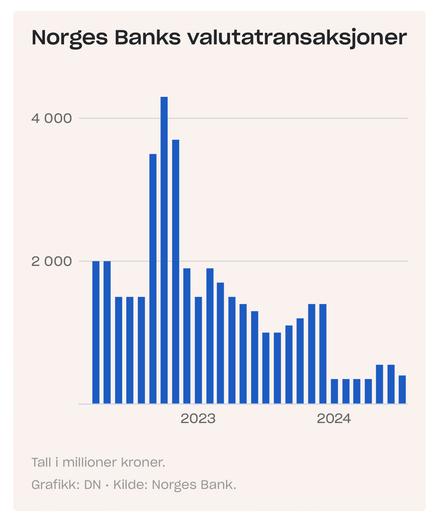
30/ Maybe they have been trying to do exactly what I’m saying here? Reducing the amount of NOK they are unloading onto the market.
https://www.dn.no/makrookonomi/norges-bank/makrookonomi/norges-bank-oker-kronesalget-til-550-mill-kroner-per-dag-i-mai/2-1-1635409
Norges Bank øker kronesalget til 550 mill. kroner per dag i mai

Etter fire måneder på rad med uendret kronesalg, økes beløpet i mai.

DN.no
@Patricia It's somewhat notable that this is a thing the US does *not* have the power to do and this is one of the reason many countries bend over backwards to avoid becoming a reserve currency. For example, China has an entirely different currency for international transactions vs. domestic transactions. https://www.youtube.com/watch?v=JHZnVdBZJfA
Would a BRICS Common Currency Work?

YouTube
@Patricia Economics is a Social Science, not an exact science, as they like to pretend. Also, it has been co-opted by rich people to defend their interests and functions as a mouthpiece, by selection: economists who advocate for rich people interests are usually rewarded with visibility, careers and "prestige" in heavily funded academia. Every other economist who dares to challenge the hegemony is basically fucked and left behind.
@Patricia The core insights probably still apply, but the smaller the economy the less autarkic it can be - the more you rely on goods coming in from outside your society the less important “taxes create the demand for currency” becomes, because more of your economic actors don't pay your taxes.
@Patricia sounds like a good week to be visiting
@mrsbeanbag oh, Norway has probably never been cheaper, probably the best time to visit tbh

@Patricia just an ignorant 'murican here, but also: My impression is that a lot of the economy of Norway has been petroleum based?

I'd think with the drive to get off oil, that increases the risk.

@danlyke sort of, but then Germany shut down its nuclear reactors and Russia invaded Ukraine and we don’t only have oil, we have gas, and mainland Europe uses a lot of gas. So we’re (as a country) earning a lot of money off of this situation too.
@Patricia yeah, after I typed that I thought about my brother in law, who's deep into a venture that involves what looks like a failing Alberta oil well, and on the one hand I'm like "that's terrible, I hope something comes from it so you can keep your house", on the other hand I hope oil in 2024 doesn't have much of a future.
@danlyke @Patricia Norway might have made money with hydrocarbons but describing it as a petrostate like this is kinda reductive

@malwareminigun yeah, although Statistia says oil is 23% of GDP down from 35% last year, up from 11% in 2020, which could be seen as having the potential to make the currency volatile.
https://www.statista.com/statistics/1450033/oil-industry-share-of-gdp-norway/

@Patricia

Norway: oil industry share of GDP 2024 | Statista

In 2024, Norway's oil and gas industry is expected to contribute nearly 24 percent to total GDP.

Statista

@danlyke @malwareminigun this is why we have strict rules on spending it, most of it is just stuffed into the sovereign wealth fund and it only spends it abroad.

“The funds holdings in equity markets
The equity investments consists of ownership shares in about 9,000 companies world wide. On average the fund owns 1.5 percent of all listed companies.”
https://www.nbim.no/en/the-fund/Market-Value/

And that’s just the stock portfolio. In addition they have a real estate portfolio. Norway as a country is very wealthy. But that doesn’t translate to Norwegians being wealthy.

The fund's market value | Norges Bank Investment Management

The fund's market value is affected by investment returns, capital inflows and exchange rates. Learn more about the market value development.

Norges Bank Investment Management

@Patricia Right, so rather than raising interest rates, they could avoid being 'overheated' by selling some of those foreign assets for USD, then use those USD to buy NOK, thus raising the effective value of NOK.

Central bankers usually don't like doing that though because it's often very short term as a fix. For example, https://youtu.be/q4k8SGmJqIA

How George Soros Broke the Bank of England

YouTube
@malwareminigun I don’t think I have heard of that being done here… instead I think they siphon off what they need before selling it off for foreign currency. I need a Norwegian economist.
@Patricia Put another way, raising interest rates is an attempt to encourage foreigners to buy NOK because they can get a better return than using their native currency. Not that I would encourage buying Rubles despite Russia's central bank offering like 20% APR. :) Selling sovereign wealth assets to buy NOK does the same thing, except the buyer is the sovereign. Either way, the money supply (in NOK) per amount of goods or services in the economy goes down.
@danlyke I agree, unfortunately the Norwegian government isn’t doing nearly enough to give us a leg to stand on when it’s over. And it should be.

@Patricia @danlyke

I generally find the petroleum taxation and the Government Pension Fund Global (GPFG, aka "the oil fund") both confusing and fascinating.

This page has a nice overview of the whole mechanism: https://www.norges-bank.no/en/topics/liquidity-and-markets/Foreign-exchange-purchases-for-GPFG/

What I believe might be an overrated misconception is that Norway will go bankrupt quickly if we lose the petroleum tax. Yes, the investment growth will need to be less aggressive (at least for some time), but the value of the GPFG itself will just increase as the value of the investments increases. And yes, the amount used to keep the state budget deficit in balance will most likely need to be adjusted.

The overall value of the GPFG is so enormous (almost 18 × 10¹² NOK; I lack the English vocabulary for that kind of amounts), invested in closer to 9000 companies in 72 countries ... with a good management, that value will just continue to increase - as long as the government does not decide to over-spend what is available - and the parliament seems to be in agreement here. More details on GPFG: https://www.nbim.no/en/

For that amount of investments to go bad - basically the economy across the whole world would need to totally collapse quite abruptly, almost at once everywhere.

It seems the overall generic message to the public is that the petroleum tax will reduce the future investment possibilities in the GPFG. They seldom seem talk about how that fund could actually develop without the petroleum tax - except "it won't be as good as now".

That doesn't mean I think we should just shut down the petroleum based production over night; it needs to be more controlled, phasing it out over some years - to avoid too many unemployed workers at a short time, etc, etc. But I struggle to see it as a complete disaster to stop the production over time, especially due to the size of the GPFG.

We just need to think differently about how that fund is managed and what the government can spend from it for the budget deficit. Norway just need to readjust itself to new realities.

Other initiatives from the government to replace the petroleum tax with something else will happen too; we live in a capitalistic state - we always wants more.

Norges Bank’s foreign exchange transactions on behalf of the government

The Norwegian government receives revenues in both NOK and foreign currency from petroleum activities. Some of these revenues are used to finance a planned central government budget deficit. Norges Bank carries out the necessary foreign exchange transactions associated with petroleum revenue spending. These foreign exchange transactions are planned and smoothed over the year and are pre-announced each month.

@dazo @danlyke oh, that’s not what I meant, I absolutely agree, but we need to invest in growing other sectors that have seen very little growth because… well, we didn’t need to. We have a highly educated population, we could be contributing a lot more to trying to prevent a global climate disaster.
@Patricia MMT—I think—would say that inflation is because there’s too much money in the economy and you should tax it out (the state’s way of taking money out of the economy).
@alper like I say in the thread, that doesn’t make sense for Norway
@Patricia Whatever theory is true it will in the end probably be overshadowed by vibes anyway.
Patricia Aas (@[email protected])

18/ In my opinion the most logical thing is that the NOK is down for the same reason gold is way up: people are scared. Russia invaded Ukraine, Israel is pushing for a regional war in the Middle East and… let’s be honest here: the US might elect a fascist dictator in a few months. Basically NOBODY will make the decision to buy NOK no matter what the interest rate is. They are putting their money where they think it’s safe and that isn’t a tiny economy by the polar circle.

Vivaldi Social
@alper global vibes. People feeling that the future is uncertain and wanting to make safer choices.

@Patricia Interest rates are such a complicated issue and one that mainstream economist struggle to explain and understand.

Mainstream will tell you that raising rates will dampen inflation, but MMT will tell that won't necessarily happen.

MMT will point out that raising rates means raising rates on bonds and thus sending out *more* money into the economy, increasing inflation. Of course, it will also make buying said bonds more attractive, reducing inflation.

So yeah, not simple at all.

@joelving and that doesn’t work either if the inflation is imported. So yet another bad model.
@Patricia They will not claim that that is the whole story! Just that it is another pressure driving inflation in one direction or another.

@Patricia I think you're right. If the German or French economy slows down, prices will fall across the EU; if they heat up, prices will rise. Norway OTOH, with roughly the same population as Germany's Hamburg Metropolitan Region, is just too tiny to move the needle in a giant common market

Why don't they spend a bit of that wealth fund on income support?

@david_megginson They have done some things, but those become drops in the ocean with interest rates 400% higher than when you took out that loan.
@Patricia The simplest explanation of inflation that I can come up with (MMT-inspired) is what happens when available productive capacity cannot keep up with rising demand.
Like, people want more of something, but all the factories are already running at max output and we can't easily scale up -> prices will increase.
Or the reverse, and much more dangerous: productive capacity collapses while demand remains. This is a key driver of hyperinflation.
@joelving but that isn’t right, and that is the problem. People are making up simplistic models for complex systems, no offense, and acting as if they are true. The current global “inflation” seems to be more connected with war. Look at the price of gold. People are scared.
@Patricia You're right. That was an over-simplification on my part, only intended to address the "overheating" part. There's tons of drivers of inflation, but they are usually ignored (like widespread price gouging has historically been ignored).
@Patricia @joelving My headcanon metaphor for money is not that it's a physical substance (gold coins) but that it's a current—the best analogy is electricity—that drives the economy and is coupled to it. Inflation is overvoltage: too much money but no extra resistance to soak it up.
@cstross @joelving but that is not our problem. Our problem is that our currency, which is a fly in the global economy, is trading at lower prices. So imports are much more expensive. That is not something we can control and not caused by an increase in consumption.
@cstross @joelving I think this model of thinking only works for large economies, or maybe for economies that don’t rely on imports as much as we do.
@Patricia @joelving Very likely true: I'm not used to thinking in terms of non-reserve currencies and how they interact with the rest of the global economy.