Congress can pass laws codifying Chevron and Roe. But to do that the Democrats need to control both chambers and the White House. If Biden wins and the Dems control both chambers, he'll be a lame duck so he'll be able to do essentially whatever the hell he wants and tell the GOP to go fuck themselves. It's honestly the only chance we've got to put the federal government back on the rails. Otherwise it's game over for democracy in our lifetimes.
People fucking need to vote blue.
#politics #USPol
@jik How will he be a lame duck?
@kithrup Even leaving aside the fact that he would be term-limited by the Constitution, no modern president has ever run for any other office after the presidency. It would be kind of unthinkable. Not needing to worry about getting elected again frees him to do things he wouldn't be able to do otherwise. It certainly wouldn't be the first time a 2nd-term president stepped on the gas for this reason.
@jik Yes, but you said *if he was elected*. He wouldn't be a lame duck for, at most, 4 years at that point.
@kithrup I don't understand what you're trying to say here.

@jik "If Biden wins and the Dems control both chambers, he'll be a lame duck"

That is not a lame duck. Lame duck refers to the period after an election.

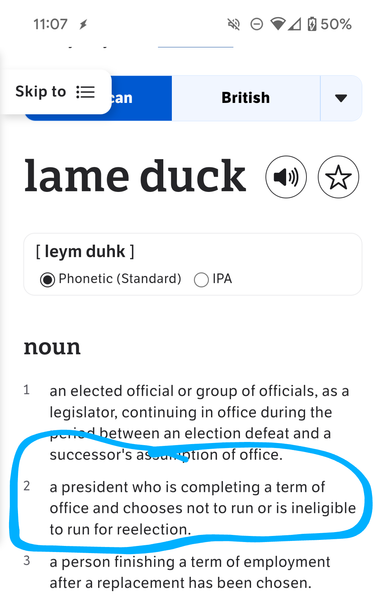
@kithrup I still don't understand you. A lame duck is someone who is finishing his term of office and not running again. If Biden wins, then for his entire second term he with be finishing his term of office and not running again, i.e., a lame duck.
Sometimes the term is used to refer to once someone's successor has already been elected. That is one meaning of the term but not the only one. The other meaning, which applies here, is when one isn't running again.
@kithrup You can see right there in the dictionary definition screenshot I posted. You're talking about the first definition. I'm talking about the second one. They're both legitimate meanings of the term.
@jik
Huh, this is the first time I've seen sense 2 (and per merriam webster, the term only goes back to 1761 and only meant sense 1 at the time.) While I'm not doubting the second use exists, I suspect it's rare enough that using it (especially re US presidents) will be confusing at best; certainly the "powerless/lame having been rejected by the electorate" aspect is only relevant to sense 1.
@kithrup