One major issue is that Laplace’s demon cannot exist within our universe. For it to have complete knowledge of all particles, it must be outside the world, looking in. Otherwise, some particles always remain unobserved, unmeasured, because they are what is doing the measuring — they are the demon. They are what is doing the observing. Therefore, Laplace’s beast cannot be a natural being. It is not made of the same stuff as the rest of the universe. It is supernatural: much more like a god than any imaginable real investigator who must study the world while being an intrinsic (and generally quite tiny) part of it.

@MolemanPeter

Right? -- tho, isn't this line of reasoning already a paradox?

1. Participation: a. in what way might something which is not-our-universe participate in it?

b. Mustn't the demon be part of the universe to observe/ measure/ change it? -- what of the boundary?

2. Coherence: which reference frame captures all?

3. Representation: how to mentally-represent all characteristics of every phenomena?

4. Consequence: & without destroying everything!

Is Laplace describing our universe?

@causalmechanics
Did you read the chapter by @yoginho ?

@MolemanPeter @yoginho

You're right Peter -- some, not all initially

I've encountered yogi's (at times hateful) rhetoric before, so did not feel compelled -- but I ought to have done before responding. That's on me

This piece has many interesting referenced ideas (a few of which I redundantly echoed, sigh) -- but also problematic word-play, false equivalences, and conclusions (which the book may address)

2.

@MolemanPeter @yoginho

Yogi, the dehumanisation of mechanics/ machine is just daft. We are machines -- why suggest machines are inhuman?

Did a cuddle lose all humanity for you because we describe the body in terms of biomechanics? (btw, did related healthcare improve or decline at the same time?)

In fact, we suffer most in areas of healthcare devoid of mechanistic account -- mental health in particular. It's totally fine to think other accounts also useful -- but deny the conversation?!

3.

@MolemanPeter @yoginho

The fact that 'some humans can be inhuman' is a good sign that 'what it is we refer to as humanity' is in-fact an essence, and distinct from 'the human surface'

This is in-part evidenced by the fact other non-human species display behaviors we increasingly recognise as overlapping this exclusive set 'of ours'

Expect this to increase as the veil of our ignorance/ arrogance lifts. No?

Humanity *is* inclusivity -- please stop contriving division

4.

@MolemanPeter @yoginho

Yogi, can you share what you are working toward with your book (for those of us who have read the hate in your words before?)

I'd like to engage on points specifically; but as it stands, I don't feel like editing your book for you

Nor putting up with the subtext creeping throughout, if I'm honest

Moving forward, I hope to better describe my position -- if I am wrong about yours, perhaps we might find common ground, which improves both

@causalmechanics

To sum up: You dis my book chapter without reading it. You blabber nonsense like "why suggest that machines are inhuman?" You make vague accusations of hateful speech and "contriving division" that you just pulled out of your own ... hat. And you expect me to engage with you?

If you don't like what I write, then feel free to unfollow. If you want a discussion, then engage properly with my arguments. Spew more weirdness at me and get blocked. The choice is yours.

@causalmechanics @yoginho @causalmechanics @yoginho "In fact, we suffer most in areas of healthcare devoid of mechanistic account -- mental health in particular.": I would not agree with "suffer most", and in mental health care mechanistic thinking does (and has done) quite al lot of damage.
Read Practicing Psychiatry in the Third Space, Guest Post by Helene Speyer [cited 2024 Jun 30]; Available from: https://www.psychiatrymargins.com/p/practicing-psychiatry-in-the-third?post_id=146088836&r=16nd63
The problem with mechanistic thinking, is well explained by @yoginho. Read also Hofstadter, Foreword to the New Edition about the brain being a machine.
( of Gödel, Escher, Bach: an Eternal Golden Braid), 2020.
"We now understand that the human mind is fundamentally not a logic engine but an analogy engine, a learning engine, a guessing engine, an esthetics-driven engine, a self-correcting engine." But he thinks that such an engine (!) could be simulated in an computer.
Practicing Psychiatry in the Third Space

Guest Post by Helene Speyer

Psychiatry at the Margins

@MolemanPeter @yoginho

Thanks, I'll read shortly. But to be clear "some mechanistic models aren't good" isn't a good argument against all; any more than "some abstractions aren't good ones" ought to render abstraction off limits

I love surfaces & essences – Hof couldn't fit more in, but he falls short around the edges

Analogy is "the logic of composed/ composable forms". Arguments like fuzzy-matching isn't mechanistic/ logic/ computational are odd

1.

@causalmechanics @yoginho Your right, but he writes the same as you do here. So you are offset by his wording?

@MolemanPeter @yoginho

> he writes the same as you do here. So you are offset by his wording?

Hofstadter, or yogi?

@MolemanPeter @causalmechanics

I have been known to use salty language, to have strong opinions, and to loose my cool sometimes with shallow thinkers, but I do *not* criticize other people's work without reading it, ask them to summarize their work for me because I hate to read it, or make vague incriminating insinuations. I don't get upset with such weirdness, because I experience it all too often. But I have no patience with this kind of behavior, and wanted to make that crystal clear.

@yoginho @causalmechanics I agree with your considerations, and see how you act on them. I try to ignore comments of that sort, or just ask -as I did-: did you read it? I also have sometimes to read between the lines to get the essence of your ideas. But I appreciate them very much! For me you are one of the best (deepest) thinkers in the field I follow.

@yoginho @MolemanPeter

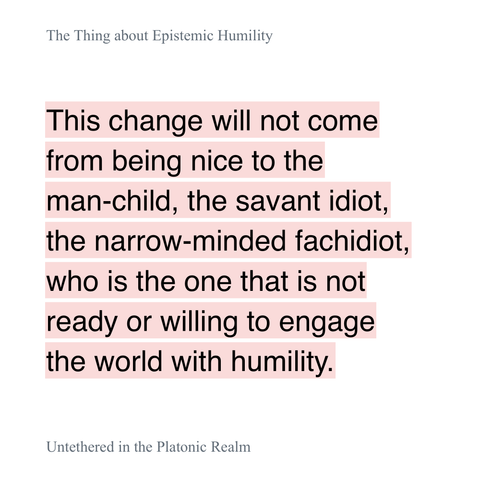
Yogi, the attached isn't "salty language", or a "strong opinion" – this is offensive, in language and intent. It is hateful

For those on the receiving end, "idiot savant" is used to dismiss, manipulate, undermine, gaslight and bully: for severe cases, this demonstrates indecency; for others, malicious misrepresentation

Seriously yogi, I've read your words for years chap – you followed this account until, what earlier today?!

Anyway, I hope this clarifies somewhat

@MolemanPeter

Peter, is this deep thinking?

@NicoleCRust

Nicole if i remember, you found this piece difficult to read, but defended Yogi at the time — is this just "salty language", or a "strong opinion"? Deep thinking? Necessary?

http://www.johannesjaeger.eu/blog/the-thing-about-epistemic-humility

The Thing about Epistemic Humility

Twice now, in the short span of one week, I've been reminded on social media that I should be more humble when arguing — that I lack epistemic humility .

Untethered in the Platonic Realm
@causalmechanics @NicoleCRust I see you are offended by this. If you are not able to extract the scientific valuable information, that is a problem. Yogi also has a problem: that he inhibits the proliferation of his valuable information by his use of language. The words ""salty language", or a "strong opinion" were in answer to my post. He would have better not include you in his answer, because your reference to them here is improper.
By the way, you call me Peter, what should I call you?

@MolemanPeter @NicoleCRust

Do we agree that this use of autism *as a slur* is unacceptable?

Are you trivialising it's use here (within a scientific "call to arms", no-less) because only problematic individuals would raise the matter, having failed to "extract the scientific information"?

If the scientific information here is so extractable, then what from exactly? And why resist the suggestion that (post extraction) any 'unacceptable remainder' be called out? What function does it serve you?

@MolemanPeter @yoginho

We use similar methods in software, logic based on type signatures of interfaces – which are like essences, distinct-from though inherently related to implementation (surfaces); whereby an interface might match plural implementations, as an essence does surfaces

(Really any heuristic-based constituent/partial/fragment pattern-matching)

Any stand-out points you might share on Hofs later treatment of analogy?

2.

@MolemanPeter @yoginho

https://www.psychiatrymargins.com/p/practicing-psychiatry-in-the-third?post_id=146088836&r=16nd63

Wow, what a remarkable article (brave, what a staggering admission re mockery...); & very useful reference for lived experience "reporting" also. Thanks

Personally, I think psychiatry (in present form) is an abomination. I get that drugs are medical/ mechanistic – but the captured circumstances and judgements of the dsm are definitely not

I'm still feeling the effect of reading that article. It's strong

Practicing Psychiatry in the Third Space

Guest Post by Helene Speyer

Psychiatry at the Margins
@causalmechanics @yoginho I think you have to seperate the person from the science, here. I have commented on his wording on another occasion. It is not always helpful.