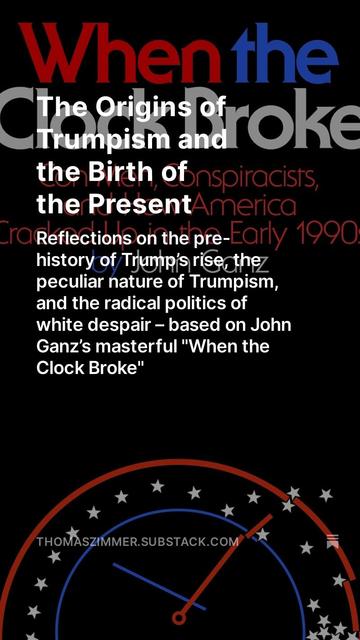
The Origins of Trumpism and the Birth of the Present
 
Reflections on the pre-history of Trump’s rise, the peculiar nature of Trumpism, and the radical politics of white despair – based on John Ganz’s masterful “When the Clock Broke”
 
Some thoughts from my new piece:
 
🧵1/
 
https://thomaszimmer.substack.com/p/the-origins-of-trumpism-and-the-birth
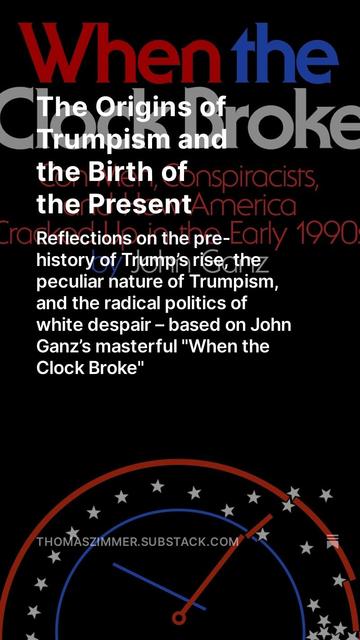
The Origins of Trumpism and the Birth of the Present

Reflections on the pre-history of Trump’s rise, the peculiar nature of Trumpism, and the radical politics of white despair – based on John Ganz’s masterful "When the Clock Broke"

Democracy Americana
Based on this brilliant book, I reflect on the nature of Trumpism and how to situate it in the American Right’s recent history; the role of the rightwing intellectual sphere; the challenge of how to approach, research, interpret, and tell the pre-history of the present. 2/
The book’s perspective on the early 1990s is undoubtedly shaped by the experience of Trumpism, and if you read it, it is inevitable you’ll read it through the lens of Trump. There is evidently a proto-MAGA dimension to a lot of what is happening here. 3/
What makes Trumpism so potent, what distinguishes Trump from the rightwing populists that came before him who, at the end of the Cold War, were ultimately kept in check? In Ganz’s interpretation, the insurgency figures of the early 90s embodied different promises. 4/
David Duke and Pat Buchanan represented the ethno-nationalist vision of “real America” as a white Christian homeland; Ross Perot offered “billionaire populism,” combining celebrity, wealth, and anti-establishment furor. 5/
Mafioso John Gotti became a folk hero because he stood for a weirdly comforting form of “gangster patriarchy” and personal mob rule. All three, as Ganz puts it, offered a version of “national coherence that was based on exclusive, strong leadership.” 6/
It broadly appealed to people – to white men, specifically – as an antidote to the feeling of decline and despair, an alternative to the lonely individualism of the post-Reagan capitalist society and the confusing, threatening pluralism of modern democracy. 7/
These were visions of a kind of national community in which a strong leader – a “man of destiny,” in Gramsci’s terms – made sure that the “right” kind of people were included and the “others” (women, minorities) were blamed and put in their place. 8/
The promise of nationalist coherence did not have a unifying champion in the early 1990s yet, the different elements of a politics of despair were still scattered. But Donald Trump represents “a kind of synthesis of all these different features,” as Ganz argues. 9/
Trump is the white nationalist, the billionaire populist, and the gangster patriarch, all in one grievance-driven package. This, to me, is the most compelling paradigm of the nature and appeal of Trumpism yet. 10/
The reason why Ganz is able to deliver such an incisive interpretation of Trumpism is that he is not reducing the early 1990s to the status of a pre-history of Trump’s rise. “When the Clock Broke” does not offer an easy origin story, it doesn’t indulge in simplistic genealogy. 11/
“When the Clock Broke” powerfully dissects how the end of the Cold War opened the door for those who emphatically rejected liberal democracy, even as an aspiration, to move closer to the mainstream, and make their case to a mainstream audience more explicitly. 12/
For the rightwing protagonists of “When the Clock Broke,” democracy – any attempt of leveling what they insisted were natural hierarchies of race, gender, wealth – was the real enemy. To the hard Right, liberal democracy wasn’t the end of history, it was the end “real America.” 13/
I also reflect on the relationship between conservatism and radicalism. In the early 90s, the self-regarding counter-revolutionaries still existed mostly on the margins of mainstream politics. Today, they define rightwing identity as well as the Rights style and agenda. 14/
Finally, I discuss the recent wave of 90s nostalgia that often has a reactionary political valence – and doesn’t hold up to the kind of precise, sincere assessment of the period’s historical significance John Ganz offers in his book.
 
Please consider subscribing:
 
https://thomaszimmer.substack.com/p/the-origins-of-trumpism-and-the-birth
The Origins of Trumpism and the Birth of the Present

Reflections on the pre-history of Trump’s rise, the peculiar nature of Trumpism, and the radical politics of white despair – based on John Ganz’s masterful "When the Clock Broke"

Democracy Americana
@tzimmer_history
David Neiwert chronicled, in real time, the rise of the neo-fascist, white supremacist movement in the Pacific Northwest during the 1990s. This movement led directly to the Sovereign Citizen movement and to people like Ammon Bundy. It's worthwhile to revisit his work.