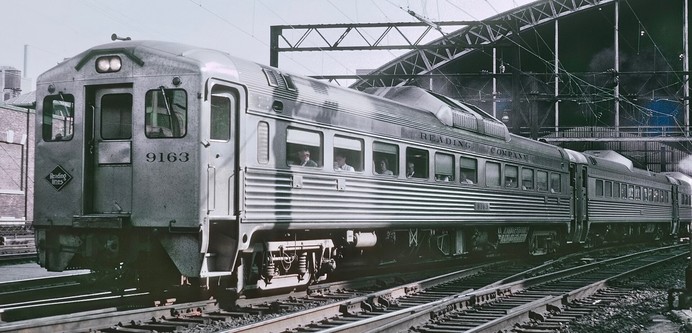
The Budd RDC (Rail Diesel Car) was a diesel multiple unit built between 1949 and 1962. They were particularly useful for rural passenger service with low traffic.
Technically, the Budd RDC also holds the US #rail speed record because the New York Central thought it'd be fun to just strap two jet engines on the top of one.
I really wish we still had these Budd RDCs or something similar today for many routes which can't justify a larger #train but where a single car would be perfect.
#history

@TransportationHistorian there is a modern, reasonably successful Budd RDC equivalent of sorts! The Alstom VLocity railcar built for the Australian passenger rail operator V/Line has some Budd heritage, as the plant that builds them was formerly a Budd licensee (Comeng Dandenong, which was owned by Bombardier by the time they started building these railcars and is now Alstom) and the cars have very-Budd-like ribbed stainless steel bodies.
They are considered to be one of the most reliable diesel railcar fleets in the world and have been continuously built from 2003 to right now. These days they’re 3-car 222-seat sets but they were originally built as 2-unit sets.
@ThermiteBeGiants @TransportationHistorian Are these the ones with hydraulic transmissions?
@ronaldb66 @TransportationHistorian yes, Voith. Very reliable, capable of up to 200kph if the engine is beefy enough (as it stands, the maximum line speed on the V/Line network is 160kph so it’s mostly academic)

@ThermiteBeGiants @TransportationHistorian Thanks for the info!

I read about them a good while ago and I was somewhat suprised by the choice for hydraulic rather than the ubiquitous generator / electric drive combo.

Not that it isn't perfectly viable technology; it seemed to have lost all industry attention though.

@ronaldb66 @TransportationHistorian diesel-hydraulic transmissions are very light but they are generally limited by total power output and can only power one bogie at a time, making them much less suitable for locomotives. Diesel-electric railcars also have the advantage of being able to be built as bimode (or even trimode using batteries) which is increasingly important when electrification is on the horizon
@ThermiteBeGiants Those look pretty cool, although I'd like to see a single car multiple unit train like the Budd RDC was. Although I believe the US also has some rules in place limiting the use of trains manufactured outside the US, which might make it difficult to import to the US, even if there was political will for it.

@TransportationHistorian @ThermiteBeGiants The most common DMUs in the US are Stadler FLIRTs, which are assembled from Swiss built knock-down kits in Utah.

Honestly though, investing any effort into DMUs today is burning cash. A specific selling point of the FLIRTs is that you can fairly cheaply replace the diesel generator units with batteries.