
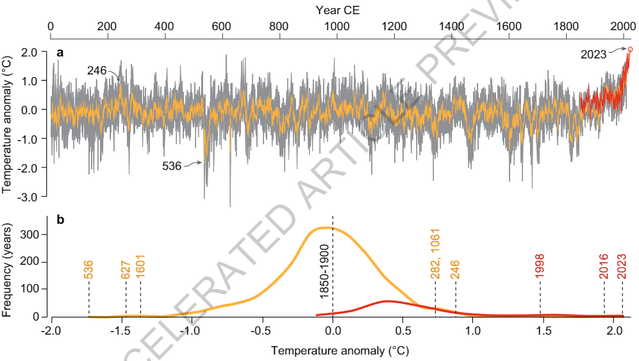
Una nueva publicación ha obtenido que el verano de 2023 ha sido el más cálido en el hemisferio norte superando por medio grado la variabilidad natural observada en los últimos 2000 años.
#CambioClimático #CrisisClimática

📰 https://www.nature.com/articles/s41586-024-07512-y

2023 summer warmth unparalleled over the past 2,000 years - Nature

Including an exceptionally warm Northern Hemisphere (NH) summer1,2, 2023 has been reported as the hottest year on record3-5. Contextualizing recent anthropogenic warming against past natural variability is nontrivial, however, because the sparse 19th century meteorological records tend to be too warm6. Here, we combine observed and reconstructed June-August (JJA) surface air temperatures to show that 2023 was the warmest NH extra-tropical summer over the past 2000 years exceeding the 95% confidence range of natural climate variability by more than half a degree Celsius. Comparison of the 2023 JJA warming against the coldest reconstructed summer in 536 CE reveals a maximum range of pre-Anthropocene-to-2023 temperatures of 3.93°C. Although 2023 is consistent with a greenhouse gases-induced warming trend7 that is amplified by an unfolding El Niño event8, this extreme emphasizes the urgency to implement international agreements for carbon emission reduction.

Nature
Este trabajo se suma a otros como este (https://tc.copernicus.org/articles/15/1157/2021/), en el que se obtuvo que la tasa actual de deshielo del glaciar de Monte Perdido sugería que el calentamiento actual es el más intenso en los últimos 2000 años (incluyendo los famosos periodos usados como excusa del óptimo climático medieval o el periodo romano).
The case of a southern European glacier which survived Roman and medieval warm periods but is disappearing under recent warming

Abstract. Mountain glaciers have generally experienced an accelerated retreat over the last 3 decades as a rapid response to current global warming. However, the response to previous warm periods in the Holocene is not well-described for glaciers of the southern Europe mountain ranges, such as the Pyrenees. The situation during the Medieval Climate Anomaly (900–1300 CE) is particularly relevant since it is not certain whether the southern European glaciers just experienced significant ice loss or whether they actually disappeared. We present here the first chronological study of a glacier located in the Central Pyrenees (NE Spain), Monte Perdido Glacier (MPG), carried out by different radiochronological techniques and a comparison with geochemical proxies from neighbouring palaeoclimate records. The chronological model evidences that the glacier persisted during the Roman period and the Medieval Climate Anomaly. The apparent absence of ice in the past ∼ 600 years suggests that any ice accumulated during the Little Ice Age has since ablated. This interpretation is supported by measured concentrations of anthropogenic metals, including Zn, Se, Cd, Hg and Pb, which have concentrations well below those typical of industrial-age ice measured at other glaciers in Europe. This study strengthens the general understanding that warming of the past few decades has been exceptional for the past 2 millennia.