I am excited to finally share our recent paper "Filtering After Shading With Stochastic Texture Filtering" (with @mattpharr@marcosalvi and Marcos Fajardo), published at ACM I3D'24 / PACM CGIT, where we won the best paper award! 1/N
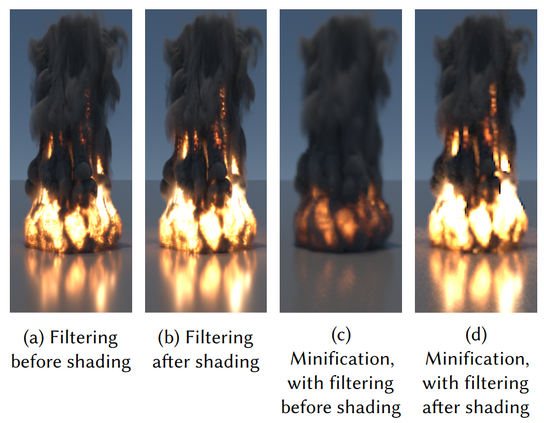
"Everyone" knows blending and filtering do not commute with non-linear functions. However, this is how texture filtering is taught and applied - we filter textures, then "shade" (apply non-linear functions). This introduces bias and error and often destroys the appearance. 2/N
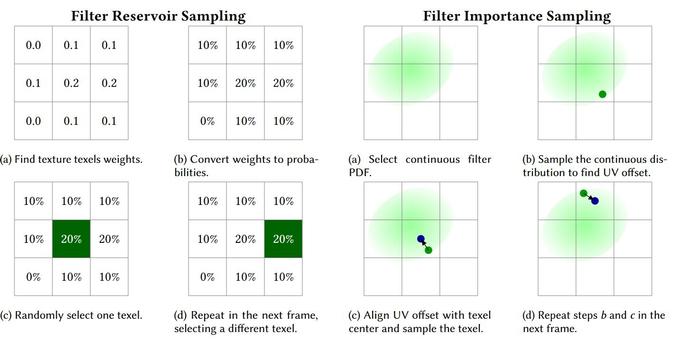
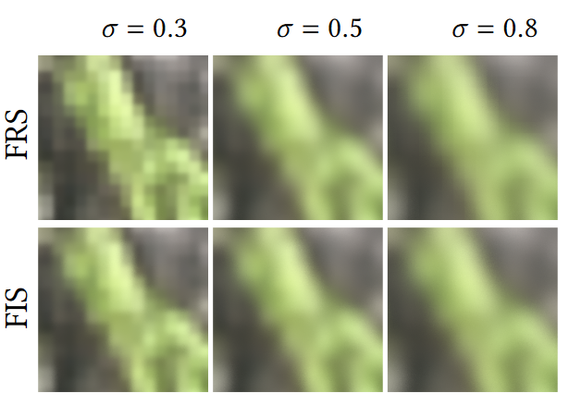
We reviewed 40y of graphics literature and unify the theory to propose "filtering after shading". To make it practical and fast, we realize it through stochastic filtering and propose unbiased Monte Carlo estimators, together with two families of low variance methods. 3/N
Many practitioners have used stochastic filters, but we generalize them, expand to negative lobe filters and infinite kernels, and propose an efficient way of sampling B-spline kernels. We discuss the limitations of those techniques and cases where we do not recommend FAS. 4/N
@lritter I don't think it can, as min/max operator cannot be estimated through MC estimators or sample averaging. You could store something in some history buffer, maybe, but then it'd be a new, different technique :)
 Bart Wronski 🇺🇦🇵🇸
 LR
LR