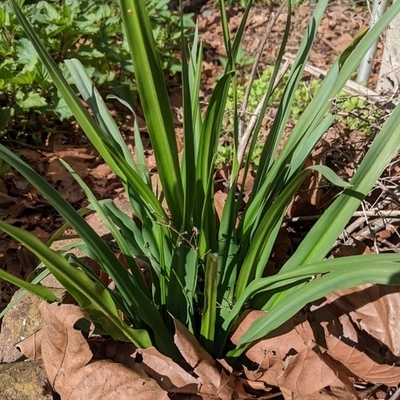
I learned about the mayapple plant, podophyllum peltatum, yesterday, when I found a little patch in a nature reserve near me. The most surprising thing about these plants to me is that they have these cool looking flowers hidden under the big leaves. Anyone know if there is a reason the flowers aren't more visible? I thought usually plants want the flowers to be easy to find so they can be pollinated.
#botany
#pollination
#mayapple
#bloomScrolling
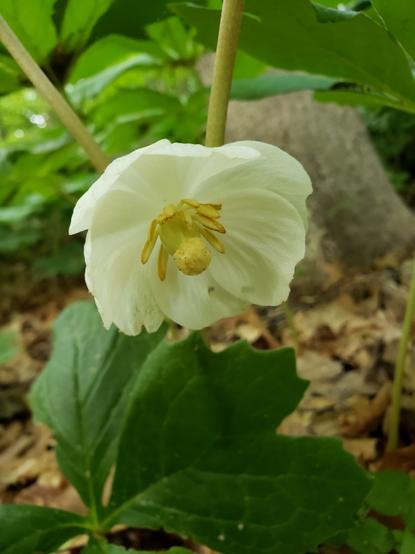
@davidruffner I couldn't quickly find what pollinates mayapple, but if it is an ant or beetle or something else which doesn't typically fly, this might be a very visible flower. There are also non visual ways that pollinators find flowers (that is, chemical signals).
@soaproot Thanks for the response, I think it makes a lot of sense, but when I looked in more detail I only found mention of bumble-bees and other "long tongue" bees pollinating the plant. See for example this info page from the Cornell Botanical Gardens: https://cornellbotanicgardens.org/plant/mayapple/
Mayapple – CornellBotanicGardens

@soaproot Interestingly I did find one scientific paper about mayapple plants. In the abstract it mentioned that mayapple does not produce nectar and relies on nearby lousewort plants that are a magnet for bumble bee queens, so that it is occasionally pollinated by the bumble bees.
https://link.springer.com/article/10.1007/BF00317156 (paywalled)

So the mystery of the hidden flowers remains, but the story is getting more complicated...

Plant interactions for pollinator visits: a test of the magnet species effect - Oecologia

From 1985–1987, patterns of fruit and seed set were studied in a population of mayapple (Podophyllum peltatum), a clonal, self-incompatible herb found in deciduous woods in eastern North America. Mayapple flowers do not produce nectar, but depend on infrequent visits by nectar-seeking queen bumble bees for pollination. In all years female reproductive success in mayapple colonies was influenced by colony size (number of flowers), by the distance to neighbouring colonies and by proximity to lousewort plants (Pedicularis canadensis), a prolific nectar producer heavily visited by bumble bees. In all years fruit and seed set were greater in mayapple colonies <25 m from lousewort flowers than in matched colonies which were >50 m from lousewort. In 1985 and 1987 the frequency of queen bumble bee visits to flowers in colonies close to lousewort was about four times greater than to distant colonies. In 1986 I removed about 80% of lousewort flowers to test whether the enhanced fruit and seed set in mayapples close to lousewort was pollinator mediated. Mayapple colonies close to flowerless lousewort patches did not differ in fruit or seed set from matched colonies >50 m from lousewort. In contrast, mayapples close to flowering lousewort patches had greater fruit and seed set compared with distant colonies. Over all years, a larger proportion of mayapples close to flowering lousewort patches had enhanced fruit and seed set compared with colonies close to louseworts without flowers. Though rarely documented, this type of facilitative interaction between plants that are highly attractive to pollinators (“magnet” species), and co-flowering species that are rarely visited by pollinators, may be widespread in plant communities.

SpringerLink
@davidruffner Wow, your research is more extensive than my quick search. Science does have answers sometimes, but it also has mysteries and sometimes the answers just lead to new mysteries.
@soaproot haha yup I'm going down the rabbit hole! 😀. I found a podcast, Fieldnotes and Folklore, with an episode dedicated to mayapple plants. Lots of interesting info including an early 1900s poem about fairies living under mayapple leaves! ... still no answer about why the flowers are under the leaves.
https://pca.st/episode/1fc8e614-cf37-4871-bc64-ba564518e273
Episode 2: Mayapple - Fieldnotes and Folklore

Fieldnotes And Folklore is a naturalist's view of science, nature, and culture. Naturalist Bekah Simon takes listeners outdoors to learn about what is out there and how different types of people have used or thought about each topic.

Pocket Casts
@davidruffner If I were a fairy I totally would want to live under a mayapple plant. For something small(ish) it is so architectural.
@soaproot I thought of this thread recently because I saw some bell peppers growing in my garden. At least some of the flowers are down below the leaves, which reminded me of how the mayapple plant has its flowers below the leaves. The bell peppers get big, so maybe it helps the plant structurally to have them closer to the main stem. Mayapple fruit are also big for a small plant so maybe they have flowers close to the stem for the same reason.
@soaproot I also reached out to Bekah Simon of the Field Notes and Folklore podcast back in May. She didn't know of research about the question about Mayapple flowers placement, but her guess was that it may be to protect the flower. The flowers come out before most trees have leaves so there is not protection from spring rain. Also she mentioned that many plants have downward pointing flowers, it is called nodding flowers. It can affect which pollinators visit.