 Lia Wong
 memes from outside fedi/atmosphere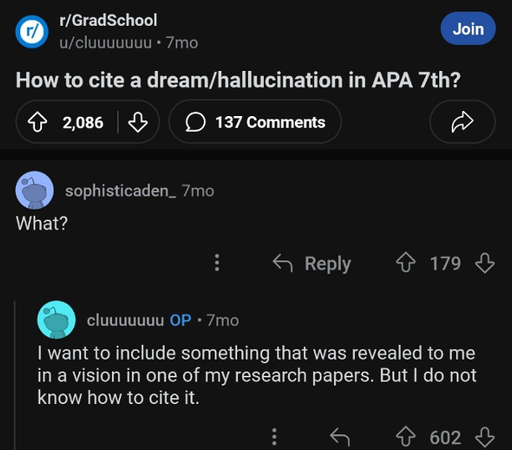
 syn
syn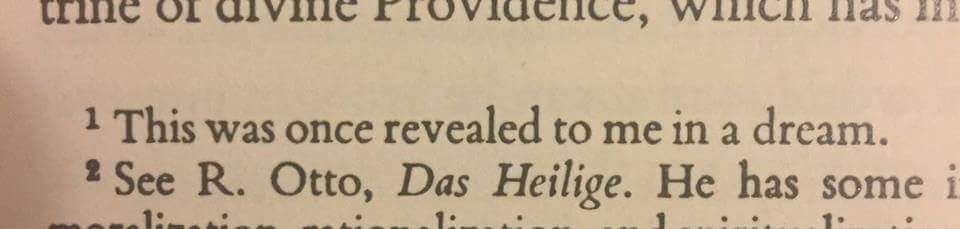
 Maddie (MIGRATING SOON)
@nonfedimemes fuck you, my source is G O D
 Hadeny
@nonfedimemes MLA, APA, or Chicago?
 Eli the Bearded
@hadeny @nonfedimemes Says APA right there. Kekulé is waiting.
 ospalh
 Aprettyture! [0172]
 Nuki Raccoon: Fedi's Favorite Furry F***poster
@nonfedimemes
You don't cite it because it's original research, unless you wrote about it in something you published already, in which case you cite that.
Note that there is precedence here, because this has already been done multiple times.
 lonely extrovert
@Nuki @nonfedimemes yup -- no citation needed, it's not from someone else's work.
 Z̈oé
Z̈oé@rothko @Nuki @nonfedimemes what if it’s from a paper you read in your dream but it doesn’t exist outside of that
@uint8_t @Nuki @nonfedimemes if it's something nobody actually wrote that actually exists, it's still your own content via your subconscious.
 Jehan Le Doe
@nonfedimemes something like : ‡ John B. Goode, "Red tiles house" dream, Boston MA, 2023.
 K4mpfie
@nonfedimemes 1)Get a diary
2) Write down your dreams
3) Publish the dream diary (Amazon will publish anything)
4) cite from your dream diary like you would cite any other book
2) Write down your dreams
3) Publish the dream diary (Amazon will publish anything)
4) cite from your dream diary like you would cite any other book
 polprog68k
 Emil Jacobs - Collectifission
@gorplop @nonfedimemes came here for this.
 skua
skuaGo the FBI way and find a citable, non-national security, source that has the same information.
 AtheistIntelligence
@nonfedimemes I believe professional citing for dreams and visions begins with, "booga booga booga."
 Matt
Matt@nonfedimemes Do like Jung and don't tell anyone
 Omar Antolín
@nonfedimemes Instead of fretting about APA you should just name the person you dreamed about as a coauthor of the paper. That's what mathematician Bob Thomason did:
"The first author must state that his coauthor and close friend, Tom Trobaugh, quite intelligent, singularly original, and inordinately generous, killed himself consequent to endogenous depression. Ninety-four days later, in my dream, Tom's simulacrum remarked, "The direct limit characterization of perfect complexes shows that they extend, just as one extends a coherent sheaf." Awaking with a start, I knew this idea had to be wrong, since some perfect complexes have a non-vanishing K₀ obstruction to extension. I had worked on this problem for 3 years, and saw this approach to be hopeless. But Tom's simulacrum had been so insistent, I knew he wouldn't let me sleep undisturbed until I had worked out the argument and could point to the gap. This work quickly led to the key results of this paper. To Tom, I could have explained why he must be listed as a coauthor. During his lifetime, Tom also pointed out the interesting comparison of the careers of Grothendieck and Newton."
 marilyn
@oantolin @nonfedimemes Haha! How did I get so far in life without knowing that story? But there's a PDF of the paper here: https://www.maths.ed.ac.uk/~v1ranick/papers/tt.pdf

 Rob 🏳️🌈 Rartsy Humanist
@nonfedimemes
Makes me think of the, "In Xanadu did Kubla Khan a stately pleasure dome decree..." poem.
Hold on. I had to go look it up. Coleridge. All I ever remember of that poem is the note explaining that he attempted to transcribe it directly from a dream but was interrupted. I felt I could relate to that in my younger days. I held an idea that creativity was mysterious and dreamlike and had to be captured. I no longer hold that view. Dreams are great inspiration though.
 nytpu the wyvern
@nonfedimemes Hey, Mendeleev said the periodic table was revealed to him in a dream!
 Matt Tearle
Ramanujan dreamed about elliptic integrals. Y’know, as you do.
 Canageek
@nonfedimemes I know it was disproven, but I love the story about Kekulé dreaming about the Ouroboros.
 Catherine: couldn’t compile
@nonfedimemes Probably best to use BibLaTeX’s
unpublished type and have it handle the rest for you MaxTheFox
@nonfedimemes Linda S. Diaz, Neurology PhD