 fossilesque
 Ignotum
“what do you do for work?”
“I watch dogs poop”
Still more useful than most office jobs.
 agent_flounder
And less shit to deal with.
 MentalEdge
Studies like this have me confused.
How do we know they use the magnetic field, and don’t just like… Look at the sun, or the shadows it casts.
 AnyOldName3
You can put magnets near dogs.
 Tier 1 Build-A-Bear 🧸
There’s also this thing called “indoors”
I dont think there are many situations where a dog frequently shits inside a human dwelling. It is a valid point though, perhaps they tested that too (dogshit smells in an enclosed space, gotta envy those researchers)
The text in the picture literally explains it’s in a free roaming environment not influenced by walls or doors.
Walls and doors don’t stop existing when you walk outside lol, big buildings exist
And "clouds"
Yes, that should be fine - water is the real danger here.
 gmtom
gmtomDogs still poop when they’re inside
Presumably, they’d do the same thing at night.
But in that case, we’d need to be sure that they aren’t using the North Star.
Dogs can poop at night…
It’s a called dumpass.
 Leate_Wonceslace
If the study was re-attempted in-Doors with a mechanism to control the magnetic field, we could be able to verify that dogs are orienting by the magnetic field instead of, say, the position of the sun.
Or, like, have night mode exist on earth. One of these ideas should work.
New study suggests dogs capable of celestial navigation: “Columbus was a sucker for using an astrolabe when he could have just brought along a good boi and watched him shit”
Should’ve just brought his astrolab
 Kokesh
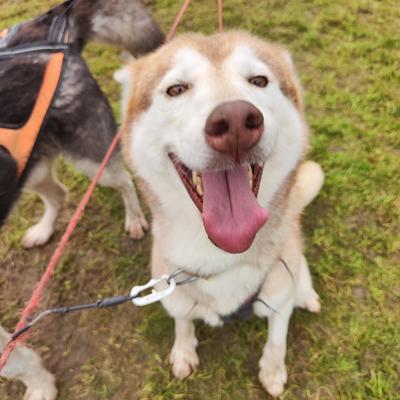
Don’t know about that… I’ve got 54 dogs and they shit in all directions.
Your house must fuckin stink mate
I think it’s a farm at that point, and yea farms stink.
Not really, only 4b love inside. Those shit outside:)
Doddio 54
I blame the sun. Dogs poop in the morning and evening when owners are not at work. The sun shines from the east and from the west during these hours. And I think they don’t like facing the sun.
My favorite explanation. Occam’s razor, ladies and gentlemen.
 LibertyLizard
This doesn’t make sense. Why wouldn’t they orient west in the morning and east in the evening?
Time of day is addressed in the study and
was not a reliable predictor of expression of alignment
They also mention that the presence of the sun is possibly likely to affect dogs less than humans - meaning that dogs might have less aversion to facing the sun.
Study is here: …biomedcentral.com/…/1742-9994-10-80

Dogs are sensitive to small variations of the Earth’s magnetic field - Frontiers in Zoology
Introduction Several mammalian species spontaneously align their body axis with respect to the Earth’s magnetic field (MF) lines in diverse behavioral contexts. Magnetic alignment is a suitable paradigm to scan for the occurrence of magnetosensitivity across animal taxa with the heuristic potential to contribute to the understanding of the mechanism of magnetoreception and identify further functions of magnetosensation apart from navigation. With this in mind we searched for signs of magnetic alignment in dogs. We measured the direction of the body axis in 70 dogs of 37 breeds during defecation (1,893 observations) and urination (5,582 observations) over a two-year period. After complete sampling, we sorted the data according to the geomagnetic conditions prevailing during the respective sampling periods. Relative declination and intensity changes of the MF during the respective dog walks were calculated from daily magnetograms. Directional preferences of dogs under different MF conditions were analyzed and tested by means of circular statistics. Results Dogs preferred to excrete with the body being aligned along the North–South axis under calm MF conditions. This directional behavior was abolished under unstable MF. The best predictor of the behavioral switch was the rate of change in declination, i.e., polar orientation of the MF. Conclusions It is for the first time that (a) magnetic sensitivity was proved in dogs, (b) a measurable, predictable behavioral reaction upon natural MF fluctuations could be unambiguously proven in a mammal, and (c) high sensitivity to small changes in polarity, rather than in intensity, of MF was identified as biologically meaningful. Our findings open new horizons in magnetoreception research. Since the MF is calm in only about 20% of the daylight period, our findings might provide an explanation why many magnetoreception experiments were hardly replicable and why directional values of records in diverse observations are frequently compromised by scatter.
They really do want an Ig Nobel Prize.
I just got a new puppy and when she poops she starts facing one directing the turns 180 while pooping then scoots over to the side a bit to finish.
Is she broken? Should I do an RMA?
Is she broken? Should I do an RMA?
Might just need to be calibrated, try turning her in a figure height in front of you a few times before the next poop and see if she aligns.
“Before” is the key word here. Trying to align a puppy during the poop is not recommended.
Have you tried just restarting it?
 AnUnusualRelic
So when you’re lost, just find a pooping dog to know where the North is. Or the south.
Wait this is useless.
If you’re not in a hurry (and you know which hemisphere you’re in) you can make a sun compass to figure out whether the dog pooped north or south. Come to think of it, you can make a sun compass observing a pooping dog first.
It works better with larger dogs. Then you can observe the shadow to determine East/West at the same time.
My 5 year old dog spins when she poos. Picking up her poo requires me to check the area she was in, as there are usually 3-4 spots it landed. But unleashed, she’s fine.The vet tells me this might be harness related. Something about the restraining leash and harness makes her spin.
But now I have a morbid curiosity to see if she starts north or south.
My dog would walk around while pooping, with a weird gait that involved putting his back paws ahead of his front paws. I once saw another dog do a handstand to poop.
 ickplant
I used to have a dog that would do a handstand to poop. He would find a tree and essentially walk up the tree with his hind legs then poop. People would literally stop in the street to watch him do it. Poop would roll down his back sometimes. It was so weird. Tried to get him to change, but no.
Does she spin clockwise or counterclockwise, and does it change when you cross the equator? Important questions
This is such bs. I watch my bdog poop in every direction
The article itself is over a decade old and based on questionable data gathering and a faulty analysis processes. If you read the article they published they essentially didn’t find anything, determined without providing evidence that other factors couldn’t be a determining factor, and then data-dredging when they could find anything statistically significant to match their hypothesis.
SkeptVet article explaining the findings in detail.
Basically it was just shitty science.
I mean my dog could be an exception but she shits always in the direction we walk. No exceptions.
I guess you could say the study was dogshit.
 Stalinwolf
My pug used to shit right on top of rocks.
Foxes are pretty notorious about that. You’ll be hiking and have a gorgeous view and look down and a rock had a fox turd right on it
Saved this for later.
Look for the full clip
My lagotto has an exquisite sense for art, he loves to place his work on the best possible pedestal. Sometimes it’s a rock or something man-made that’s sufficiently elevated and stands out, but he also sometimes plants his ass on top of a bush or a small tree.
 🇰 🌀 🇱 🇦 🇳 🇦 🇰 🇮 🏆
Gonna start bringing a compass with me when walking my dogs now…
Apparently we no longer need compasses. Just bring the dog out to the deck to figure out where we’re going.
I’m amazed. I am also amazed that someone was paid to observe dogs defecating in the wild.
Congratulations! You have now subscribed to #DogPoopPics!
Someone asked to be paid to observe dogs defecating.
 𝓔𝓶𝓶𝓲𝓮
𝓔𝓶𝓶𝓲𝓮This is some real shit
Top shitpost
 pH3ra
pH3raLiterally the shittiest compass ever
 Pyr
PyrI would assume it’s because pooping is a very vulnerable moment, and they prefer to not face the sun and being blinded while doing so.