 xfreed
Turning Men Down In Public

Maybe don’t constantly listen what media says? Otherwise u will end up paranoid.
 richieadler
Yeah, disregard advice destined to protect an endangered group when you belong to that group. That’s going to go reallllllly well.
 Ogmios
Is it actually intended to protect you, or is it intended to constantly neg you to the point you become a hollow shell of a woman, overly eager to please others out of fear for what might happen if you don’t, no longer capable of recognizing good in others so you’ll settle for the abusive relationships you’ve been conditioned to expect?
Funny how this is almost never what actually happens.
You kidding? Fear porn is a solid half of social media, at least.
I was denying the point that all fears women have are false or baseless.
If that’s what you thought I was saying, you’re not understanding my point.
Translation:
I don’t consider women human beings capable of discerning a good situation from a bad one.
I believe that women are so simple minded that warning them of the worst case scenario irrevocably ruins them socially.
I think that if we keep showing women the consequences of not being wary of men who may be violent, they will inexplicably choose abusive relationships where that violence is ever present.
Man, you sound like you have zero respect for women whatsoever. You really think that women are so weak minded as a whole that just being exposed to the violence primarily levied against women is just going to break all women mentally?
It’s not something specific about women, but people in general respond poorly to being constantly bombarded with fear porn. the only thing specific to women in this scenario is the flavour of fear porn being peddled.
It’s not fear porn. It’s reality.
If what you’re saying is that people respond poorly in general to the news, then fine. But that’s hardly the same thing as being negged into abusive relationships.
You can use real scenarios as fear porn by hyper focusing on them, far beyond what’s reasonable, and to the exclusion of everything else.
You’re treading a fine line with that logic claiming that news like this is designed to neg women into being constantly afraid.
If making people aware of dangerous situations is a good thing, then being aware of how media can be used maliciously is also a good lesson.
Sure. But painting women as completely beholden to the news to the point that they’re negged into paranoia and abusive relationships is blatantly over representing the problem.
Well you’re just completely misrepresenting what I’ve said there.
or is it intended to constantly neg you to the point you become a hollow shell of a woman, overly eager to please others out of fear for hypotheticals, no longer capable of recognizing good in others so you’ll settle for the abusive relationships you’ve been conditioned to expect?
I’m using your words, in your phrasing. If I’m misrepresenting what you said, then you might want to reexamine what you said.
You should read it more carefully. I’m speaking about the motives of those who spread fear porn, not the aptitude of women as a whole.
Ok, and claiming that news pertaining to the rape and murder of women by men who were spurned is manipulative is better in what way?
Painting news organizations as having the overall goal of egging women into paranoia and abusive relationships doesn’t even make sense. If anything, their goal would be clicks, not sewing chaos in that way.
And anyway, insinuating that the problem in the original post is the news fear mongering to condition women, and not the pervasive problem of violent men assaulting women, is itself insulting to women. Which is the point I was originally making.
But painting women as completely beholden to the news to the point that they’re negged into paranoia and abusive relationships
I would say it’s people in general. Women just happen to be the targets of this particular manipulation. But all people are extremely susceptible to manipulation.
Men are just as likely to get murdered by men as women are likely to get murdered by men.
And yet men are not afraid of talking to other men.
It ain’t the stats, it’s the perception.
Women are physically inferior to men, and most men don’t have a sense of romantic entitlement towards other men. I really can’t believe I have to explain why the dynamic of men telling another man no is different from a woman doing the same.
Fear, of course. It’s a very simple dynamic.
Fear of demonstrably real repercussion. Not unwarranted fear.
You’re trying to state that the fear should be just the same, but the dynamic is not. Men don’t tend to kill other men out of unrequited love. Trying to say that the difference lies purely in how the media portrays the problem is completely ignoring the context.
It doesn’t matter if the murder rate of men to women vs me is roughly the same if the causes are fundamentally different.
Thank you for being the voice of reason, and backing it up with data, Any chance you can share the source?
FBI Crime Stats (from 2022, latest yearfor which data is available)
Thank you!
Me have been screaming at me in public about their penis feelings since i was in primary school and that’s the very least of it. Women don’t need the media to know we’re in danger. Men will bombard us with enough sexual harrassment to do that themselves.
 cerement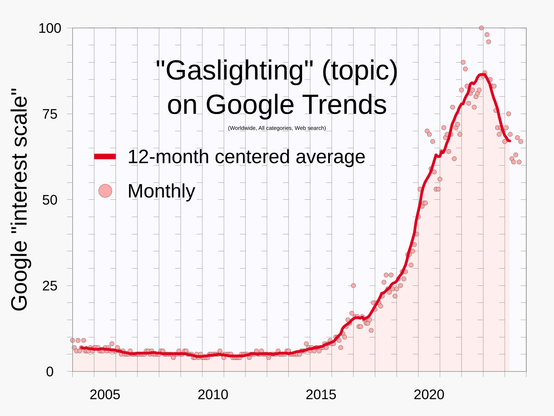
It’s incredible how many people think gaslighting is literally any instance of saying something untrue
I think it’s valid to bring up gaslighting here since the poster they’re replying to is implying that we shouldn’t believe women are victims as much as they are. It’s pretty much a guarantee that everyone will know a woman who has been subject to sexual assault in their life.
I’m posting this thinking you only see gaslighting as its intentional use by other people. But there’s also the instance of self-gaslighting, where one creates their own demons.
We’ll take as an example the idea of the movie “Number 23”. Where Jim Carrey plays a man who becomes obsessed with the number 23, starts seeing it everywhere and begins the search for a conspiracy related to it.
When we begin to fear something, we start taking it as a serious possibly of happening. We get drawn by news we’d otherwise pay less attention to, we start searching our surroundings for the chance that something like that might happen, we begin to view potential aggressors with distrust. And the longer we focus on this fear, the more it takes over and compromises our judgement. This is where the self-gaslighting comes in. We twist the world to have it conform to this fear, second-guess every interaction, attribute hidden meanings to every conversation and consider anyone who might be able to act as we fear as someone willing to act in that way.
Self-gaslighting can be inferred from the comic above because all we see are the instances in which the fear is magnified in an otherwise normal day.
Catcalling, sticking too close in the subway, dismissive reactions, they’re all normal, rude behavior that happen to anyone, but in different ways.
Catcalling specifically happens to women as an uneducated attempt to flirt or show off. Most of the time it’s just a dumb ritual of teasing that most of the initiators simply forget about, but on the rare occasions that it devolves to violence, anyone can be a target: the woman in question, the friends the watched it happen or any random passerby that had the misfortune of being a passive observer. Most women don’t stick around long enough to see that part happen though.
Sticking too close in the subway, if not by a violent individual who would be violent regardless when given the chance, is an awkward social need or a sign of depression. Have you ever seen the meme about a guy relieving himself in the men’s restroom, only to have another guy come in and stop at a urinal right next to the first guy? That’s not just a meme. Men have to suffer such individuals all the time.
And in the subway specifically, maybe the person is a creep. But also maybe they don’t care who sits around because they like that spot, it soothes them after a long day at work, it’s their one real joy and you’re in the way. Or maybe they’re socially awkward and want to start a conversation, but are too shy to do so in public. Or maybe they’re just a creep. Really, they’re probably just a creep. The subway brings out the weird in people.
And finally, dismissive reactions are normal in everything. We don’t want to live in fear, we don’t want to blow things out of proportions, we don’t want to engage in stressful situations all around. It’s like going to WebMD, it says you have cancer, so you freak out, people tell you to chill and you’re upset they’re not freaking out with you.
You may consider the dismissal as a lack of emotional support, yet on the contrary, trying to calm you down is the best emotional support one can offer even though it’s done poorly. Freaking out doesn’t help, ever.
All in all, self-gaslighting into believing things are worse than they actually are is more common than we think. But the opposite is also very much true. The dog sitting in a burning room meme saying “This is fine” is the gold standard in today’s society.
 agent_flounder
Maybe actually listen to women’s experiences, instead.
I can tell you haven’t.
 v9CYKjLeia10dZpz88iU
Terrorists can’t steal planes if no one buys flight tickets. 🧠
No.fucking.shit. !!
I can’t believe you’re getting downvoted.
I can’t believe you’re getting downvoted.
 Nepenthe
Guess what happened the two whole times I deliberately ignored the "paranoia."
Go on. Guess.
Go on. Guess.
You can’t do anything if you take all the crazy people on the street in consideration
This man might be crazy! I better go on a date with him lol
Yeah. Hilarious.
Turn him down and he yells, calls the woman names, maybe attacks her now or later, stalks her, rapes her, murders her, kills a kid, shoots up a mall, or mows down a crowd with a van, or…
Men fear rejection, women fear being killed.
 agamemnonymous
When men hear “What’s the worst that could happen?” they focus on the “could” and think about probable results and rank them by awfulness. This makes sense because the gender of “man” is sociologically defined in no small part by expendability,
When women hear “What’s the worst that could happen?” they focus on the “worst” and think about awful results and rank them by probability. This makes sense because the gender of “woman” is sociologically defined in no small part by preciousness.
This is completely garbage. The reason women have this attitude towards men is because of all the sexual assault that happens, more than 80% of the victims are women and more than 95% of the perpetrators are men.
This line of reasoning doesn’t have anything to do with the lofty ideals of what a gender role is in society or women thinking themselves “precious” or focusing on “could” vs “worst” or whatever you call that. It has to do with the fact that, statistically, women are in more danger than men. Full stop.
You’ve misunderstood my point.
Please do enlighten me. Because from where I’m standing, it looks like you’ve blamed women considering the worst case scenario on some self-important role attached to their gender, and not the very basic and obvious line of reasoning that their safety is on the line.
I can see that. I neither blame anyone, nor ascribe self-importance. Men are encouraged to disregard threats, women encouraged to take them seriously. This is an observation, not a moral judgement.
Violence against men is statistically underreported, and they’re still the majority of reported victims. Everyone’s safety is on the line, men are just taught to disregard that risk and women are taught not to. Again, observation, not moral judgement.
That’s fair. I did misunderstand your point. It wasn’t very clear just reading it back.
of all the sexual assault that happens, more than 80% of the victims are women and more than 95% of the perpetrators are men.
This is completely false. I followed your link and found that the original citation is “U.S. Dept. of Justice, Violence Against Women Report, 2002.” I wasn’t able to find this specific report to check the data, but the reference I usually use is the often-cited 2011 CDC Sexual Violence report, which is the origin of the “99% of rapists are men” myth (but more on that later), so I don’t think you’d object to it too much.
Here are the statistics for sexual violence in the year 2011, according to the CDC:
an estimated 1.6% of women reported that they were raped in the 12 months preceding the survey. The case count for men reporting rape in the preceding 12 months was too small to produce a statistically reliable prevalence estimate.
And
The percentages of women and men who experienced these other forms of sexual violence victimization in the 12 months preceding the survey were an estimated 5.5% and 5.1%, respectively.
Added together, we see that 7.1% of women and 5.1% of men reported being victims of sexual violence in 2011. That is, 58% of victims of all sexual violence in 2011 were women, and 42% were men.
Now on to your second claim: that more than 95% of perpetrators are men. From the “Characteristics of Sexual Violence Perpetrators” section about a third of the way down, keeping in mind the percentages above:
For female rape victims, an estimated 99.0% had only male perpetrators (more on this later…). In addition, an estimated 94.7% of female victims of sexual violence other than rape had only male perpetrators.
And
For male victims, the sex of the perpetrator varied by the type of sexual violence experienced. The majority of male rape victims (an estimated 79.3%) had only male perpetrators. For three of the other forms of sexual violence, a majority of male victims had only female perpetrators: being made to penetrate (an estimated 82.6%), sexual coercion (an estimated 80.0%), and unwanted sexual contact (an estimated 54.7%). For noncontact unwanted sexual experiences, nearly half of male victims (an estimated 46.0%) had only male perpetrators and an estimated 43.6% had only female perpetrators.
To help us with the breakdowns of these numbers, earlier in the report we find that:
1.7% of men were made to penetrate a perpetrator in the 12 months preceding the survey [and] an estimated 1.3% of men experienced sexual coercion in the 12 months before taking the survey [and] an estimated 1.6% of men having experienced unwanted sexual contact in the 12 months before taking the survey [and] an estimated 2.5% of men experienced this type of victimization (noncontact unwanted sexual experiences) in the previous 12 months
So, of the 1.7% of made to penetrate male victims, 82.6% of perpetrators were female. Of the 1.3% sexual coercion, 80% of perpetrators were female. Of the 1.6% unwanted sexual contact, 54.7% were female, and of the 2.5% noncontact, 43.6% were female.
So, 1.4% of the 1.7% made to penetrate, 1% of the 1.3% sexual coercion, .9% of the 1.6% unwanted sexual contact, and 1.1% of the 2.5% noncontact.
So, 4.4% of the 7.1% of men reporting sexual violence had female perpetrators. That is, 62% of sexual violence against men is committed by women (in 2011).
So, going back to our numbers above, we see that 62% of the 42% of sexual violence with men as victims was committed by women.
Our final numbers are: 74% of sexual violence is committed by men, and 26% is committed by women. Which ain’t great, but that feels a lot more realistic, and it’s a far cry from the intentionally misleading numbers you’re citing.
BUT IT GETS WORSE…
What happens when we look at just rape? Note that first we have to figure out what the CDC means by “rape”, because at first “99% of rape is committed by men” looks pretty damning.
Well, “rape” is defined by the CDC for the purposes of this study as “completed or attempted forced penetration or alcohol- or drug-facilitated penetration”. That is, only being penetrated counts as rape.
Men, on the other hand, get the completely separate category “made to penetrate”, that is, “being forced to have sex with someone, just doing the penetrating instead of being penetrated.”
So, 99% of rapists are men because rape is intentionally defined as “penetration” to exclude male victims of rape from the statistics. I wonder why…
Well, what happens when we actually look at those numbers, counting “made to penetrate” as, y’know, rape, because it is rape?
an estimated 1.6% of women (or approximately 1.9 million women) were raped in the 12 months before taking the survey
And
The case count for men reporting rape in the preceding 12 months was too small to produce a statistically reliable prevalence estimate.
Which is, again, because male rape victims are excluded from this definition. Also, we have this:
an estimated 1.7% of men were made to penetrate a perpetrator in the 12 months preceding the survey
And
Characteristics of Sexual Violence Perpetrators For female rape victims, an estimated 99.0% had only male perpetrators. In addition, an estimated 94.7% of female victims of sexual violence other than rape had only male perpetrators. For male victims, the sex of the perpetrator varied by the type of sexual violence experienced. The majority of male rape victims (an estimated 79.3%) had only male perpetrators. For three of the other forms of sexual violence, a majority of male victims had only female perpetrators: being made to penetrate (an estimated 82.6%), sexual coercion (an estimated 80.0%),
Note that these numbers clearly show that made to penetrate happens just as much each year as “rape”. This means that fully half of rape victims are men (in 2011 - the number fluctuates in the other years of the study, but not more than 5%).
Finally, if 99% of rapists are men and 83% of “made to penetrators” are women … then an estimated 42% of the perpetrators of nonconsensual sex (that is, rape) in 2011 were women.
Sorry for the wall of text, but I think it’s important to debunk this sort of misandrist misinformation, especially when you’re all over this thread acting like it’s gospel.
I’m just going to leave the cdc report on sexual assault from 2010-2012 that says the same thing as my initial claim, with the same statistics in detail, for you to draw your own conclusions from. Check the tables from page 18 onward.
My friend, statistics aren’t sexist. They just are. I don’t really have time to sit here and argue that women suffer more from sexual violence than men do. It’s not really up for debate, and I’ve learned not to engage the people who think it is.
I think you’ll want to check those numbers, actually, since they back up everything I’m saying.
For example, could you please point out where your claim that “more than 80% of the victims are women and more than 95% of the perpetrators are men” is borne out by the yearly data in this report?
My friend, statistics aren’t sexist. They just are.
I agree, which is why I took the time to cite the statistics exactly, instead of throwing out random numbers that aren’t borne out by the data.
I don’t really have time to sit here and argue that women suffer more from sexual violence than men do. It’s not really up for debate, and I’ve learned not to engage the people who think it is.
I’m not arguing that women don’t suffer more from sexual violence than men do. I’m just arguing that women suffer much less from sexual violence compared to men than is usually believed, and that men are provably raped as often as women are.
As you say, this is not up for debate, and whether you debate me or not, this information is now available and organized for anyone who doesn’t insist on closing their eyes to misandry.
Page 25 and 32. Male perpetrators only statistic.
It’s not ambiguous.
I didn’t claim that the statistics I made were on rape or penetration or any specific form of sexual violence. Just that incidences are much higher in women being the victims and men being the perpetrators.
Anyway, I’m not continuing this conversation further. It’s completely ridiculous to look at these statistics and draw the conclusion that I must be misandirist for reading the numbers how they are, because your breakdown of the numbers don’t exactly line up with mine but they still paint the same overall picture.
Have a good night.
 imaqtpie
Thank you for taking the time to break down these numbers. That CDC report is extremely misleading and this is not the first time I’ve seen someone attempt to break down the numbers. But you’ve done an especially good job of explaining it.
you should probably look up the author of that times article, and read it more closely.
The article seems mostly fine to me. The only thing I saw that I really disagreed with was her assertion that “made to penetrate” victims shouldn’t call themselves rape victims. I fully agree with her that getting drunk and then regretting your actions the night before should not constitute rape, and I also believe that the CDC’s questionnaire is misleading and far less than perfect. What were your problems with it?
As far as Cathy Young herself, I’d never heard of her before, but according to her Wikipedia page it seems like we might agree on quite a bit. The Wiki article is short, however, so I may not have the entire story. Is there some reason I should dislike her?
As far as Cathy Young herself, I’d never heard of her before, but according to her Wikipedia page it seems like we might agree on quite a bit. The Wiki article is short, however, so I may not have the entire story. Is there some reason I should dislike her?
I don’t know much about her, but I do know that she’s kind of consistently had shit takes about like, gamergate, and I think SA more generally, but sue me if I’m wrong, I don’t really know too much. It’s mostly like, old news shit takes that I can’t remember the specific basis for. I associate her with bringing bad vibes to the function, and MGTOW shit. In any case, I think it would probably be better practice to just, cite the study that she’s citing directly, if that’s the actual like, statistical set that you want to have a citation of, right, that’s probably better practice. Especially if you’re using the same source she is for your analysis, that kind of makes her analysis a little bit, both redundant, and not really like, on topic. But I’m not your grandma, you can do whatever you want.
For the article itself, I think if I’m reading it correctly, and maybe also the study, then I kind of, disagree with her extrapolations about drunk sexual acts. Mostly in this-
" It is safe to assume that the vast majority of the CDC’s male respondents who were “made to penetrate” someone would not call themselves rape victims—and with good reason." -type of shit. It’s a study that inherently relies on self-reporting, right, but the basis of the study’s questions are to kind of get away from this blanket “Hey, were you raped?”
-type of shit. There are definitely cases in which people have been SA’d, and would accurately describe a SA experience if you were to question them, but wouldn’t define the act as SA. I think this is probably the case for a lot of male SA, and I think this is legitimately the case for prison SA, in many instances, if I’m remembering correctly. So I don’t really think that the person’s testimony should be considered reliable, and more than that, I think the “appealing to the theoretical person’s definition of a thing as being accurate to the thing” tactic is a little, weird. Gives me bad vibes.
For the study, right, I know I just said, sometimes people don’t accurately self-report, right, but I think I’d also probably think that it’s a mistake to kind of, prioritize the “last 12 months” stats, because they’re “more accurate”. They’re not really more or less accurate, they’re just kind of, more accurate to what they are specifically about. Which is questioning if SA happened in the last 12 months, among the polled peoples. We don’t really know if there’s kind of just a specific subset of the population of women, through some other factor or age range, that’s experiencing SA at higher rates, which I would think is probably somewhat likely. But that’s also, my dumb ass, so who knows. In any case, given that, I kinda find her-
“In other words, if being made to penetrate someone was counted as rape—and why shouldn’t it be?—then the headlines could have focused on a truly sensational CDC finding: that women rape men as often as men rape women.”
-to be a kind of cherry picked and sensationalist, while also kind of treading a maybe more socially acceptable “centrist” libnuts kind of position. It’s technically accurate, which oh yes, pog futurama reference that nobody gets the context to, but you can kind of see why it’s like, stupid, right?
Probably, this kinda stuff is why I remember not liking her that much. Take this all with like, a mountain of salt, though, I am somewhat known to be a pretty good vector for misinfo, lies, and deceit. If I say that, then I’m free from the burden of proof, or like, holding reasonable positions, right? I can just say whatever I want? That sounds right, let’s go with that.
Turn him down and he yells, calls the woman names, maybe attacks her now or later, stalks her, rapes her, murders her, kills a kid, shoots up a mall, or mows down a crowd with a van, or…
Definitely common everyday occurrences and not massively-cherry picked sensationalism.
women fear being killed
A completely irrational fear in the US at least, given that in a country of 340,000,000, less than 5,000 women are murdered a year. And that’s even if you pretended every single murder was by a rejected man.
Stop letting ideological propaganda make you paranoid.
Hey, you missed this part:
he yells, calls the woman names
Talk about how this part doesn’t happen because you’ve never personally seen it.

That’s not at all what gaslighting means lol
I know it’s the trendy new word among children but please take the time to read the article you yourself linked.
You’re so passive aggressive. I hate gatekeeping in all its forms.
Both sexes yell and call people names. Arguably, women are more likely to do it when rejected, on average (being called a f-slur (I wouldn’t censor it but I don’t know if I’m allowed to frankly use words like that here) by a woman you just turned down is a popular play, I’ve noticed, over the years), simply because they’re more likely to be less exposed to rejection (since they approach, and therefore put themselves in a position where they can be rejected, much less often), and exposure to rejection is generally how someone learns how to handle it maturely.
Also, you clearly have no idea what gaslighting is.
Excuse me but what the fuck are you going on about irrational fear? Do you live in unicorn sparkle land? I’m regularly followed by absolute creeps and people will yell and get physically aggravated at me if I turn them down wrong and personally I don’t know a single femme person where this isn’t just a known risk of going outside. I’ve literally had a gun pulled on me in broad daylight in the middle of town and they followed me in their car for several blocks. My partner had someone yell at them while taking out trash “One of these days I’m going to kill one of you fucking c*nts”. I’ve been molested in a parking lot while there were people around. We don’t even live in sketchy neighborhoods. The fear is not irrational and not unfounded and we never know which of these encounters could end in assault or death so we have to assume and act in a way to prep for the worst
Excuse me but what the fuck are you going on about irrational fear?
It is objectively irrational to actively fear something that happens to 0.0014% (that’s 14% of 1% of 1%) of the population (and I was specifically talking about “being killed”, which is what I quoted–you’re not trying to move the goalposts by pretending I was talking about anything else, are you~?), whether you like it or not. You should be dozens of times more terrified to ever step in a car than to reject a man, if things were in proportion. But, because your fear is irrational, you’re not.
Given that you indeed shoved those goalposts a large distance from what I was saying in the rest of your comment, and that I see from your comment history that you believe in the “patriarchy” conspiracy theory, it’s clear to me it would serve no purpose to seriously discuss anything on this topic with you.
336,199,359 people, more or less. And that is both male and female. If we’re talking numbers of women murdered, how about you use the number of women in the USA, not the numbers of both women and men?
And while we’re at it, how about you include the number of women who are doxxed, beaten, and raped too? It isn’t just murder. 1 in 4 women in the US have dealt with harassment from a man, often times serious harassment. That it doesn’t always end in murder doesn’t make it less of a problem.