
Our galaxy's young star clusters now have accurately measured masses, radii, and classifications!

My new paper out today uses a new method to distinguish between bound and unbound clusters, improving the usability of the cluster census and setting new observational constraints.
In our cluster catalogue from last year, we created the largest ever deduplicated catalogue of star clusters in the Milky Way.

But it came with a catch - we also found hundreds of new clusters near to the Sun, but many didn't look like gravitationally bound open clusters.

To show you a couple of examples, these two new clusters are statistically significant young groups of stars - but they don't look 'clumpy' like an open cluster.

HSC 1131 looks more like a stream of stars, and HSC 2376 like an unbound OB association.

We suspected they aren't gravitationally bound, but didn't have a good way to tell this. It was clear that a new method to distinguish between bound and unbound clusters was needed!

I tried MANY things over ~2 years, and the best approach was measuring cluster Jacobi radii.

A bound cluster has some radius within which its gravity is stronger than the Milky Way (i.e., it has enough mass within some radius), whereas an unbound one won't have enough mass at any radius to be self-gravitating.

It works! It can reliably tell them apart!

Having unbound and bound star clusters in the same catalogue is really cool!

We show that they form at about the same initial size - but while bound clusters stay roughly the same size, unbound ones keep expanding (as expected). Unbound ones also have much lower average masses.

Measuring masses for 6957 clusters as a part of this work was *not* trivial, and trying to do it accurately means there are a lot of insights in the paper!

I don't think any other paper has incorporated selection effect corrections in cluster masses, but it makes a BIG difference.

Naively, an old cluster like Trumpler 5 looks like it lacks low-mass stars. But after corrections, its mass function is compatible with a Kroupa IMF!

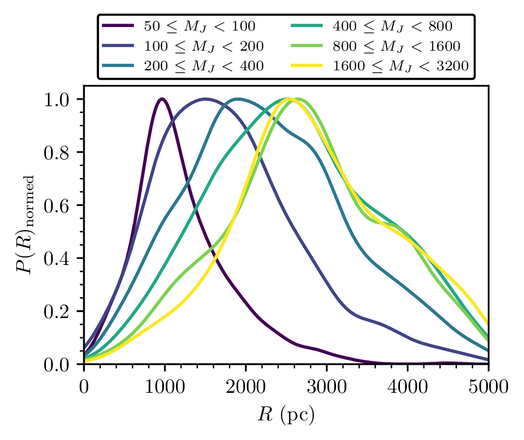
Having this many accurate cluster masses for the first time is super exciting, and one thing I noticed quickly is that the completeness of our catalogue depends strongly on mass.

We derived a ~100% completeness limit as a function of cluster mass for the catalogue!

From this completeness estimate, we show we're about ~100% complete for clusters above 100 solar masses within 1 kpc, or ~100% complete for clusters above 230 solar masses within 1.8 kpc.

We also use the completeness estimate to estimate that the Milky Way contains about 120,000 open clusters in total (⚠️ this is a rough estimate ⚠️), only ~4% of which are currently known.

Also, ~0.1% of the Milky Way's stars are currently in an open cluster.

For the theorists out there, we also set some really cool constraints on cluster formation and destruction with this catalogue!

We derive the first ever Gaia global cluster mass function (+ confirm the Gaia age function too), showing that low-mass clusters are destroyed faster. These results set new constraints on the star cluster formation and destruction rate.

Finally, one of the most curious results in this work is that after correcting for selection effects, most clusters have a mass function compatible with the Kroupa IMF.

That's right - **after correcting for selection effects**, the IMF in the Milky Way is pretty much universal!

A histogram of all cluster mass function bins (see below) has almost all compatible with expected values from a Kroupa IMF, within a little bit of scatter.

Some notable outliers (probably method issues) are discussed in the paper.

This is really significant because many other cluster mass papers find a varying IMF.

However, we show that almost all variation can be explained by not accounting for selection effects.

The paper has been accepted in A&A, but you can read it now on the arXiv!

There's a link to download the data in the comments of the arXiv posting.

https://arxiv.org/abs/2403.05143

Improving the open cluster census. III. Using cluster masses, radii, and dynamics to create a cleaned open cluster catalogue

The census of open clusters has exploded in size thanks to data from the Gaia satellite. However, it is likely that many of these reported clusters are not gravitationally bound, making the open cluster census impractical for many scientific applications. We test different physically motivated methods for distinguishing between bound and unbound clusters, using them to create a cleaned cluster catalogue. We derived completeness-corrected photometric masses for 6956 clusters from our earlier work. Then, we used these masses to compute the size of the Roche surface of these clusters (their Jacobi radius) and distinguish between bound and unbound clusters. We find that only 5647 (79%) of the clusters from our previous catalogue are compatible with bound open clusters, dropping to just 11% of clusters within 250 pc. 3530 open clusters are in a strongly cut high quality sample. The moving groups in our sample show different trends in their size as a function of age and mass, suggesting that they are unbound and undergoing different dynamical processes. Our cluster mass measurements constitute the largest catalogue of Milky Way cluster masses to date, which we also use for further science. Firstly, we inferred the mass-dependent completeness limit of the open cluster census, showing that the census is complete within 1.8 kpc only for objects heavier than 230 M$_\odot$. Next, we derived a completeness-corrected age and mass function for our open cluster catalogue, including estimating that the Milky Way contains a total of $1.3 \times 10^5$ open clusters, only ~4% of which are currently known. Finally, we show that most open clusters have mass functions compatible with the Kroupa initial mass function. We demonstrate Jacobi radii for distinguishing between bound and unbound star clusters, and publish an updated star cluster catalogue with masses and improved cluster classifications. (abridged)

arXiv.org

Finally, I'm still on the job market - I got really close with a few different postdoctoral fellowships, but it doesn't seem like anything has worked out 😭

Get in touch if you have any postdoc openings. I'd love to keep working on star clusters and/or machine learning!

@emilydoesastro We have a faculty position on data science open …( I am not involved)